Your Results
Conscious Authentic Level
Your score was between 0 – 23
This is the best result on the quiz and suggests that unconscious relationship rules do not strongly govern how you love, give, react, or relate. You have developed a meaningful level of emotional separation, self-awareness, and inner authority, which allows you to remain connected to your Authentic Self in relationships.
You are usually able to recognize your needs, express your preferences, and make choices that are true for you. When someone is disappointed, withdrawn, critical, or emotionally reactive, you are more likely to pause and reflect rather than immediately appease, rescue, overexplain, or question yourself.
Your behavior and responses are internally driven and you show up in your relationships authentically. Your agenda is to create a conscious relationship based on satisfying mutual needs, preferences, goals and ambitions. You can tolerate differences, separation and changes introduced by your partner and others.
While you are aware of other people’s moods and emotions, you don’t believe it is your responsibility to rescue or manage them. You care deeply about others without automatically assuming that it is your job to fix what they feel, solve their problems, or make yourself smaller to preserve the relationship.
You may still notice old relationship rules under pressure, particularly in relationships that are highly important or emotionally charged. You may occasionally experience guilt after setting a boundary, hesitate before expressing a difficult truth, or become overly self-sufficient when vulnerability is required. However, these patterns do not appear to control your relationships or define your sense of self.
From a developmental perspective, you have likely already done meaningful work to separate love from self-sacrifice, caring from carrying, and emotional connection from emotional responsibility. You have developed enough inner steadiness to remain connected to your values, needs, and voice, even when someone else is uncomfortable.
This gives you greater freedom to choose how you respond rather than reacting from fear, guilt, obligation, or the belief that you must earn love through what you give or do.
Relationship freedom is not only the absence of self-abandonment, but the presence of your authentic self. Your work is to strengthen the relationship capacities you have yet to fully develop, so that your authentic self is present in all areas of your life.

How You Use Relationship Rules
You understand the beliefs and relationship rules you bring into your relationships and can recognize when an old rule is being activated. During conflict, you are less likely to rely on “shoulds,” assume your partner ought to know what you need, or treat their behavior as proof that something is wrong with you or the relationship.
You can approach conflict with greater objectivity, separate facts from emotional interpretations, and remain curious about your partner’s perspective. You are able to express what you feel and need directly, tolerate differences, and work toward conscious agreements rather than trying to make the other person conform to your private rules.
Unconscious relationship rules may still surface, but they do not usually determine your choices or behavior. They are more likely to trigger a desire to develop a capacity or bring something that has remained unconscious into consciousness. Despite an initial reaction, your authentic self can generally remain present, reflective, and engaged.

Your answers suggest that you have developed many of the capacities needed to remain connected to yourself while being emotionally connected to another person. You are generally able to recognize your feelings and needs, maintain a stable sense of self when someone reacts differently from you, and make choices without allowing fear, guilt, or another person’s approval to take over.
Most of the foundational capacities of the authentic self are available to you. You may have accurate self-awareness, a reasonably stable sense of self-esteem, continuity of self across different relationships, and the ability to tolerate time alone without experiencing it as rejection or abandonment. These capacities allow you to know who you are without requiring another person to confirm it.
You have the ability to self-soothe, reality-test your interpretations, tolerate emotional discomfort, and recover from disappointment without immediately turning it into a relationship crisis. Your ability to delay your reaction gives you time to question the story being activated and respond to what is actually happening.
Your agency and authority are likely well developed. You can recognize that your needs and limits matter, express yourself directly, make commitments that reflect your values, and follow through even when someone else would prefer something different. You are less likely to abandon an important choice simply because another person is uncomfortable with it.
Become Who You Are Meant to Be
At this level, development turns toward greater depth, intimacy, and integration. The work is not primarily about overcoming obvious self-abandoning rules. It is about examining the subtle places where parts of you remain hidden, controlled, idealized, or disowned.
You may benefit from exploring whether you can express yourself as freely as you understand yourself. Can you reveal your desires without managing how they will be received? Can you receive another person’s vulnerability without interpreting it through your own fears? Can you remain curious when your partner’s reality is very different from yours?
The capacities that may now require deeper attention are authentic self-expression, intimate self-expression, receiving intimacy, and relational differentiation. These capacities allow you to move beyond functioning well in relationships and toward being more fully known within them.
Your next stage is about becoming more conscious of the parts of yourself that do not fit neatly within your existing identity. This includes exploring shadow material, unspoken longings, projections, unresolved inner conflicts, and the parts of yourself you may still protect through competence, independence, or emotional control.
The question at this level is not simply, “How do I stop following old rules?” It is:
“What remains unknown, unexpressed, or unlived within me?”
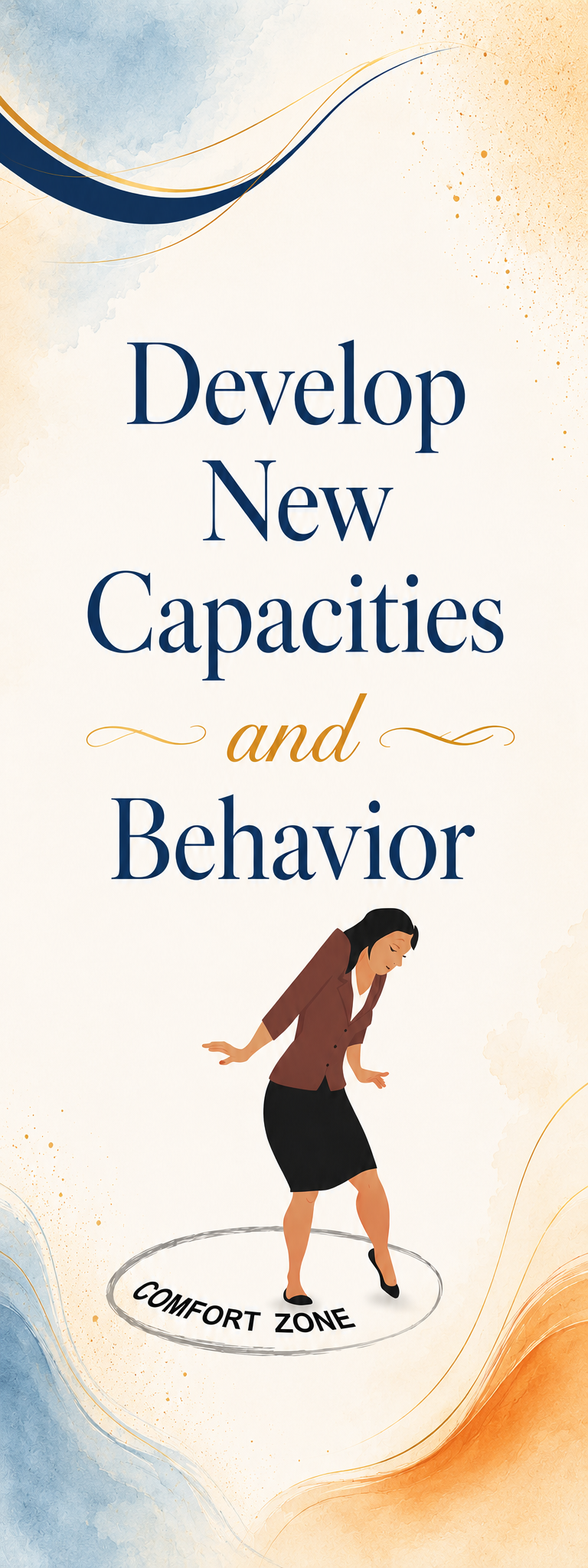
Next Steps

Work With Me
At this level, the work is less about changing obvious relationship rules and more about exploring what remains outside awareness. Therapeutic coaching can help you examine shadow material, hidden conflicts, projections, and the parts of yourself that may still be controlled, protected, or left unexpressed.
Explore working with me to deepen intimacy, integration, and authentic self-expression.
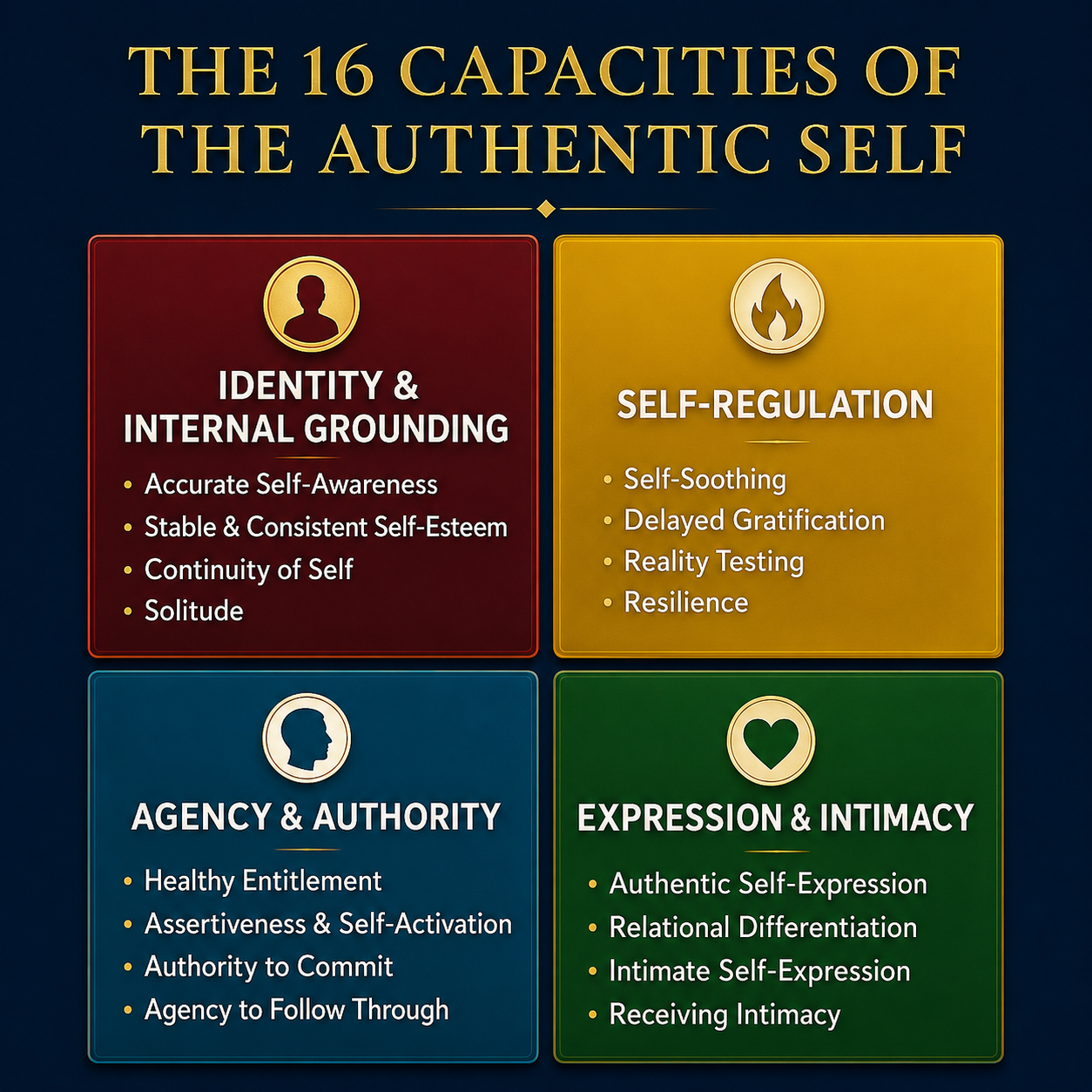
Identify Capacities
The 16 capacities of the authentic self can help you recognize which capacities are well developed and where further growth may deepen your relationships. At this level, the focus is often on authentic self-expression, intimate self-expression, receiving intimacy, and relational differentiation.
Explore the capacities that can help you become more fully known while remaining fully yourself.

Book a Consultation
A consultation can help you clarify what your next stage of development is asking of you and identify the subtle patterns, unexpressed parts, or unconscious material that may still influence how you relate.
Book a consultation to explore the deeper work of individuation and conscious relationship growth.