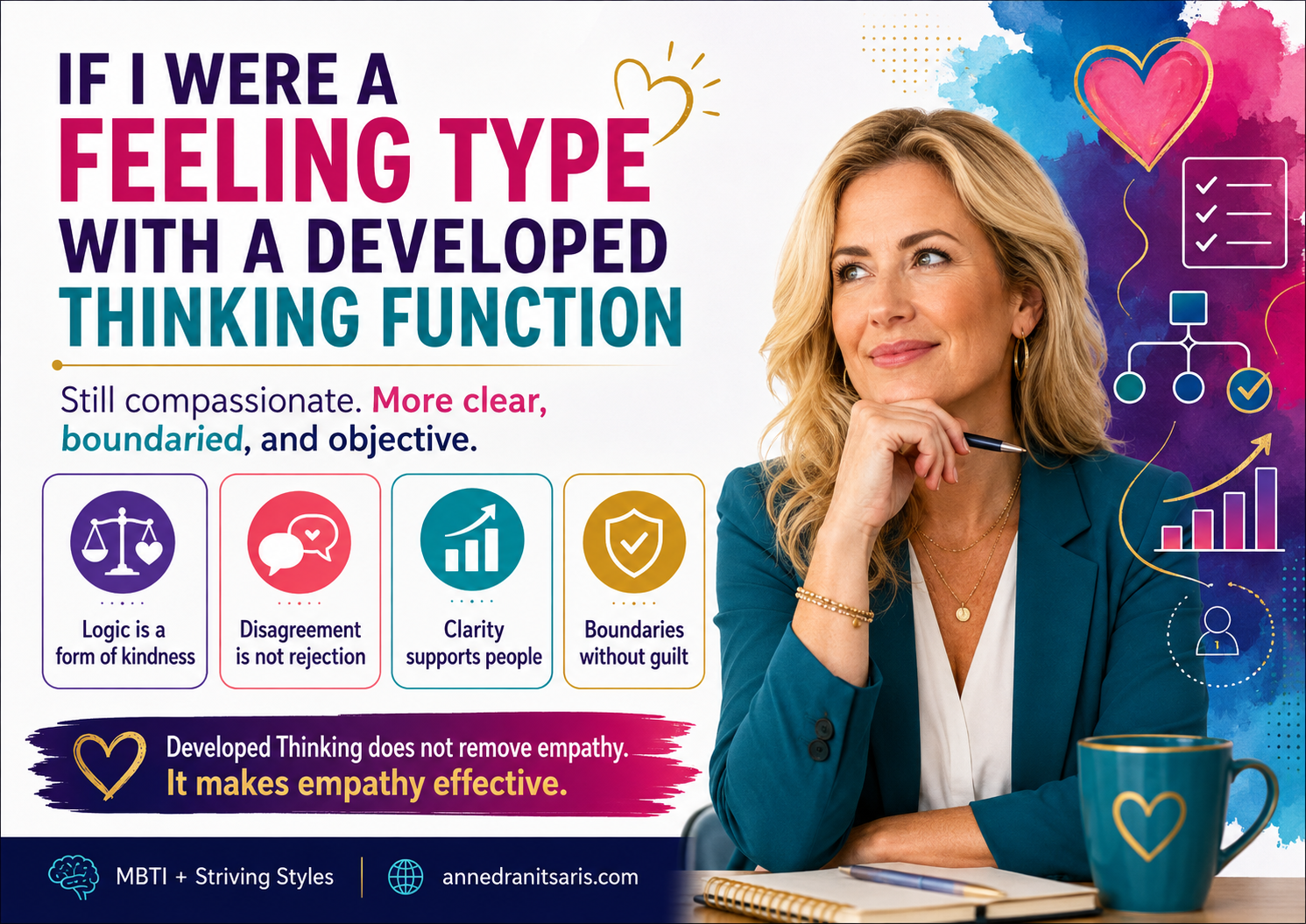
1. I’d Still Care Deeply About Everyone Involved
Let’s get one thing out of the way: developing my Thinking function wouldn’t suddenly turn me into a cold, ruthless corporate robot who views human beings as disposable assets.
- I’d still care whether everyone’s voice is heard in the meeting.
- I’d still notice the exact second someone’s tone shifts after receiving feedback.
- And yes, I would still bring snacks to the team brainstorming session.
What would change is my relentless urge to let everyone’s emotional weather pattern dictate the direction of the ship.
A developed Thinking function would act like a split-second circuit breaker, prompting me to ask: Am I delaying this hard decision because it’s truly the wrong move, or am I just trying to dodge 10 minutes of uncomfortable tension?
I might even do something radical: hold a firm boundary without apologizing six times for having it.
It would feel unnatural at first—like voluntarily choosing a harsher user interface—but apparently, healthy relationships thrive on structure, not just good vibes.
2. I’d Discover That Logic Is a Form of Kindness
As a Feeling type, I am deeply comfortable tuning into values, maintaining harmony, and ensuring everyone feels supported and validated.
What I tend to forget is that clarity, efficiency, and sound logic are critical acts of care.
- A clear process prevents burnout.
- A well-structured project plan saves people from working late.
- Honest, objective feedback helps people actually grow instead of staying comfortably stuck.
Developing my Thinking function wouldn’t make me less compassionate—it would just make my compassion practical. I could still care about a colleague’s stress level while saying, “Let’s look at the data to see why this process keeps failing.” Logic isn’t a heartless attack on someone’s effort. It’s the framework that keeps the house from falling down.
3. I’d Stop Treating Every Disagreement Like a Personal Fracture
When a debate breaks out in a meeting, my brain’s default response is often Crisis Intervention Mode:
Is everyone okay? Is someone offended? Should we take a break? Do we need a group hug? I can mediate a group hug.
With a developed Thinking function, I might finally realize that when people debate an idea, they aren’t attacking each other’s worth as human beings.
They’re just testing the structural integrity of a concept.
This requires me to adopt an approach that automaticalaly seems cold and unfeeling:
“That’s a fair comment. Let’s weigh the pros and cons.”
And then—here’s the real hero’s journey—I have to actively suppress the urge to check in on everyone five minutes later with, “Are we still friends?”
Progress.
4. I’d Realize Facts Support Best Interests
Feeling types love to focus on personal alignment: If everyone is happy and the intentions are pure, surely the project will succeed!
Enter Thinking, bringing along a deeply inconvenient variable: Objective Facts.
If a strategy is logically flawed, no amount of passion, good intentions, or enthusiastic consensus will make it work. Explaining that everyone felt great about the plan doesn’t fix a budget deficit.
Harmonizing isn’t automatically “leadership,” and “I just want everyone to agree” is usually what people say right before approving a watered-down compromise that satisfies no one. The truth doesn’t become cruel just because it’s delivered with an Excel spreadsheet.
5. I’d Become Better at Appreciation
Undeveloped Feeling types operate on a very specific internal policy:
“If making this choice makes someone sad or upset, it must be the wrong choice.”
Shockingly, this system gets a 1-star rating on long-term organizational health.
Developing Thinking means prioritizing criteria over climate. It means evaluating options based on long-term impact, strategic fit, and resource allocation—and doing it before I accidentally promise three different people conflicting outcomes just to keep the peace in the moment.
6. I’d Stop Confusing Objectivity With Cruelty
The biggest fear for a Feeling type is that leaning into logic means becoming cold, unfeeling, and detached.
It doesn’t.
- I can analyze a mistake without condemning the person who made it.
- I can say “No” to a request without feeling like a terrible human being.
- I can enforce a standard while still being deeply empathetic.
Logic isn’t cruelty. Developed Thinking gives you access to both heart and head—no trade-offs required.
7. I’d Still Maintain My Preference for Feeling
Developing your Thinking function doesn’t mean swapping your heart for a calculator.
I’d still celebrate team wins with genuine enthusiasm. I’d still care about company culture. I’d still intuitively read the energy in a conversation within three seconds.
The difference is backbone and precision. Instead of only asking, “How does everyone feel about this?” I can also ask:
- “Does this actually make logical sense?”
- “What are the objective facts here?”
- “What is the most effective way to solve this problem permanently?”
That doesn’t weaken my empathy; it makes my empathy effective. Because the ultimate sign of a developed Feeling type isn’t just caring about people.
It’s knowing that loving people well sometimes requires delivering clear, logical, and uncomfortable truths.
Is Your Preferred Decision-Making Function Feeling?
If you are an ENFJ, ESFJ, INFP, or ISFP, Feeling is your dominant function. If you are an INFJ, ISFJ, ENFP, or ESFP, Feeling is your auxiliary function—meaning relational impact, values, and human connection form your natural baseline for making decisions.
Discovering your MBTI type and Striving Style reveals the core operating system behind those choices. But Striving Styles takes it a step further: it uncovers the emotional needs driving your behavior, highlights where your empathy turns into self-protection or people-pleasing under stress, and maps out the exact capacities you need to develop next.
Real growth isn’t about sacrificing your empathy, compassion, or desire for harmony. It’s about knowing when relational awareness is enough—and when a situation calls for objective boundary-setting, cold logic, and clear analysis.
Ready to discover your next stage of development?
Learn more about individual assessments, coaching, and team development at annedranitsaris.com.