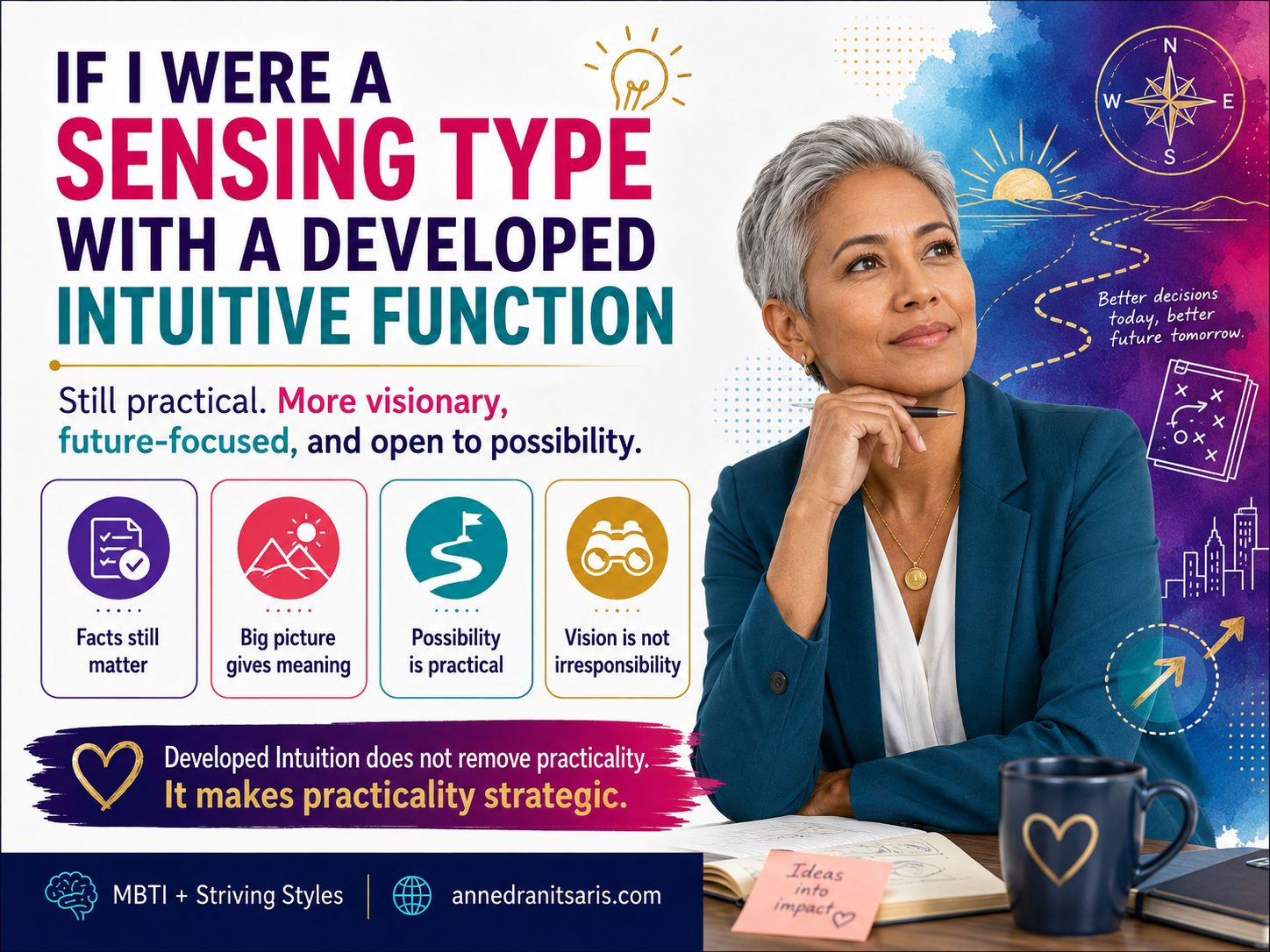
1. I’d Still Value the Facts, Details, and Present Reality
Let’s get one thing out of the way: developing my Intuitive function wouldn’t suddenly turn me into a head-in-the-clouds dreamer who forgets to pay their bills, misplaces their keys, or ignores the physical realities right in front of them.
- I’d still notice the exact line-item error on page 14 of the budget.
- I’d still rely on proven, practical methods that have worked reliably in the past.
- And yes, I would still value real-world experience over unproven, pie-in-the-sky theories.
What would change is my default assumption that what is happening right now is the only reality that matters.
A developed Intuitive function would act like a perimeter scan, prompting me to ask: This current method works fine today, but where will this put us two years down the road?
I might even do something radical: entertain a completely wild, abstract idea without immediately listing 10 reasons why it’s impractical within the first 30 seconds.
It would feel unnatural at first—like stepping off a solid concrete path into open fog—but apparently, sustainable long-term success requires looking at the horizon, not just watching your feet.
2. I’d Discover That Possibility Is a Form of Practicality
As a Sensing type, I am deeply comfortable living in the concrete present, mastering tangible skills, and relying on sensory data and past experience.
What I tend to forget is that anticipating change, seeing hidden patterns, and innovating are critical acts of survival.
- Exploring theoretical possibilities prevents sudden obsolescence.
- Connecting disparate ideas helps spot market shifts before they hit.
- Reading between the lines helps me understand the overarching strategy, not just the step-by-step procedure.
Developing my Intuitive function wouldn’t make me impractical; it would make my practicality future-proof. I could still execute a flawless daily process while saying, “Let’s brainstorm three alternate scenarios in case the market shifts next quarter.”
Innovation isn’t a frivolous waste of time. It’s the foresight that keeps the entire operation relevant.
3. I’d Stop Treating Conceptual Changes Like Personal Threats
When someone proposes changes to or transformation of a system that I believe is currently working, my brain’s default response is Containment Mode:
Why fix something that isn’t broken? Where is the concrete data for this? This has worked for us in the past, why change it? These people who think their ideas are better, don’t know what they are doing.
With a developed Intuitive function, I might finally realize that when people propose changes to existing systems or strategic pivots, they aren’t trying to undermine my hard work or destroy stability.
They’re just testing potential futures.
This requires me to adopt a mindset that initially feels wildly unsafe:
“That’s an interesting concept to explore. Let’s talk about what that concept could look like if we implemented it.”
And then—here’s the real hero’s journey—I have to actively suppress the urge to immediately ask for a detailed step-by-step project plan before the idea has even had room to breathe.
Progress.
4. I’d Realize That the Big Picture Gives Meaning to the Details
Sensing types love to focus on execution: If everyone executes their individual tasks perfectly and follows the procedure, the project will succeed!
Enter Intuition, bringing along a deeply inconvenient variable: Strategic Context.
If a project is moving in the wrong overall direction, executing flawed tasks with 100% precision and efficiency still results in failure. Perfecting a process that no longer serves a purpose isn’t progress.
Focusing exclusively on the present facts isn’t automatically “grounded,” and “Let’s just focus on what’s in front of us” is usually what people say right before getting blindsided by a shift they refused to anticipate.
5. I’d Upgrade My Problem-Solving Framework
Undeveloped Sensing types operate on a very specific internal policy:
“If I haven’t seen this specific approach to solving our problem before, or if there isn’t a proven template, we shouldn’t attempt it.”
Developing Intuition means exploring and even prioritizing potential over past precedent. It means evaluating options based on overarching implications, underlying patterns, and future trajectories—and doing it before I accidentally shoot down a game-changing opportunity just because it feels unfamiliar.
It means resisting the impulse to say “no” when someone makes a suggestion you haven’t thought of.
6. I’d Stop Confusing Vision With Irresponsibility
The biggest fear for a Sensing type is that leaning into intuition means becoming flaky, unfocused, and detached from reality.
It doesn’t.
- I can explore an abstract concept without losing my grip on current operations.
- I can read between the lines without ignoring the explicit facts.
- I can embrace vision while remaining grounded in execution.
Vision isn’t irresponsibility. Developed Intuition gives you access to both the earth and the sky—no trade-offs required.
7. I’d Still Maintain My Preference for Sensing
Developing your Intuitive function doesn’t mean swapping your checklist for a crystal ball.
I’d still value efficiency, facts, and tangible results. I’d still keep the wheels turning reliably. I’d still bring practical realism to every conversation.
The difference is range and foresight. Instead of only asking, “What are the immediate facts right now?” I can also ask:
- “What does this pattern imply for the future?”
- “What is the underlying meaning or big-picture strategy here?”
- “What possibilities are we missing by only focusing on what’s visible?”
That doesn’t weaken my practical grounding—it makes my grounding strategic. Because the ultimate sign of a developed Sensing type isn’t just maintaining what works today.
It’s having the vision to build what will be needed tomorrow.
Is Your Preferred Decision-Making Function Sensing?
If you are an ISTJ, ISFJ, ESTP, or ESFP, Sensing is your dominant function. If you are an ESTJ, ESFJ, ISTP, or ISFP, Sensing is your auxiliary function—meaning facts, concrete realities, and lived experience form your natural baseline for gathering information and perceiving the world.
Discovering your MBTI type and Striving Style reveals the core operating system behind those choices. But Striving Styles takes it a step further: it uncovers the emotional needs driving your behavior, highlights where your reliance on the familiar turns into self-protection or resistance to change under stress, and maps out the exact capacities you need to develop next.
Real growth isn’t about sacrificing your practical nature, realism, or attention to detail. It’s about knowing when present facts are enough—and when a situation calls for strategic vision, abstract thinking, and exploring new possibilities.
Ready to discover your next stage of development?
Learn more about individual assessments, coaching, and team development at annedranitsaris.com.