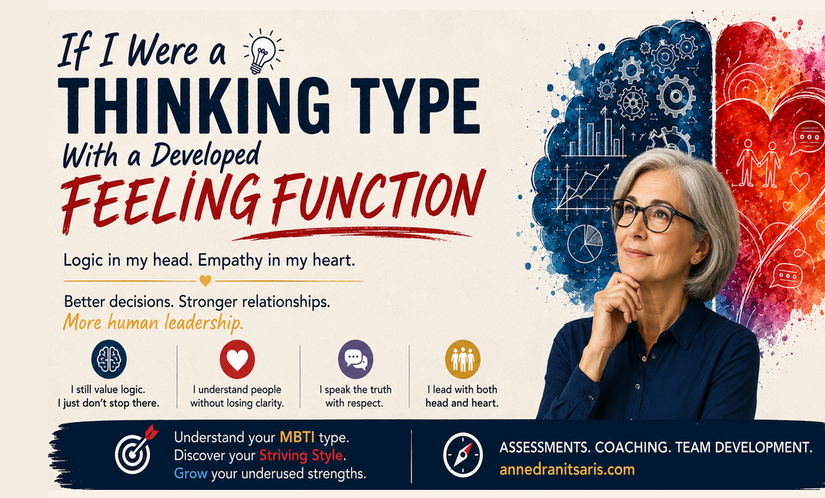
1. I’d Still Know When You’re Wrong
Let’s get one thing out of the way: developing my Feeling function wouldn’t suddenly turn off my ability to spot faulty logic, weak arguments, or terrible processes.
- I’d still immediately notice that this meeting could have been a two-sentence email.
- I’d still calculate three faster ways to complete the task you’re currently working on.
- And yes, I would absolutely still have strong, unprompted opinions about your spreadsheet formatting.
What would change is my relentless belief that every single observation needs to be voiced immediately.
A developed Feeling function would act like a split-second pause menu, prompting me to ask: Is correcting you in front of eight people actually necessary for project success, or am I just addicted to the quiet high of being right?
I might even do something radical: wait until later and speak to you privately.
It would feel unnatural at first—like voluntarily choosing a slower processor—but apparently, human relationships come with their own non-negotiable operating procedures.
2. I’d Discover That People Are Data Too
As a Thinking type, I am deeply comfortable gathering facts, running diagnostics, and rendering cold, beautiful decisions based on pure logic.
What I tend to forget is that people are critical variables in the system I’m analyzing.
- Their trust is data.
- Their morale is a key performance metric.
- Their willingness to tell me the truth directly affects output quality.
Developing my Feeling function wouldn’t make my decisions less rational—it would just make my dataset complete. I could still look at a project and decide the answer is a hard “No.” But saying, “I can see why that’s disappointing,” before dropping the hammer isn’t an unnecessary emotional garnish. It’s basic system compatibility. It’s acknowledging there’s a human user on the other side of the screen.
3. I’d Stop Treating Human Emotion Like a Bug in the Code
When someone tells me they’re upset, my brain immediately enters Troubleshooting Mode:
What broke? What are the options? What is the most efficient patch? Do you need a flowchart? I can make a flowchart.
With a developed Feeling function, I might finally realize that when people vent, they aren’t submitting a formal ticket for corrective action.
Sometimes, they just want to be heard.
This requires me to deploy a phrase that initially feels wildly inefficient:
“Wow, that sounds really tough.”
And then—here’s the real hero’s journey—I have to actively suppress the urge to follow it up with, “Anyway, here are three easy steps to fix your life.”
Progress.
4. I’d Realize Delivery Is 50% of the Product
Thinking types love to hide behind pure intention: If my facts were accurate and my intention was to help, then clearly the interaction was a triumph!
Enter Feeling, bringing along a deeply inconvenient variable: Impact.
If three people walk out of a meeting feeling completely dismissed, explaining to them that I technically didn’t dismiss them according to the literal dictionary definition doesn’t fix the team dynamics.
Bluntness isn’t automatically “clarity,” and “I’m just being honest” is usually what people say right after choosing the least skillful way to deliver the truth. The truth doesn’t lose its integrity just because you wrap it in basic human courtesy.
5. I’d Become Better at Appreciation
Undeveloped Thinking types operate on a very specific internal policy:
“If I had a problem with your performance, you’d hear about it. Therefore, my silence is a glowing performance review.”
Shockingly, this system gets a 1-star rating on employee retention surveys.
Developing Feeling means making praise explicit. It means telling people what they contributed, why it mattered, and how it helped the team—and doing it before they submit their two-week notice and suddenly unlock my dormant ability to write a heartfelt eulogy for their career.
6. I’d Stop Confusing Empathy With Surrender
The biggest fear for a Thinking type is that honoring emotions means handing the steering wheel over to a crying toddler.
It doesn’t.
- I can validate your perspective without adopting it.
- I can care that a decision hurts without changing the decision.
- I can treat you like a human being while still holding you to a deadline.
Empathy isn’t capitulation. Developed Feeling gives you access to both clarity and humanity—no trade-offs required.
7. I’d Still Maintain My Preference for Thinking
Developing your Feeling function doesn’t mean swapping your brain for a box of tissues. I’d still roast bad logic. I’d still demand clear agendas for every meeting. I’d still solve complex problems faster than most people can read the brief.
The difference is range. Instead of only asking, “Does this make logical sense?” I can also ask:
- “What actually matters to the people in this room?”
- “What impact am I having right now?”
- “How can I deliver this so they can actually hear it?”
That doesn’t weaken me. It makes it formidable. Because the ultimate sign of a developed Thinking type isn’t just knowing you’re right.
It’s knowing that being right is rarely the most important thing happening in the room.
Is Your Preferred Decision-Making Function Thinking?
If you are an ENTJ, ESTJ, INTP or ISTP, Thinking is your dominant function. If you are an INTJ, ISTJ, ENTP or ESTP, Thinking is your auxiliary function and still plays a major role in how you evaluate information, solve problems and make decisions.
Understanding your MBTI type or Striving Style can tell you which psychological functions you naturally rely on. Striving Styles goes deeper, showing the emotional needs driving those functions, how they can become exaggerated when you are self-protective, and which less-developed capacities can help you become more flexible and effective.
Development isn’t about becoming less logical, decisive, or analytical. It’s about learning when those strengths are enough and when the situation requires you to bring more empathy, awareness of impact, and responsiveness to other people you interact with.
If you want to understand your MBTI type, Striving Style, and where your next stage of development lies, learn more about individual assessments, coaching, and team development at annedranitsaris.com.