Category: Repeating Patterns

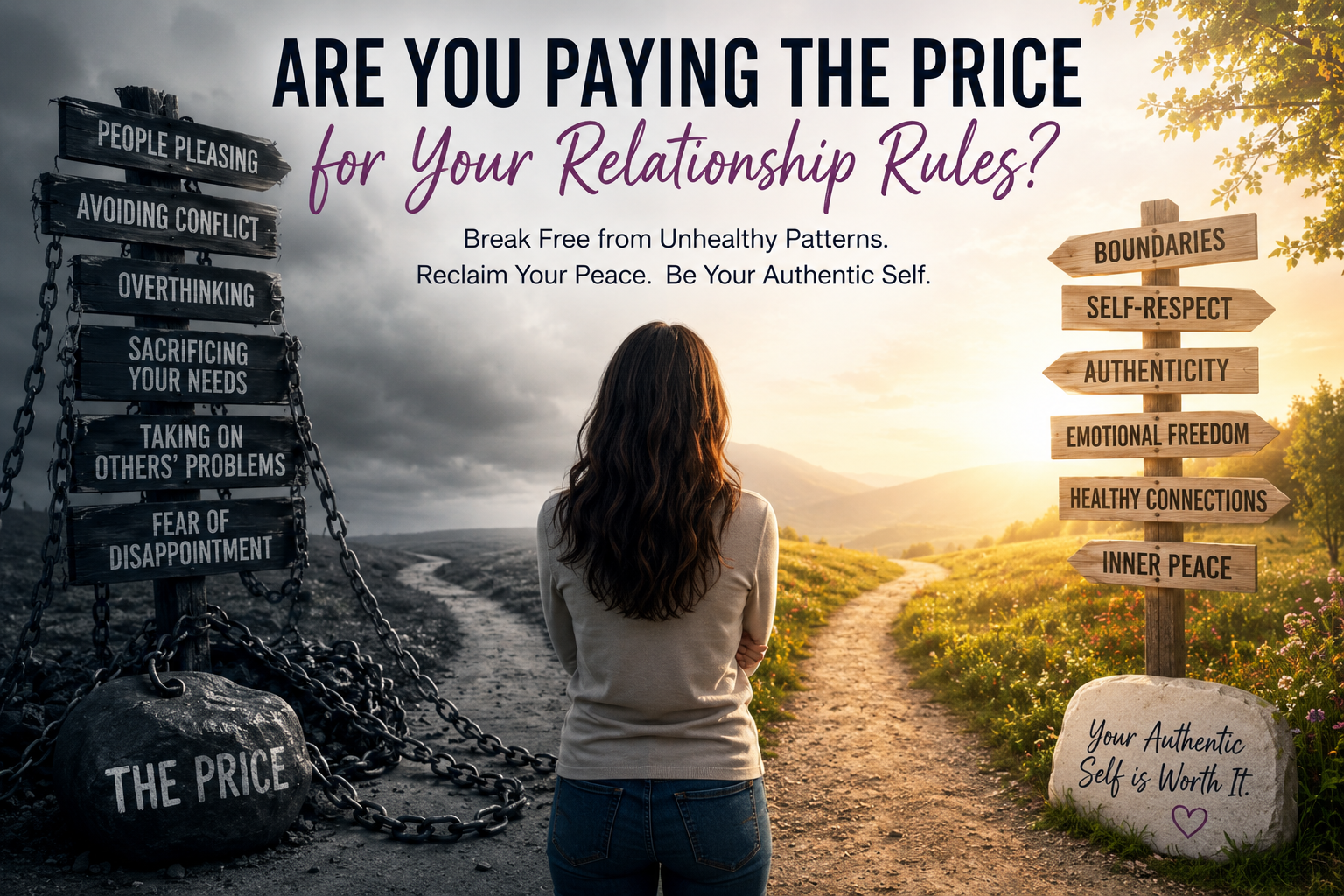
  • Stop Paying the Price for Your Relationship Rules!

    Stop Paying the Price for Your Relationship Rules!

    Most people never stop to ask what their relationships are costing them.

    Not financially. Emotionally.

    We become so accustomed to accommodating, overthinking, rescuing, avoiding conflict, walking on eggshells, or carrying the emotional weight of a relationship that it simply feels normal. We tell ourselves, “This is just who I am.”

    But what if it isn’t?

    What if the very relationship rules you developed to protect your relationships are quietly costing you your peace, confidence, health, and sense of self?

    The Hidden Costs You Don’t See

    Every relationship operates according to a set of unwritten rules.

    Some are healthy. They create trust, respect, and emotional safety.

    Others were formed years ago as survival strategies. They helped you gain approval, avoid rejection, reduce conflict, or feel needed. Over time, these strategies became automatic.

    You may not even realize you are living by relationship rules such as:

    I should keep everyone happy.
    This rule helps regulate anxiety by giving you something to manage. If everyone seems okay, you can feel okay. The cost is that you become responsible for the emotional climate around you, even when other people’s feelings are not yours to fix.

    I should never disappoint anyone.
    This rule reduces the anxiety of conflict, rejection, or disapproval. You avoid the discomfort of letting others down by overexplaining, overgiving, or saying yes when you mean no. The cost is that your own needs, limits, and preferences disappear.

    I should fix other people’s problems.
    This rule creates a sense of control when someone else is struggling. Helping may feel loving, useful, or necessary, but it can also be a way to calm your own discomfort. The cost is that others do not develop their own strength, accountability, or capacity.

    I should assume I have done something wrong if someone is upset.
    This rule helps you make sense of emotional tension quickly. Rather than tolerating uncertainty, you turn inward and blame yourself. The cost is that you may apologize, appease, or take responsibility for things that do not belong to you.

    I should put my needs last.
    This rule lowers the anxiety of being seen as selfish, demanding, or difficult. It may help you feel safe in relationships because you are not asking too much. The cost is resentment, exhaustion, and a quiet disconnection from your own authentic self.

    These rules don’t simply influence your relationships. They shape your identity.

    Following Relationship Rules at Your Expense

    Living by these relationship rules has other costs in addition to those mentioned above.

    You may find yourself:

    • Feeling emotionally exhausted after every interaction.
    • Becoming resentful while continuing to say yes.
    • Losing confidence in your own judgment.
    • Feeling responsible for everyone else’s emotions.
    • Staying in relationships that no longer feel healthy.
    • Constantly questioning yourself after conversations.
    • Struggling to know what you actually want.

    The greatest cost is often the loss of yourself.

    When your energy is devoted to managing other people’s feelings, there is very little left for discovering who you really are.

    Why It’s So Difficult to Change

    Many people believe they simply need stronger boundaries or more confidence.

    Those can certainly help, but they rarely solve the real problem.

    The behaviours are being driven by your adaptive persona, the part of you that learned how to gain acceptance, avoid rejection, and create emotional safety.

    As long as your persona believes these rules keep you safe, it will continue to follow them, even when they are creating pain.

    This is why insight alone rarely creates lasting change.

    There Is Another Way

    Healthy relationships do not require you to abandon yourself in order to maintain connection.

    As you strengthen the capacities of your authentic self, you become more comfortable allowing others to experience disappointment, frustration, or the natural consequences of their choices. You no longer feel compelled to regulate their emotions at the expense of your own wellbeing.

    Relationships become less about managing everyone else and more about showing up honestly, respectfully, and authentically.

    That is where genuine intimacy begins.

    If you have been wondering why the same relationship patterns keep repeating, perhaps it is time to ask a different question.

    Are you paying a price for the relationship rules you’ve been living by?

    Awareness is where change begins. Once you recognize the rules that have been shaping your relationships, you can begin replacing them with healthier ways of connecting that allow both you and the people you love to grow.

  • Are You Overidentified With Your Online Persona?

    Are You Overidentified With Your Online Persona?

    How instant approval, fear of rejection, and the internet-as-judge keep you performing for acceptance instead of developing your authentic self.

    Before we post the photograph, share the thought, write the comment, or put another piece of our life online, many of us pause.

    We don’t simply ask, “Is this what I want to say?” We ask, “How will this be received?” Beneath that question is often a deeper one: “Will I be approved of, ignored, misunderstood, judged, or rejected?”

    This is one of the hidden psychological realities of social media. The internet has become more than a place where we communicate. For many people, it has become an externalized superego, a judging authority that appears to know what is acceptable, admirable, shameful, relevant, attractive, intelligent, successful, or worthy of attention.

    It approves. It rejects. It compares. It measures.

    Because the judgment is public, immediate, and visible through likes, comments, shares, silence, criticism, and unfollows, we begin adapting ourselves to it. We start shaping what we say, how we look, what we reveal, and what we hide according to how we imagine we will be received.

    This is where our anxiety gets activated, and our online persona begins to take over.

    We Take Our Attachment Patterns Online

    Long before social media, we learned how to adapt ourselves to the people around us. In our families, relationships, schools, workplaces, and communities, we discovered which parts of us were welcomed and which parts seemed to create disapproval, conflict, rejection, or shame.

    When attachment was secure enough, we had more room to develop a stable sense of self. We could feel connected without constantly monitoring whether we were acceptable. We could make mistakes, express needs, tolerate disappointment, and recover from relational tension without losing ourselves.

    When attachment was insecure or anxious, we often learned something different. We learned to scan for signs of approval or disapproval. We became sensitive to changes in tone, silence, rejection, criticism, and emotional distance. We began organizing ourselves around the reactions of others.

    That pattern doesn’t disappear when we go online. We take it with us.

    Social media can become a perfect environment for anxious attachment because it offers endless signs to interpret. Who liked the post? Who didn’t? Why did that person view the story but not respond? Why did one post get attention while another was ignored? Why did someone else receive praise, recognition, or visibility while we did not?

    The anxious attachment system looks for evidence of whether we are safe, wanted, valued, and accepted. Online, that search becomes constant.

    What appears to be simple posting, scrolling, or checking can become an ongoing attempt to regulate insecurity.

    How the Adaptive Persona Moves Online

    The adaptive persona is the self we learned to create in order to feel safe, valued, needed, admired, accepted, or in control. It is not completely false. It is often built from real strengths and qualities. The problem is that these qualities become organized around self-protection rather than authentic development.

    We may have become pleasing, capable, funny, successful, agreeable, strong, impressive, needed, smart, resilient, or emotionally contained because those were the versions of ourselves that helped us manage our anxiety and influence the reactions of others.

    These personas helped us survive emotionally. They helped us manage the fear of rejection, abandonment, criticism, or disapproval. They helped us function in environments where our authentic self did not feel safe enough or developed enough to lead.

    Social media gives the adaptive persona a much larger stage.

    Now we can edit the image, polish the words, select the moment, manage the impression, and monitor the reaction. We can create an online self that looks confident, desirable, intelligent, socially aware, emotionally evolved, productive, successful, spiritual, kind, interesting, or completely authentic.

    With artificial intelligence, filters, editing tools, and endless examples of how other people present themselves, we can refine the persona even further. We can make ourselves appear more polished, more successful, more emotionally mature, more attractive, more insightful, and more fully developed than we actually feel inside.

    Yet the more energy we put into maintaining this persona, the more we can lose contact with the self beneath it.

    Developmental Delay and the Search for Approval

    When we are stuck in a developmental delay, we are more likely to look outside ourselves for the recognition, validation, and approval we didn’t fully internalize earlier in life.

    This is not a conscious choice. It is an adaptive pattern.

    If we didn’t develop a strong enough sense of inner worth, emotional security, self-recognition, and internal authority, we may continue seeking these experiences from others. Social media can become especially powerful because it offers immediate feedback. A like, comment, share, or positive reaction can feel like evidence that we matter, that we are seen, and that we are acceptable.

    The problem is that online approval doesn’t develop the authentic self. More often, it strengthens the adaptive persona.

    Instead of asking, “Who am I becoming?” we begin asking, “Who do I need to be to be accepted?”

    This is where the developmental delay continues. We keep investing energy in the image, identity, and presentation that seem most likely to receive approval. We may become more polished, more strategic, more visible, more pleasing, or more impressive, but not necessarily more developed.

    The need for recognition remains unmet at a deeper level because we try to satisfy it through performance. We keep becoming the person we think others will approve of rather than strengthening the capacities that allow us to recognize, value, and express who we truly are.

    Living From the Outside In

    When the internet becomes the judge, and the persona becomes the performance, we begin living from the outside in.

    A meal becomes something to photograph before it is tasted. A holiday becomes something to present before it is fully experienced. An achievement becomes evidence that we are progressing. A struggle becomes material for a lesson.

    Even vulnerability can become part of the performance when we share only the parts of ourselves that will still make us appear brave, wise, relatable, or inspiring.

    This doesn’t mean people are being dishonest. It means the persona is doing what it was designed to do. It is organizing the self around approval and protection.

    The internet-as-superego tells us what deserves approval. The adaptive social persona tries to become the version of ourselves most likely to receive it.

    That is why social media can be so emotionally consuming. We aren’t only posting content. We often present a version of ourselves and wait to see whether it will be accepted.

    Waiting for the Verdict

    When people respond positively, we may feel a brief sense of relief. When they ignore us, we may feel embarrassed, invisible, or unimportant. When they criticize us, we may feel hurt, shamed, or diminished.

    The rational brain may know that online reactions are shaped by algorithms, timing, and other people’s projections, but the emotional brain can still experience the response as a verdict.

    The more identified we become with our online persona, the more threatening judgment feels.

    If we are known as successful, we may hide uncertainty. If we are known as wise, we may avoid admitting confusion. If we are known as happy, we may conceal loneliness. If we are known as strong, we may struggle to ask for help. If we are known as authentic, we may feel pressure to keep proving how real we are.

    The persona begins as a means of gaining approval, but it can eventually become a trap.

    It limits what we allow ourselves to feel, say, need, question, or become.

    Performing Growth Instead of Developing

    This is one of the greatest costs of living through an adaptive online persona. We can spend so much energy on being perceived that we have little left for development.

    We may post about boundaries while still avoiding the discomfort of setting them. We may talk about self-worth while depending on the audience to reassure us. We may share language about healing while continuing to organize our lives around approval, comparison, and fear of judgment.

    The internet allows us to display the image of development without necessarily doing the developmental work.

    We can look self-aware without being able to regulate our emotions. We can appear confident while still depending on external validation. We can talk about authenticity while continuing to shape ourselves around what will be admired, approved of, or accepted.

    The persona becomes more polished while the authentic self remains underdeveloped.

    How the Authentic Self Develops

    The authentic self develops differently.

    It doesn’t grow through performance. It develops through self-awareness, emotional honesty, reflection, accountability, and the willingness to stay present with ourselves when we feel uncertain, unseen, criticized, or uncomfortable.

    Much of this work is private. It doesn’t always photograph well. It may not produce immediate validation. It may look ordinary from the outside, yet it is the foundation of real psychological growth.

    The authentic self strengthens when we can ask, “What am I feeling?” before asking, “How do I look?” It develops when we can recognize whether we are sharing from truth or seeking validation through approval. It grows when we can tolerate being misunderstood without conforming, defending, collapsing, or reshaping ourselves to become acceptable again.

    This is where development resumes. We begin strengthening the inner capacities that allow us to know ourselves, regulate ourselves, value ourselves, and choose how we want to show up without making the audience the final authority.

    Using Social Media Without Losing Yourself

    This doesn’t mean we have to abandon social media. We can share our work, ideas, photographs, stories, and experiences. We can use the internet to connect, teach, express, create, and contribute.

    The difference is that we stop treating the internet as the final judge of who we are.

    We stop giving the audience the power to decide our worth.

    We stop pouring our emotional energy into maintaining an adaptive persona and begin redirecting that energy toward developing the capacities of the Authentic Self.

    Because the life we curate online is not the same as the life we are here to live.

    And the self we perform for approval is not the same as the self we are meant to become.

    Begin Turning Your Energy Back Toward Yourself

    Notice where your online persona has become a substitute for your authentic self. Notice how much time you spend perfecting a post, a sentence and selecting a picture on social media. What are you trying to prove, protect, or receive through the version of yourself you present to others? Where are you seeking recognition online because the deeper need for self-recognition, emotional security, and inner worth has not yet been fully developed?

    You don’t need to disappear from social media. You can begin by becoming more aware of the adaptive patterns that shape how you show up online and in your relationships.

    My books, assessments, and therapeutic coaching can help you understand the persona you have developed, recognize the emotional rules driving it, and begin strengthening the authentic self beneath it.

    Explore my work at annedranitsaris.com and take the next step toward becoming who you are meant to be.

  • Who’s Showing Up in Your Relationships?

    Who’s Showing Up in Your Relationships?

    Do you know which version of you most often shows up in your relationships?

    It’s a simple question, but it isn’t an easy one to answer honestly. Most of us know who we are and even how we would prefer to behave. That doesn’t mean that it’s the person we form relationships with. The self who shows up in a relationship depends far more on whether we arrived in adulthood with a secure attachment.

    You may have noticed how quickly it happens. At home, at work, in friendships, with family, and even with clients, you can shift almost as quickly as you change your clothes. A familiar way of being takes over before you even realize what you are doing.

    You might have had a bad day at work and spent the whole drive home looking forward to unwinding with your partner. But the moment you walk through the door, you pick up the emotional tone in the room. Something feels off. Without stopping to ask what you need, you become the supportive one. You comfort them, reassure them, offer to make dinner, suggest they relax, and maybe even offer a massage. In a matter of minutes, your own need to decompress disappears behind the role your persona knows how to play.

    The same thing happens at work. You may walk into a meeting ready to contribute, but the moment someone questions your idea or seems unimpressed, your attention shifts. You stop being connected to what you know and start managing how you’re being received. You explain more than you need to. You soften your point. You look for approval. You offer to do extra work. You make yourself useful, so no one can question your value. By the time the meeting ends, you’ve survived the experience with your image intact instead of simply participating in it.

    Those familiar behaviors belong to your adaptive persona, and this is how it works. It doesn’t ask, “What do I feel?” “What do I want to express?” or “What do I need right now?” It asks, “What do I have to become to keep this emotionally safe?”

    THE AGENDA IS SAFETY, NOT AUTHENTICITY

    Your adaptive persona isn’t your authentic self. It is the version of you that developed to regulate your own emotions and manage others’. Its agenda is safety, not authenticity. It learned how to reduce tension, prevent escalation, stay acceptable, manage uncertainty, and keep you functioning when your nervous system didn’t feel secure.

    So the real question is not only, “Who am I in this relationship?” It is, “Who do I become when I don’t feel safe to be myself?”

    At home, do you become the one who keeps things calm because tension feels unbearable? Do you carry the emotional weight because it gives you a sense of control? Do you become overly responsible because someone has to hold everything together?

    At work, do you become the one who proves, performs, overdelivers, hides uncertainty, avoids asking for help, or waits for recognition to confirm that you matter?

    These patterns can look functional from the outside. Other people may even reward them. They may see you as dependable, capable, generous, professional, loyal, or easy to work with. But inside, you know when you are not fully there as yourself. You know when you are managing the room instead of being in the room.

    THE RULES RUNNING BENEATH THE SURFACE

    Your adaptive persona does not operate randomly. It is run by rules.

    These rules tell the persona what to do when emotional safety feels uncertain. They tell it when to become agreeable, when to stay quiet, when to rationalize, when to take care of everyone, when to withdraw, when to overfunction, and when to hide what you actually need.

    You may not consciously hear the rule in your mind, but you live it in your relationships. It shows up in the moment you soften your truth to avoid tension, offer help before anyone asks, work harder to be recognized, or become self-sufficient when you really want support.

    The rule is often disguised as responsibility, kindness, patience, independence, ambition, loyalty, or strength. But underneath the behavior, the persona is trying to keep you regulated. It is trying to lower anxiety, prevent conflict, manage another person’s reaction, avoid disappointment, and protect you from feeling emotionally exposed.

    That is why the same pattern follows you into different relationships. The people may change, but the rule remains active because it lives inside the adaptive persona. Until you can see the rule, the persona keeps deciding who you become.

    WHY YOU DON’T FEEL SAFE TO BE YOU

    If you’ve ever wondered what’s still holding you back after all the work you’ve done, the question is: Why does it still feel unsafe to be my authentic self in relationships?

    Most often, it is because more of your developmental energy went into staying safe during your formative years than into building the relationship capacities of your authentic self. You may have experienced trauma, have ADHD, or you may be a survivor of childhood neglect or abuse.

    Your persona learned how to change your behavior to self-regulate, manage others’ emotions, and preserve connections, but that does not mean you developed the inner capacities needed to show up as yourself in relationships.

    This all explains why your adaptive persona is so strong.

    It is also the call for you to pick up your development where it left off and become who you are meant to be in relationships.

    My book, Are Your Relationship Rules Ruining Your Happiness? will help you understand the rules your adaptive persona has been living by, why those rules keep shaping your relationships, and how to begin building the capacities that allow your authentic self to show up.

    NOW AVAILABLE ON AMAZON: Are Your Relationship Rules Ruining Your Happiness? How Unconscious Relationship Patterns Sabotage Love—and How to Break Free. Take advantage of the book launch special price until May 15, 2026.

  • Why You Keep Repeating the Same Emotional Patterns

    Why You Keep Repeating the Same Emotional Patterns

    Your Brain Is Not Trying to Ruin Your Life. It Is Trying to Protect the Story It Already Knows.

    Have you ever watched yourself react and wondered, “Why am I doing this again?”

    You know you’re overreacting. You know you’re getting pulled into the same argument, the same relationship dynamic, the same shutdown, the same caretaking, the same need to explain, prove, defend, rescue, withdraw, control, or make everything okay. You can see the pattern clearly after the fact, yet when it’s happening, something takes over. It’s like your brain has been hijacked, and your body tenses. Your mind races. Your emotions surge. Your old story becomes the only story that you listen to.

    This is why people feel so ashamed of their patterns. They think, “I should know better by now.” But the problem is not that you don’t know better. The problem is that the part of your brain responsible for survival does not care what you know when it believes you are under threat. Our instinctual brain doesn’t remember; it reacts.

    The instinctual brain does not wait for a thoughtful discussion before it reacts. It scans for danger, compares the present moment to what it has already lived through, and decides almost instantly whether you are safe or not. The threat may not be physical. It may be emotional. A look, a tone, a delay in response, someone’s disappointment, a criticism, a partner pulling away, a child’s anger, a client’s disapproval, or the possibility of conflict can be enough to activate your self-protective survival system.

    Once that happens, you aren’t responding to the situation in front of you. You are reacting to the story your nervous system believes is happening.

    The story driving the reaction may be, “They’re angry that I don’t agree, and I’m going to get in trouble.” It may be, “I’m not safe unless I keep everyone happy.” It may be, “If I stop managing their emotions, I am going to be blamed for their feelings.” It may be, “If I ask for what I want, I’ll be shamed for being needy. I’d better not say anything.”

    These stories are not intellectual ideas. They are survival conclusions formed in childhood experience and repeated enough times that your brain and body learned to treat them as truth. They are the rules you live by in relationships.

    The Adaptive Persona Is the Brain’s Survival Strategy

    The adaptive persona is the version of you that developed when you needed to survive emotionally. It was built around what was necessary at the time. If being pleasing reduced conflict, pleasing became part of the strategy. If being capable brought approval, capability became armor. If taking responsibility for everyone’s feelings created a sense of control, overfunctioning became automatic. If staying quiet kept you from being criticized, silence became protection. If rescuing others made you feel needed, rescuing became part of this adaptive identity.

    The adaptive persona is not a flaw. It is evidence of intelligence, sensitivity, and adaptation. It shows how hard your self-protective system worked to keep you emotionally regulated, accepted, useful, and safe. The difficulty is that the adaptive persona does not know when the original danger is over. It continues to organize your reactions long after the circumstances have changed.

    This is why you may be a mature, capable, insightful adult and still feel like a frightened, angry, ashamed, rejected, or desperate younger part of yourself when you are triggered. The adaptive persona does not operate from your current age, wisdom, or adult capacity. It operates from the emotional age at which the pattern was formed. Its development stalled there and remains delayed.

    When that part of you takes over, you do not simply think differently. You become different. Your voice changes. Your posture changes. Your assumptions change. Your ability to listen changes. Your capacity for choice narrows. The old story becomes louder than the present truth.

    Why the Same Pattern Keeps Repeating

    Most people try to change patterns by focusing on behavior. They tell themselves they will stop caretaking, stop reacting, stop chasing, stop avoiding, stop exploding, stop apologizing, stop explaining, or stop choosing unavailable people. They make sincere promises to themselves. They mean every word. Then the next emotionally charged situation arrives, and the same response returns.

    This happens because the behavior is not the root of the pattern. The behavior is the outcome of a threat response from the instinctual brain.

    A person does not overgive simply because they are generous. They may overgive because their brain has learned that giving prevents rejection, anger, guilt, or emotional distance. A person does not control everything simply because they like control. They may control because uncertainty activates helplessness. A person does not avoid conflict simply because they prefer peace. They may avoid conflict because disagreement once felt dangerous, humiliating, destabilizing, or impossible to repair.

    This is why advice often fails. “Set a boundary” sounds simple until the body reacts as if setting a boundary will cost you connection. “Speak up” sounds empowering until your nervous system interprets honesty as danger. “Stop rescuing” sounds obvious until another person’s distress activates the old rule that you are responsible for fixing it.

    The pattern continues because the brain is trying to prevent the old pain from recurring. It does not ask, “Is this good for my growth?” It asks, “Have I survived this before, and what did I do then?”

    That is the power of the old story. The brain repeats what it knows because familiarity feels safer than freedom.

    Your Trigger Is a Doorway Into the Pattern

    A trigger is often misunderstood as a sign that something is wrong with you. It is more useful to see it as a doorway. It reveals where the nervous system has attached meaning to a situation. The trigger tells you that your brain has connected what is happening now with something it already knows.

    When someone does not respond quickly, the story becomes “I don’t matter.” Someone is disappointed, and the story becomes, “I have failed.” Someone disagrees, and the story becomes, “I’m under attack.” Someone needs something from you, and the story becomes, “I have no choice.” Someone praises you, and the story becomes, “They don’t really mean it.” Someone offers care, and the story becomes, “I don’t deserve this.”

    Once the story is activated, your body begins to behave as if it were true. You may feel anxious, defensive, resentful, ashamed, guilty, responsible, frozen, or desperate to make things right. You may start explaining yourself before anyone has accused you. You may apologize when you have done nothing wrong. You may say yes while your whole body is saying no. You may become critical or controlling because vulnerability feels too exposed. You may shut down because staying present feels unbearable.

    This is not random. It is organized. The brain is not inventing a reaction in the moment. It is following a pathway laid down during the formative years, then strengthened each time the same emotional threat appeared. What began as a narrow path became a well-traveled road, and over time, a survival superhighway. When the brain senses a familiar threat, it does not pause to ask whether the old story is still true. It takes the fastest route it knows.

    Insight Helps, But It Doesn’t Rewire the Pattern

    Many people who come to this work already understand a great deal about themselves. They know their childhood history. They know they have abandonment wounds, codependent tendencies, perfectionistic standards, trauma responses, attachment injuries, or difficulty setting boundaries. They may have read the books, listened to the podcasts, attended therapy, and developed language to describe what happened to them.

    Yet the same pattern still shows up.

    That can feel discouraging, but it actually reveals something important. Insight gives you language. It helps you name the pattern, understand where it came from, and stop blaming yourself for reactions that once made sense. But insight belongs largely to the rational brain. It helps you understand the story; it does not automatically reach the instinctual survival brain that is still scanning for threat.

    When the survival brain is activated, it does not stop to consider what you have learned, what you have read, or what you now understand about yourself. It reacts from the old pathway, the one built through repeated emotional experience. To that part of the brain, the old story still feels true. The threat still feels real. The old response still feels necessary.

    To change a survival pattern, you have to work with the system that is running it. That means slowing down the automatic reaction, identifying the underlying emotional rule, recognizing the adaptive persona that has taken over, and building enough internal safety to choose a different response.

    You cannot shame a survival pattern into changing. You cannot lecture it into disappearing. You cannot bypass it with positive thinking. The part of you that developed the pattern needs to be understood, regulated, strengthened, and given a new experience of safety.

    The Emotional Rule Beneath the Reaction

    Underneath every repeated pattern is an emotional rule. Rules began as a child’s conclusions, became beliefs, and emerged as adult relationship rules. These rules are often unconscious, but they shape how you relate, love, work, lead, parent, and protect yourself.

    The rule may be, “I have to be useful to be valued.” It may be, “I must not upset people.” It may be, “I have to be strong because no one will help me.” It may be, “If someone is unhappy, it is my job to fix it.” It may be, “I cannot trust myself unless others approve.” It may be, “I should not need too much.” It may be, “If I relax, something will go wrong.” It may be, “If I let people see the real me, they will leave, criticize, or reject me.”

    These rules are so familiar that they feel obvious and right. People say, “This is just how I am.” But often, it is not who you are. It is who you became in order to manage emotional threat.

    This distinction matters because if you believe the adaptive persona is your authentic self, you will keep trying to improve it. You will become a better pleaser, a more polished overfunctioner, a more impressive performer, a more controlled rescuer, or a more acceptable version of the person who keeps abandoning herself internally.

    Healing begins when you can say, “This is a pattern. This is a rule. This is a survival reaction. This is not my authentic self.”

    Relationship Patterns Are Where the Old Story Shows Itself Most Clearly

    Relationships activate our deepest survival patterns because relationships touch our earliest needs for attachment, safety, recognition, autonomy, comfort, repair, and belonging. You may function well professionally, appear confident socially, and manage responsibilities effectively, yet still become highly reactive in intimate or emotionally important relationships.

    This is because relationships do not simply ask us to behave well. They ask us to stay connected to ourselves while also staying connected to another person. That requires self-awareness, emotional development, and the ability to identify the developmental delays of the capacities of the authentic self needed for secure attachment. Without those capacities, the adaptive persona steps in and does what it has always done. Keep you safe by reacting by submitting, controlling your emotions, or becoming defensive. It may try to avoid vulnerability by intellectualizing everything. It may try to feel powerful by withdrawing first. It may try to feel needed by rescuing.

    In the moment, these reactions feel necessary. Afterward, they often feel painful, confusing, or self-betraying. I often hear clients say, “Why do I keep acting like that when I know better?”

    The problem is that trying to figure yourself out from the rational mind leads you in the wrong direction. The simplest answer is often the most important one: your brain perceived a threat. Once that happened, your adaptive persona reacted through the old survival pathway wired to protect you. In that moment, the survival brain hijacked the rational brain, making logic, insight, and choice much harder to access.

    That reaction is the signal. It tells you that the adaptive persona has been running the relationship instead of the authentic self.

    How I Work With These Patterns

    The way I work is designed to get beneath the surface behaviour and into the inner system that keeps the pattern alive. We do not simply talk about what happened this week and then come up with a strategy to do better next time. We slow the pattern down so you can observe it as it is happening, rather than being taken over by it.

    We identify what triggers you, what story gets activated, what your body does in response, what adaptive persona takes over, and what emotional rule begins directing your behaviour. We explore where the pattern began, why it once made sense, and how it continues to shape your relationships, choices, boundaries, leadership, communication, and sense of self.

    This work is grounded in mindfulness. It helps you develop an observing self, the part of you that can notice what is happening inside you without immediately reacting from it. This is compassionate work, but it is not passive. It asks you to stay present when you are triggered into self-protection, especially when there is no real threat in the present moment. It asks you to pause, notice, breathe, and anchor yourself in what is happening now, rather than being pulled automatically into the old survival story.

    Mindfulness also helps you recognize the inner conflict between the brain’s self-protective and self-actualizing systems. The adaptive persona is trying to protect you by reacting from the instinctual brain and following the old rules. The authentic self is trying to develop, relate, choose, and respond from the rational brain and from who you are now. The work is to observe both without judgment.

    The goal is not to blame the past or stay endlessly focused on the wound. The goal is to develop the emotional capacity, self-awareness, and nervous system regulation needed to respond from your authentic self, rather than from the survival story your brain keeps repeating.

    In practical terms, this means learning how to recognize the pattern before it takes over. It means pausing long enough to notice the threat response. It means identifying the relationship rule rather than obeying it. It means tolerating the discomfort of doing something different. It means developing boundaries that are not driven by anger or guilt. It means communicating with clarity rather than defensively. It means remaining present when your old pattern wants to rescue, retreat, appease, control, explain, collapse, or attack.

    This is how the brain begins to lay down new pathways. Not because you forced yourself to be different, but because you created enough awareness, presence, and internal safety to practice a new response.

    You Are Not Doomed to Repeat the Story

    The story your brain has been protecting is not the final truth of your life. It is a survival map created from earlier experiences. At one time, it may have helped you navigate emotional uncertainty, avoid conflict, earn approval, maintain connection, or protect yourself from disappointment. But a survival map is not the same as a life path. It simply shows you where the developmental delay occurred and where you need to resume your development.

    You can understand the pattern without being controlled by it. You can respect the adaptive persona without letting it lead your relationships. You can honor what protected you while choosing to develop beyond it. You can learn to recognize the moment when your brain says, “This is dangerous,” and ask whether the danger is real or whether the old story has been activated again.

    That is where development resumes. It begins in the space between trigger and reaction. It begins when you can feel the old pull without automatically obeying it. It begins when you can say, “I know this story, but I do not have to live from it.”

    A Call to Begin the Work

    If you keep finding yourself in the same reactive relationship pattern, the answer is not another promise to try harder. Trying harder often strengthens the adaptive persona because it keeps you working from the same relationship rules.

    The deeper work is to understand what your brain is protecting, what your nervous system is reacting to, what emotional rule is directing your behavior, and what part of you needs to develop so the old story no longer takes over.

    This is the work I do with clients. We go beneath the behavior, beneath the repeating relationship dynamic, beneath the guilt, anger, fear, overgiving, shutdown, control, perfectionism, and self-doubt. We work with the pattern at its root so you can begin responding from your authentic self rather than from the adaptive persona that has been trying to keep you safe.

    If this conversation feels uncomfortably familiar, it may be because you are ready to stop explaining the pattern and start changing it. You do not have to keep living from the same story, reacting to the same threat response, and calling it who you are.

    Book a discovery call, and let’s begin the work of understanding the relationship pattern that has been running your life, so you can finally develop the freedom to respond differently and become who you are meant to be.

    ___________________________________________________________________________

    Not ready to chat yet? If you recognize yourself in these patterns, my book, Are Your Relationship Rules Ruining Your Happiness? How Unconscious Relationship Patterns Sabotage Love—and How to Break Free will help you understand the hidden rules, survival responses, and adaptive persona that keep you repeating the same relationship story.

    This book is for you if you’re ready to stop blaming yourself, stop trying to “figure it out” from the same old mindset, and begin seeing the deeper pattern that has been running beneath your choices. It will help you understand why you react the way you do, why insight alone hasn’t been enough, and what needs to change so you can begin relating from your authentic self instead of from fear, guilt, overgiving, control, or self-protection.

    Order your copy today and begin the work of breaking the relationship rules that have been keeping you stuck.