Category: Relationships

  • Stop Paying the Price for Your Relationship Rules!

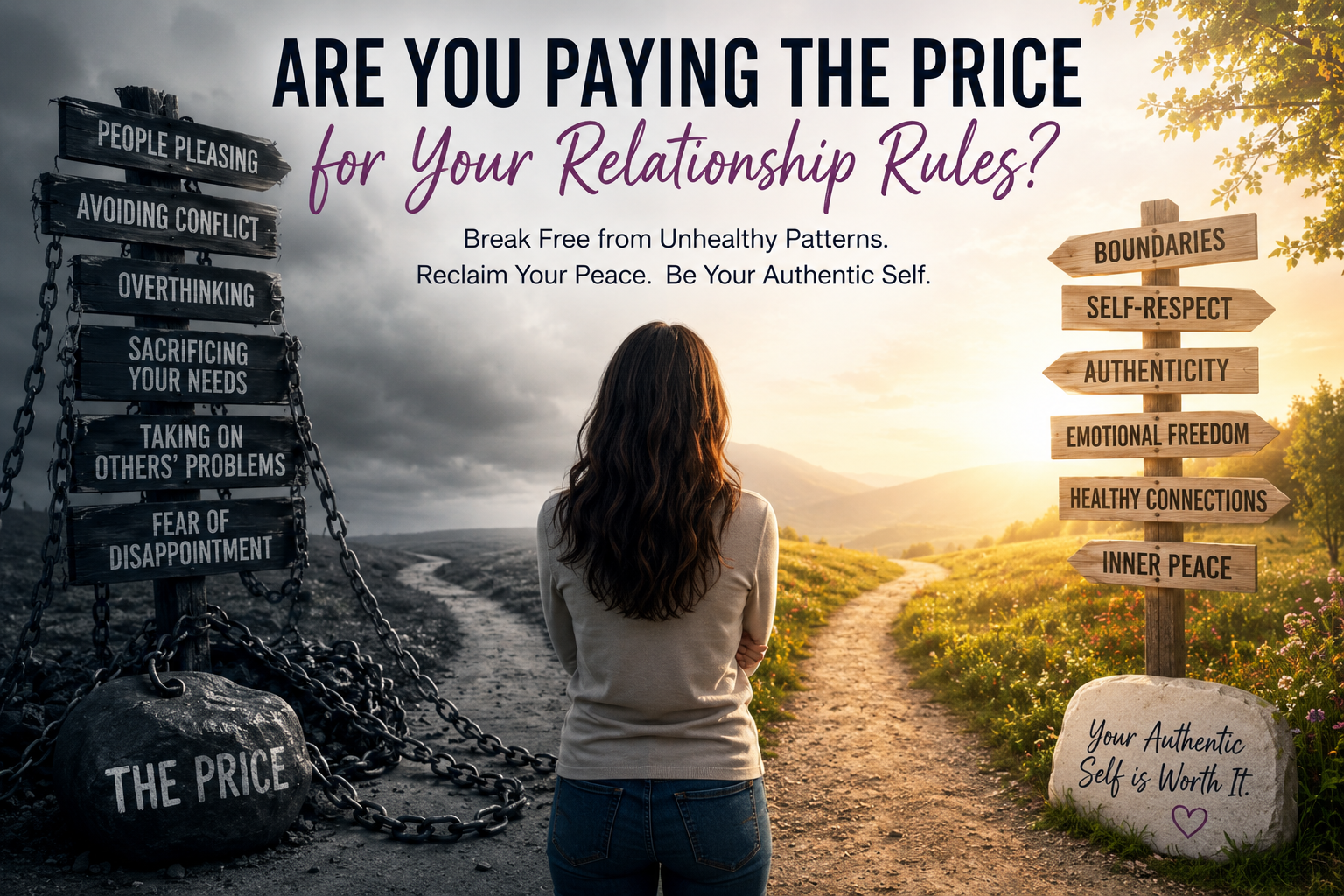
    Stop Paying the Price for Your Relationship Rules!

    Most people never stop to ask what their relationships are costing them.

    Not financially. Emotionally.

    We become so accustomed to accommodating, overthinking, rescuing, avoiding conflict, walking on eggshells, or carrying the emotional weight of a relationship that it simply feels normal. We tell ourselves, “This is just who I am.”

    But what if it isn’t?

    What if the very relationship rules you developed to protect your relationships are quietly costing you your peace, confidence, health, and sense of self?

    The Hidden Costs You Don’t See

    Every relationship operates according to a set of unwritten rules.

    Some are healthy. They create trust, respect, and emotional safety.

    Others were formed years ago as survival strategies. They helped you gain approval, avoid rejection, reduce conflict, or feel needed. Over time, these strategies became automatic.

    You may not even realize you are living by relationship rules such as:

    I should keep everyone happy.
    This rule helps regulate anxiety by giving you something to manage. If everyone seems okay, you can feel okay. The cost is that you become responsible for the emotional climate around you, even when other people’s feelings are not yours to fix.

    I should never disappoint anyone.
    This rule reduces the anxiety of conflict, rejection, or disapproval. You avoid the discomfort of letting others down by overexplaining, overgiving, or saying yes when you mean no. The cost is that your own needs, limits, and preferences disappear.

    I should fix other people’s problems.
    This rule creates a sense of control when someone else is struggling. Helping may feel loving, useful, or necessary, but it can also be a way to calm your own discomfort. The cost is that others do not develop their own strength, accountability, or capacity.

    I should assume I have done something wrong if someone is upset.
    This rule helps you make sense of emotional tension quickly. Rather than tolerating uncertainty, you turn inward and blame yourself. The cost is that you may apologize, appease, or take responsibility for things that do not belong to you.

    I should put my needs last.
    This rule lowers the anxiety of being seen as selfish, demanding, or difficult. It may help you feel safe in relationships because you are not asking too much. The cost is resentment, exhaustion, and a quiet disconnection from your own authentic self.

    These rules don’t simply influence your relationships. They shape your identity.

    Following Relationship Rules at Your Expense

    Living by these relationship rules has other costs in addition to those mentioned above.

    You may find yourself:

    • Feeling emotionally exhausted after every interaction.
    • Becoming resentful while continuing to say yes.
    • Losing confidence in your own judgment.
    • Feeling responsible for everyone else’s emotions.
    • Staying in relationships that no longer feel healthy.
    • Constantly questioning yourself after conversations.
    • Struggling to know what you actually want.

    The greatest cost is often the loss of yourself.

    When your energy is devoted to managing other people’s feelings, there is very little left for discovering who you really are.

    Why It’s So Difficult to Change

    Many people believe they simply need stronger boundaries or more confidence.

    Those can certainly help, but they rarely solve the real problem.

    The behaviours are being driven by your adaptive persona, the part of you that learned how to gain acceptance, avoid rejection, and create emotional safety.

    As long as your persona believes these rules keep you safe, it will continue to follow them, even when they are creating pain.

    This is why insight alone rarely creates lasting change.

    There Is Another Way

    Healthy relationships do not require you to abandon yourself in order to maintain connection.

    As you strengthen the capacities of your authentic self, you become more comfortable allowing others to experience disappointment, frustration, or the natural consequences of their choices. You no longer feel compelled to regulate their emotions at the expense of your own wellbeing.

    Relationships become less about managing everyone else and more about showing up honestly, respectfully, and authentically.

    That is where genuine intimacy begins.

    If you have been wondering why the same relationship patterns keep repeating, perhaps it is time to ask a different question.

    Are you paying a price for the relationship rules you’ve been living by?

    Awareness is where change begins. Once you recognize the rules that have been shaping your relationships, you can begin replacing them with healthier ways of connecting that allow both you and the people you love to grow.

  • Who’s Showing Up in Your Relationships?

    Who’s Showing Up in Your Relationships?

    Do you know which version of you most often shows up in your relationships?

    It’s a simple question, but it isn’t an easy one to answer honestly. Most of us know who we are and even how we would prefer to behave. That doesn’t mean that it’s the person we form relationships with. The self who shows up in a relationship depends far more on whether we arrived in adulthood with a secure attachment.

    You may have noticed how quickly it happens. At home, at work, in friendships, with family, and even with clients, you can shift almost as quickly as you change your clothes. A familiar way of being takes over before you even realize what you are doing.

    You might have had a bad day at work and spent the whole drive home looking forward to unwinding with your partner. But the moment you walk through the door, you pick up the emotional tone in the room. Something feels off. Without stopping to ask what you need, you become the supportive one. You comfort them, reassure them, offer to make dinner, suggest they relax, and maybe even offer a massage. In a matter of minutes, your own need to decompress disappears behind the role your persona knows how to play.

    The same thing happens at work. You may walk into a meeting ready to contribute, but the moment someone questions your idea or seems unimpressed, your attention shifts. You stop being connected to what you know and start managing how you’re being received. You explain more than you need to. You soften your point. You look for approval. You offer to do extra work. You make yourself useful, so no one can question your value. By the time the meeting ends, you’ve survived the experience with your image intact instead of simply participating in it.

    Those familiar behaviors belong to your adaptive persona, and this is how it works. It doesn’t ask, “What do I feel?” “What do I want to express?” or “What do I need right now?” It asks, “What do I have to become to keep this emotionally safe?”

    THE AGENDA IS SAFETY, NOT AUTHENTICITY

    Your adaptive persona isn’t your authentic self. It is the version of you that developed to regulate your own emotions and manage others’. Its agenda is safety, not authenticity. It learned how to reduce tension, prevent escalation, stay acceptable, manage uncertainty, and keep you functioning when your nervous system didn’t feel secure.

    So the real question is not only, “Who am I in this relationship?” It is, “Who do I become when I don’t feel safe to be myself?”

    At home, do you become the one who keeps things calm because tension feels unbearable? Do you carry the emotional weight because it gives you a sense of control? Do you become overly responsible because someone has to hold everything together?

    At work, do you become the one who proves, performs, overdelivers, hides uncertainty, avoids asking for help, or waits for recognition to confirm that you matter?

    These patterns can look functional from the outside. Other people may even reward them. They may see you as dependable, capable, generous, professional, loyal, or easy to work with. But inside, you know when you are not fully there as yourself. You know when you are managing the room instead of being in the room.

    THE RULES RUNNING BENEATH THE SURFACE

    Your adaptive persona does not operate randomly. It is run by rules.

    These rules tell the persona what to do when emotional safety feels uncertain. They tell it when to become agreeable, when to stay quiet, when to rationalize, when to take care of everyone, when to withdraw, when to overfunction, and when to hide what you actually need.

    You may not consciously hear the rule in your mind, but you live it in your relationships. It shows up in the moment you soften your truth to avoid tension, offer help before anyone asks, work harder to be recognized, or become self-sufficient when you really want support.

    The rule is often disguised as responsibility, kindness, patience, independence, ambition, loyalty, or strength. But underneath the behavior, the persona is trying to keep you regulated. It is trying to lower anxiety, prevent conflict, manage another person’s reaction, avoid disappointment, and protect you from feeling emotionally exposed.

    That is why the same pattern follows you into different relationships. The people may change, but the rule remains active because it lives inside the adaptive persona. Until you can see the rule, the persona keeps deciding who you become.

    WHY YOU DON’T FEEL SAFE TO BE YOU

    If you’ve ever wondered what’s still holding you back after all the work you’ve done, the question is: Why does it still feel unsafe to be my authentic self in relationships?

    Most often, it is because more of your developmental energy went into staying safe during your formative years than into building the relationship capacities of your authentic self. You may have experienced trauma, have ADHD, or you may be a survivor of childhood neglect or abuse.

    Your persona learned how to change your behavior to self-regulate, manage others’ emotions, and preserve connections, but that does not mean you developed the inner capacities needed to show up as yourself in relationships.

    This all explains why your adaptive persona is so strong.

    It is also the call for you to pick up your development where it left off and become who you are meant to be in relationships.

    My book, Are Your Relationship Rules Ruining Your Happiness? will help you understand the rules your adaptive persona has been living by, why those rules keep shaping your relationships, and how to begin building the capacities that allow your authentic self to show up.

    NOW AVAILABLE ON AMAZON: Are Your Relationship Rules Ruining Your Happiness? How Unconscious Relationship Patterns Sabotage Love—and How to Break Free. 

  • ARE YOU CARRYING THE RELATIONSHIP INSTEAD OF BEING IN IT?

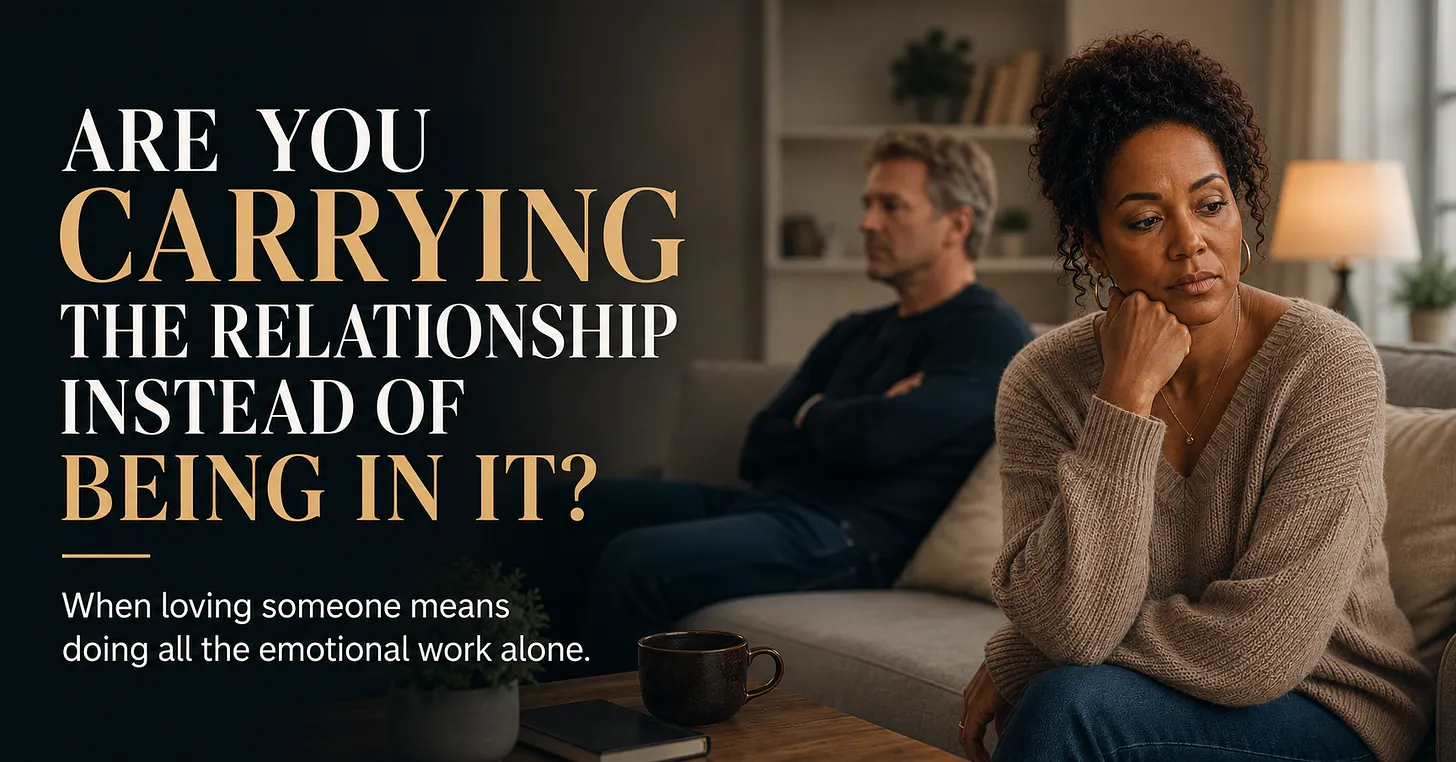
    ARE YOU CARRYING THE RELATIONSHIP INSTEAD OF BEING IN IT?

    How unconscious relationship rules keep you overfunctioning, waiting, and losing yourself

    A relationship can survive for years on the effort of one person. The devastating moment comes when we finally realize we are the only one keeping it alive.

    You are the competent one and don’t give up easily. You try to understand your partner’s behavior, make room for their limitations, and keep hoping the relationship will become more satisfying once they change their behavior.

    You initiate the important conversations because your partner avoids them. You monitor their moods so you know when it is safe to bring something up. You carefully choose your words, trying to prevent defensiveness or withdrawal. You explain away disappointing behavior because they have been stressed, hurt, busy, overwhelmed, or simply unable to give more. When conflict happens, you’re the one who reflects, apologizes, repairs, or tries again.

    Over time, what began as patience becomes a job. You aren’t in the relationship; you’re managing it. The relationship stays intact because you keep compensating for what is missing.

    And yet, you still believe it’s about a deficit in you. That if you just find the right words, become more understanding, lower your expectations, or remain patient a little longer, you will finally have the relationship you have been working so hard to create.

    WHEN YOU KEEP WAITING FOR THE PERSON THEY WERE AT THE BEGINNING

    You may look back and say, “I know they have it in them to be loving, attentive, interested, and emotionally available.” They were like this at the beginning of the relationship.” And they probably were. In the beginning, they may have listened intently, made you feel important, shown affection freely, pursued you with enthusiasm, and appeared to share your values and expectations about relationships. You did not imagine that version of them. You experienced it.

    The painful question is whether that person represented their capacity for a mature relationship or the image they needed you to believe in so you would choose them. For some partners, the beginning of the relationship is a period of heightened effort, when they are motivated to win your attention, admiration, loyalty, or commitment. Once they feel secure that you are invested, the attentiveness fades, the emotional effort declines, and you are left wondering what happened to the person you fell in love with. You keep waiting for them to return, because the relationship began with enough evidence to convince you that more is possible.

    This is what makes a bait-and-switch relationship so difficult to leave or even see clearly. You are not only attached to the relationship as it is; you are attached to the memory of how it felt in the beginning and the hope that, with enough patience, love, understanding, or effort, you can bring that person back. But a partner’s early behavior matters less than the pattern they sustain over time. The real relationship is not the one they offered as they drew you in. It is the one you are living in now.

    And you believe you must have done something for them to withdraw love and you set about to get it back.

    THE HIDDEN RULE THAT KEEPS YOU TRYING

    People who carry relationships don’t always recognize what they are doing at first. Their behavior can feel natural, responsible, loving, or mature. They may take pride in being the person who can forgive, understand, accommodate, remain calm, or see the other person’s perspective.

    Beneath that effort, however, is a belief that drives a number of unconscious relationship rules:

    “If I work hard enough at this relationship, they will love me again the way they did at the beginning.”e

    That rule may show up in many “should” statements:

    I should be more understanding.

    I should not expect too much.

    I should give them time.

    I should stay calm, and they will eventually listen.

    If I am patient enough, they should be interested in me again.

    I should stop pushing for what I want, and things will get better

    These rules don’t begin in adult relationships. They develop much earlier, when a child learns to manage their own emotional security by paying close attention to and managing others’ feelings, needs, reactions, and availability. Rather than developing the capacity to remain connected to their own emotional reality while expecting mutuality from others, they adopt an adaptive persona that helps them maintain stable relationships at the expense of their own happiness.

    They become the capable one, the accommodating one, the understanding one, the forgiving one, or the one who does not need very much.

    This persona may help them function successfully in many areas of life. They can be dependable, responsible, insightful, generous, and highly attuned to others. In intimate relationships, however, the same pattern can keep them invested in trying to make a one-sided relationship work.

    THE RESENTMENT THAT BUILDS WHEN YOU KEEP ACCOMMODATING

    People who carry relationships often feel guilty when resentment begins to surface. Rather than seeing their anger or disappointment as a response to an unequal relationship, they are pulled back into the conclusions they formed in childhood: I’m selfish for wanting more. I’m mean for being angry. I’m bad for having needs. I’m wrong for expecting anything from someone else. These are the beliefs that took hold when their needs were criticized, dismissed, or met with the same hurtful names they may still silently call themselves today.

    Once those old feelings are triggered, their unconscious relationship rules move quickly to silence their protest. They tell themselves they should be more loving, more compassionate, more patient, more accepting, and less demanding. Instead of questioning why the relationship requires so much effort while giving so little back, they turn the question on themselves. They interpret their irritability, withdrawal, criticism, or emotional exhaustion as evidence that they are becoming the problem.

    But resentment is a normal response when you have been giving more than you genuinely want to give while receiving less than you need to remain emotionally engaged. It is the feeling that emerges when your needs, limits, and disappointments have been pushed aside for too long. Yet the adaptive persona does not allow resentment to speak clearly. It silences the protest by repeating the same accusations you heard as a child, teaching you to feel ashamed of the very feelings that are trying to tell you something is wrong.

    Resentment is not healed by becoming better at tolerating deprivation or more skilled at explaining away another person’s lack of participation. It begins to change when you stop judging yourself for having reached your limit, face the imbalance honestly, and recognize that it is not your responsibility to keep making up for what the other person is unwilling or unable to bring to the relationship.

    WAITING FOR SOMEONE TO BECOME THE PARTNER YOU NEED

    There is often a great deal of waiting in a relationship carried by one person.

    You wait for your partner to mature, heal, become less defensive, prioritize the relationship, communicate more openly, show more affection, or finally understand how deeply their behavior has affected you.

    You may hold tightly to the moments when they do show up: a heartfelt conversation, an apology, an affectionate weekend, a thoughtful gesture, or a renewed promise. Those moments feel like evidence that the relationship you want is possible. They can sustain hope for months or years.

    The difficulty is that meaningful change does not consist of brief periods of increased effort after you have reached your limit. It is demonstrated through consistent participation, accountability, emotional engagement, and a willingness to develop the capacities required for a mutual relationship.

    When those things do not happen, waiting becomes another way of abandoning yourself. You remain loyal to the possibility of who your partner could become while becoming increasingly disconnected from the reality of what your relationship actually is.

    LOVE SHOULD NOT REQUIRE YOU TO DISAPPEAR

    Carrying a relationship slowly changes how you experience yourself. You may become more anxious, watchful, resentful, discouraged, or emotionally flat. You may lose confidence in your perceptions because your concerns are repeatedly dismissed or left unresolved. You may stop bringing up what matters because the effort feels pointless. You may become so accustomed to managing the relationship that you no longer ask whether it nourishes you, challenges both partners to grow, or allows you to exist as a full person within it.

    When you have carried a relationship for too long, you can lose sight of your own experience. You become focused on keeping the peace, avoiding disappointment, and getting through one more difficult conversation. Your needs grow quieter, while your resentment, loneliness, and exhaustion grow stronger.

    Love is not supposed to require you to disappear so the relationship can survive. It should not depend on you overlooking what hurts, accepting what never changes, or carrying responsibilities that belong to two people.

    You deserve more than being needed to keep a relationship functioning. You deserve a relationship in which you are seen, considered, responded to, and met with the same willingness to grow that you bring.

    There comes a point when the question is no longer, “How do I make this relationship work?” It becomes, “Why am I working so hard to sustain a relationship that is not giving me what I need?”

    Are Your Relationship Rules Ruining Your Happiness? helps you recognize the unconscious rules that keep you overfunctioning, tolerating, and waiting for change. It offers a path back to yourself so you can stop compensating, adapting, and abandoning yourself in the hopes your partner will become who you need them to be.

    The book helps you identify the unconscious rules that keep you overfunctioning, tolerating, compensating, and waiting so you can begin building relationships from your authentic self rather than an adaptive persona.

    Available now on Amazon.
  • How I Accidentally Trained My Partner to Underfunction

    How I Accidentally Trained My Partner to Underfunction

    Are you mothering your partner, then blaming him for needing a mother?

    Have you ever looked at your partner and thought, “I feel like I’m raising another child”?

    Or maybe you’ve said it out loud in frustration: “I feel more like your mother than your partner.”

    It’s a painful thing to admit when you love someone. You don’t want to sound superior. You don’t want to be critical. You don’t want the relationship to feel like one person is the adult and the other is being managed.

    Yet this is exactly where many relationships end up.

    One person, usually the woman, becomes the one who notices, remembers, organizes, reminds, anticipates, follows up, and keeps things moving. Their partner becomes dependent, avoidant, or disengaged. Then both people get locked into an unconscious relationship pattern neither of them likes. They are no longer relating from their authentic selves but from adaptive personas created in childhood to self-regulate and keep the relationship feeling safe.

    I write about this and other relationship patterns in Are Your Relationship Rules Ruining Your Happiness? because relationship unhappiness and conflict are rarely just about chores, forgetfulness, or who does more around the house. Beneath the pattern are unconscious relationship rules that tell us who we have to be and who our partner should be in order to feel secure, valued, needed, or loved.

    The Moment I Saw What I Was Doing

    I remember realizing this early in my own marriage. There were things my husband was perfectly capable of doing for himself, yet I kept stepping in. I reminded him, organized things for him, thought ahead for him, organized activities for his children, solved things before he had to deal with them, and then felt quietly resentful that he wasn’t carrying his weight.

    At first, I told myself I was being helpful. I was being loving. I was making life easier for everyone.

    But that wasn’t the whole truth.

    Underneath my helpfulness was an unconscious relationship rule:

    “I should step in because I have more capacity.”

    That rule sounded reasonable to me. I was organized. I could multitask. I could see what needed to be done before other people noticed. I was responsive, agile, and willing. I could get things moving quickly. I could prevent unnecessary problems. I could keep everything functioning.

    The trouble was that this rule didn’t just shape my behavior. It shaped the relationship.

    Without realizing it, I was participating in an unconscious relationship contract. In my contract, he was supposed to be my partner and match my skills, initiative, values, and capacities. The contract was unspoken; he had never agreed to it, and yet, I felt let down when he broke one of the rules.

    Instead of discussing the contract and rules (I didn’t know anything about unconscious contracts and relationship rules at the time), I stepped in more, and the relationship adapted to my capacity, which frustrated me even further. I increasingly took his behavior personally, became angry at him for not respecting me and using me, etc. Fortunately, I had an insightful therapist who pointed out that I was enabling instead of leading and that I needed to step up in a different way. Not expecting him to know without discussion. Not showing him what he should do, but actually telling him what he must do and what I would no longer do.

    That was challenging for me. To see how I had set him up to depend on me to be in charge. I was doing things for him that he could have done himself, then resenting him for letting me do them. I was treating him as though he needed managing, then feeling hurt that he wasn’t showing up as an adult.

    That’s when I saw how I had contributed to the parent-child dynamic I said I didn’t want.

    The Relationship Rule That Says, “I Should Step In”

    One of my unconscious relationship rules was, “It’s my responsibility to step in because I have more capacity.”

    That belief felt reasonable. I could organize quickly. I could multitask. I could see what needed to happen before other people noticed. I was highly responsive, agile, and willing.

    For many women, this is their normal. We step in because it’s faster than waiting. We do it ourselves because explaining takes too long. We prevent the problem because we don’t want to deal with the consequences later. When we’re honest with ourselves, we admit we do it because we can do it better and faster, which makes us feel strong, capable, and sometimes even superior.

    Before long, the relationship has quietly reorganized around our capacity.

    We become the one in charge, creating dependence on us to be the organizing principle in our relationship, filling the gap before our partner has had time to know there is one. Then we wonder why our partner doesn’t develop more initiative.

    This is how relationship rules ruin our happiness. We don’t realize that we are using an adaptive relationship pattern in which the persona says, “I’ll just take care of it,” while the authentic self is increasingly resentful and lonely. It feels familiar. Just like our childhood.

    The Harder Question

    When we say, “I feel like your mother,” we may be naming something real. Our partner may not be contributing to the partnership and may be breaking the unconscious relationship contract you thought he had agreed to.

    But the harder question is, “Why have I stepped into this role?”

    What do I believe will happen if I stop reminding, fixing, managing, or rescuing? What approval am I still trying to earn by being so capable? What part of me feels safer being needed than being known?

    These questions don’t excuse another adult’s lack of responsibility. They help us see the relationship rules that keep our adaptive persona participating in the pattern.

    That’s the central invitation of Are Your Relationship Rules Ruining Your Happiness? We don’t change relationship patterns simply by blaming ourselves, blaming our partner, or trying harder to behave differently. We change them by recognizing the unconscious rules that continue to drive what we do.

    When we understand the rule, we can rewrite it. We can stop confusing love with overfunctioning. We can stop mistaking being needed for being securely attached. We can stop calling emotional management intimacy.

    Then we can ask for something more honest.

    Because we can’t create adult intimacy while treating another adult like a child. We can’t feel fulfilled while carrying the relationship. We can’t keep doing everything and then feel surprised when the other person lets us.

    The shift begins when we stop compensating for the absence of partnership and start noticing what happens when we no longer play the mothering role.

    That’s when we finally get to see whether the relationship can grow.

    And that’s when we stop being the mother and ask to be met as a partner.

    ___________________________________________________________________________

    Get your copy of Are Your Relationship Rules Ruining Your Happiness? and find out more about unconscious relationship contracts, the relationship rules that keep the adaptive persona in charge, and the capacities of the authentic self that help us create more secure, mutual, and emotionally honest relationships.

  • Who’s Showing Up in Your Relationships?

    Who’s Showing Up in Your Relationships?

    Do you know which version of you most often shows up in your relationships?

    It’s a simple question, but it isn’t an easy one to answer honestly. Most of us know who we are and even how we would prefer to behave. That doesn’t mean that it’s the person we form relationships with. The self who shows up in a relationship depends far more on whether we arrived in adulthood with a secure attachment.

    You may have noticed how quickly it happens. At home, at work, in friendships, with family, and even with clients, you can shift almost as quickly as you change your clothes. A familiar way of being takes over before you even realize what you are doing.

    You might have had a bad day at work and spent the whole drive home looking forward to unwinding with your partner. But the moment you walk through the door, you pick up the emotional tone in the room. Something feels off. Without stopping to ask what you need, you become the supportive one. You comfort them, reassure them, offer to make dinner, suggest they relax, and maybe even offer a massage. In a matter of minutes, your own need to decompress disappears behind the role your persona knows how to play.

    The same thing happens at work. You may walk into a meeting ready to contribute, but the moment someone questions your idea or seems unimpressed, your attention shifts. You stop being connected to what you know and start managing how you’re being received. You explain more than you need to. You soften your point. You look for approval. You offer to do extra work. You make yourself useful, so no one can question your value. By the time the meeting ends, you’ve survived the experience with your image intact instead of simply participating in it.

    Those familiar behaviors belong to your adaptive persona, and this is how it works. It doesn’t ask, “What do I feel?” “What do I want to express?” or “What do I need right now?” It asks, “What do I have to become to keep this emotionally safe?”

    THE AGENDA IS SAFETY, NOT AUTHENTICITY

    Your adaptive persona isn’t your authentic self. It is the version of you that developed to regulate your own emotions and manage others’. Its agenda is safety, not authenticity. It learned how to reduce tension, prevent escalation, stay acceptable, manage uncertainty, and keep you functioning when your nervous system didn’t feel secure.

    So the real question is not only, “Who am I in this relationship?” It is, “Who do I become when I don’t feel safe to be myself?”

    At home, do you become the one who keeps things calm because tension feels unbearable? Do you carry the emotional weight because it gives you a sense of control? Do you become overly responsible because someone has to hold everything together?

    At work, do you become the one who proves, performs, overdelivers, hides uncertainty, avoids asking for help, or waits for recognition to confirm that you matter?

    These patterns can look functional from the outside. Other people may even reward them. They may see you as dependable, capable, generous, professional, loyal, or easy to work with. But inside, you know when you are not fully there as yourself. You know when you are managing the room instead of being in the room.

    THE RULES RUNNING BENEATH THE SURFACE

    Your adaptive persona does not operate randomly. It is run by rules.

    These rules tell the persona what to do when emotional safety feels uncertain. They tell it when to become agreeable, when to stay quiet, when to rationalize, when to take care of everyone, when to withdraw, when to overfunction, and when to hide what you actually need.

    You may not consciously hear the rule in your mind, but you live it in your relationships. It shows up in the moment you soften your truth to avoid tension, offer help before anyone asks, work harder to be recognized, or become self-sufficient when you really want support.

    The rule is often disguised as responsibility, kindness, patience, independence, ambition, loyalty, or strength. But underneath the behavior, the persona is trying to keep you regulated. It is trying to lower anxiety, prevent conflict, manage another person’s reaction, avoid disappointment, and protect you from feeling emotionally exposed.

    That is why the same pattern follows you into different relationships. The people may change, but the rule remains active because it lives inside the adaptive persona. Until you can see the rule, the persona keeps deciding who you become.

    WHY YOU DON’T FEEL SAFE TO BE YOU

    If you’ve ever wondered what’s still holding you back after all the work you’ve done, the question is: Why does it still feel unsafe to be my authentic self in relationships?

    Most often, it is because more of your developmental energy went into staying safe during your formative years than into building the relationship capacities of your authentic self. You may have experienced trauma, have ADHD, or you may be a survivor of childhood neglect or abuse.

    Your persona learned how to change your behavior to self-regulate, manage others’ emotions, and preserve connections, but that does not mean you developed the inner capacities needed to show up as yourself in relationships.

    This all explains why your adaptive persona is so strong.

    It is also the call for you to pick up your development where it left off and become who you are meant to be in relationships.

    My book, Are Your Relationship Rules Ruining Your Happiness? will help you understand the rules your adaptive persona has been living by, why those rules keep shaping your relationships, and how to begin building the capacities that allow your authentic self to show up.

    NOW AVAILABLE ON AMAZON: Are Your Relationship Rules Ruining Your Happiness? How Unconscious Relationship Patterns Sabotage Love—and How to Break Free. Take advantage of the book launch special price until May 15, 2026.