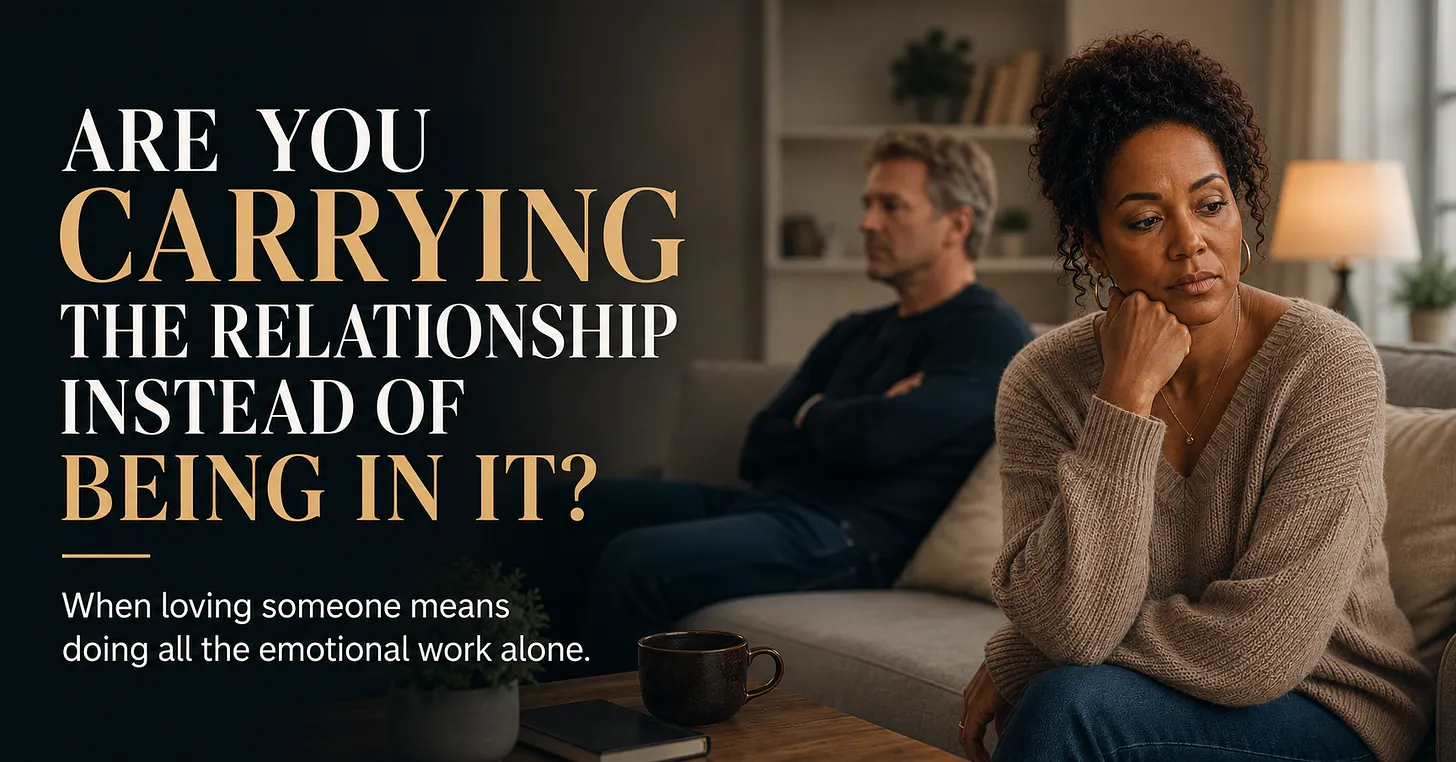
How unconscious relationship rules keep you overfunctioning, waiting, and losing yourself
A relationship can survive for years on the effort of one person. The devastating moment comes when we finally realize we are the only one keeping it alive.
You are the competent one and don’t give up easily. You try to understand your partner’s behavior, make room for their limitations, and keep hoping the relationship will become more satisfying once they change their behavior.
You initiate the important conversations because your partner avoids them. You monitor their moods so you know when it is safe to bring something up. You carefully choose your words, trying to prevent defensiveness or withdrawal. You explain away disappointing behavior because they have been stressed, hurt, busy, overwhelmed, or simply unable to give more. When conflict happens, you’re the one who reflects, apologizes, repairs, or tries again.
Over time, what began as patience becomes a job. You aren’t in the relationship; you’re managing it. The relationship stays intact because you keep compensating for what is missing.
And yet, you still believe it’s about a deficit in you. That if you just find the right words, become more understanding, lower your expectations, or remain patient a little longer, you will finally have the relationship you have been working so hard to create.
WHEN YOU KEEP WAITING FOR THE PERSON THEY WERE AT THE BEGINNING
You may look back and say, “I know they have it in them to be loving, attentive, interested, and emotionally available.” They were like this at the beginning of the relationship.” And they probably were. In the beginning, they may have listened intently, made you feel important, shown affection freely, pursued you with enthusiasm, and appeared to share your values and expectations about relationships. You did not imagine that version of them. You experienced it.
The painful question is whether that person represented their capacity for a mature relationship or the image they needed you to believe in so you would choose them. For some partners, the beginning of the relationship is a period of heightened effort, when they are motivated to win your attention, admiration, loyalty, or commitment. Once they feel secure that you are invested, the attentiveness fades, the emotional effort declines, and you are left wondering what happened to the person you fell in love with. You keep waiting for them to return, because the relationship began with enough evidence to convince you that more is possible.
This is what makes a bait-and-switch relationship so difficult to leave or even see clearly. You are not only attached to the relationship as it is; you are attached to the memory of how it felt in the beginning and the hope that, with enough patience, love, understanding, or effort, you can bring that person back. But a partner’s early behavior matters less than the pattern they sustain over time. The real relationship is not the one they offered as they drew you in. It is the one you are living in now.
And you believe you must have done something for them to withdraw love and you set about to get it back.
THE HIDDEN RULE THAT KEEPS YOU TRYING
People who carry relationships don’t always recognize what they are doing at first. Their behavior can feel natural, responsible, loving, or mature. They may take pride in being the person who can forgive, understand, accommodate, remain calm, or see the other person’s perspective.
Beneath that effort, however, is a belief that drives a number of unconscious relationship rules:
“If I work hard enough at this relationship, they will love me again the way they did at the beginning.”e
That rule may show up in many “should” statements:
I should be more understanding.
I should not expect too much.
I should give them time.
I should stay calm, and they will eventually listen.
If I am patient enough, they should be interested in me again.
I should stop pushing for what I want, and things will get better
These rules don’t begin in adult relationships. They develop much earlier, when a child learns to manage their own emotional security by paying close attention to and managing others’ feelings, needs, reactions, and availability. Rather than developing the capacity to remain connected to their own emotional reality while expecting mutuality from others, they adopt an adaptive persona that helps them maintain stable relationships at the expense of their own happiness.
They become the capable one, the accommodating one, the understanding one, the forgiving one, or the one who does not need very much.
This persona may help them function successfully in many areas of life. They can be dependable, responsible, insightful, generous, and highly attuned to others. In intimate relationships, however, the same pattern can keep them invested in trying to make a one-sided relationship work.
THE RESENTMENT THAT BUILDS WHEN YOU KEEP ACCOMMODATING
People who carry relationships often feel guilty when resentment begins to surface. Rather than seeing their anger or disappointment as a response to an unequal relationship, they are pulled back into the conclusions they formed in childhood: I’m selfish for wanting more. I’m mean for being angry. I’m bad for having needs. I’m wrong for expecting anything from someone else. These are the beliefs that took hold when their needs were criticized, dismissed, or met with the same hurtful names they may still silently call themselves today.
Once those old feelings are triggered, their unconscious relationship rules move quickly to silence their protest. They tell themselves they should be more loving, more compassionate, more patient, more accepting, and less demanding. Instead of questioning why the relationship requires so much effort while giving so little back, they turn the question on themselves. They interpret their irritability, withdrawal, criticism, or emotional exhaustion as evidence that they are becoming the problem.
But resentment is a normal response when you have been giving more than you genuinely want to give while receiving less than you need to remain emotionally engaged. It is the feeling that emerges when your needs, limits, and disappointments have been pushed aside for too long. Yet the adaptive persona does not allow resentment to speak clearly. It silences the protest by repeating the same accusations you heard as a child, teaching you to feel ashamed of the very feelings that are trying to tell you something is wrong.
Resentment is not healed by becoming better at tolerating deprivation or more skilled at explaining away another person’s lack of participation. It begins to change when you stop judging yourself for having reached your limit, face the imbalance honestly, and recognize that it is not your responsibility to keep making up for what the other person is unwilling or unable to bring to the relationship.
WAITING FOR SOMEONE TO BECOME THE PARTNER YOU NEED
There is often a great deal of waiting in a relationship carried by one person.
You wait for your partner to mature, heal, become less defensive, prioritize the relationship, communicate more openly, show more affection, or finally understand how deeply their behavior has affected you.
You may hold tightly to the moments when they do show up: a heartfelt conversation, an apology, an affectionate weekend, a thoughtful gesture, or a renewed promise. Those moments feel like evidence that the relationship you want is possible. They can sustain hope for months or years.
The difficulty is that meaningful change does not consist of brief periods of increased effort after you have reached your limit. It is demonstrated through consistent participation, accountability, emotional engagement, and a willingness to develop the capacities required for a mutual relationship.
When those things do not happen, waiting becomes another way of abandoning yourself. You remain loyal to the possibility of who your partner could become while becoming increasingly disconnected from the reality of what your relationship actually is.
LOVE SHOULD NOT REQUIRE YOU TO DISAPPEAR
Carrying a relationship slowly changes how you experience yourself. You may become more anxious, watchful, resentful, discouraged, or emotionally flat. You may lose confidence in your perceptions because your concerns are repeatedly dismissed or left unresolved. You may stop bringing up what matters because the effort feels pointless. You may become so accustomed to managing the relationship that you no longer ask whether it nourishes you, challenges both partners to grow, or allows you to exist as a full person within it.
When you have carried a relationship for too long, you can lose sight of your own experience. You become focused on keeping the peace, avoiding disappointment, and getting through one more difficult conversation. Your needs grow quieter, while your resentment, loneliness, and exhaustion grow stronger.
Love is not supposed to require you to disappear so the relationship can survive. It should not depend on you overlooking what hurts, accepting what never changes, or carrying responsibilities that belong to two people.
You deserve more than being needed to keep a relationship functioning. You deserve a relationship in which you are seen, considered, responded to, and met with the same willingness to grow that you bring.
There comes a point when the question is no longer, “How do I make this relationship work?” It becomes, “Why am I working so hard to sustain a relationship that is not giving me what I need?”
Are Your Relationship Rules Ruining Your Happiness? helps you recognize the unconscious rules that keep you overfunctioning, tolerating, and waiting for change. It offers a path back to yourself so you can stop compensating, adapting, and abandoning yourself in the hopes your partner will become who you need them to be.
The book helps you identify the unconscious rules that keep you overfunctioning, tolerating, compensating, and waiting so you can begin building relationships from your authentic self rather than an adaptive persona.