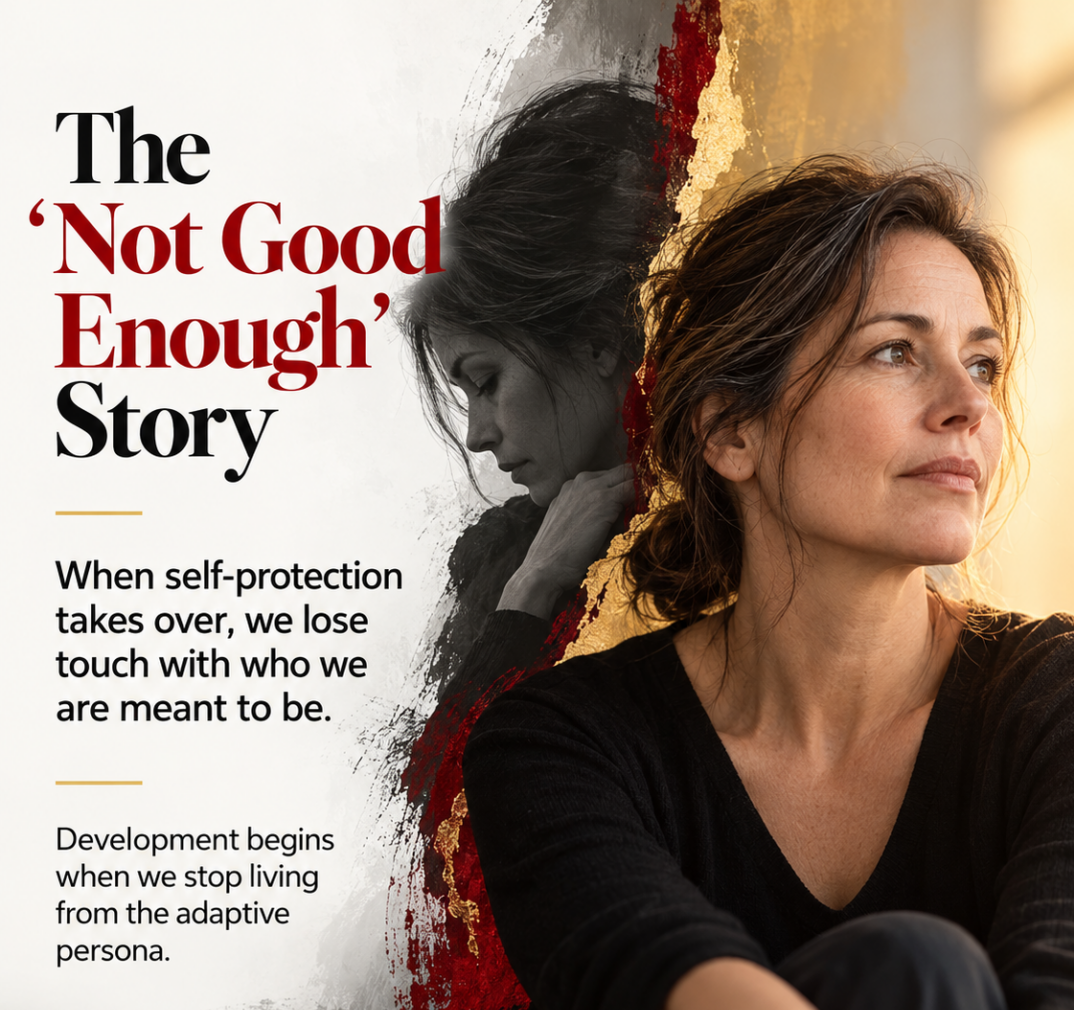
Most of us have a story we tell ourselves when something happens that leaves us feeling uncertain, exposed, rejected, criticized, or disappointed. Someone doesn’t answer a message, your boss suddenly wants a meeting, a friend seems distant, your partner is quiet, or you make a mistake at work. Before we know what any of it means, our brain starts filling in the blanks, and for many people the story quickly becomes some version of, “I did something wrong,” “I made them mad,” or “I should have handled that better.” Underneath those thoughts is often an older and more deeply rooted belief that says, “I’m not good enough.”
That belief can take many forms. Maybe it’s not smart enough, successful enough, lovable enough, capable enough, attractive enough, or interesting enough. Whatever form it takes, the story often begins early, when we’re trying to make sense of what’s happening in relationships with the people we depend on most.
Where the Story Begins
As children, we don’t have the developmental capacity to understand the complexity of our parents’ inner lives. We don’t know that a parent may be stressed because of work, unhappy because of their marriage, depressed because of their own history, or overwhelmed by circumstances that have nothing to do with us. We only know how they are behaving toward us, and when that behavior includes criticism, blame, withdrawal, shaming, or emotional unpredictability, we tend to make sense of it in a very personal way.
If a parent is upset, we assume we caused it. If they are disappointed, we believe we’ve failed. If they’re stressed and tell us we’re too demanding, too sensitive, too difficult, too selfish, or too much, we don’t have the ability to step back and question whether the problem belongs to them. Instead, we start adapting.
We become more careful about what we say, more attentive to their moods, more helpful, more agreeable, more successful, or less demanding. Over time, we come to believe that we must be what others need us to be to feel safe and connected. Over time, this becomes our primary way of self-regulation.
How the Self-Protective Brain Takes Over
Once the brain sees our primary caregivers as unsafe, our self-protective system becomes more vigilant. We start scanning to see how others are feeling before thinking about our own feelings. We think about how others want us to act and behave before speaking or acting. We constantly notice tone, expression, silence, withdrawal, irritation, disappointment, and subtle shifts in behavior because we’ve learned those cues may signal danger to the relationship.
Without realizing it, we begin to organize ourselves around preventing that danger. We may become highly responsible because being dependable brings approval. We may become pleasing because conflict feels risky. We may become accomplished because success brings recognition. We may become independent because relying on others feels unsafe. We may become emotionally contained because vulnerability feels too exposing.
The specific pattern differs from person to person, but the process is the same. We develop an adaptive persona that helps us protect ourselves and get our needs met. The more successful that persona becomes, the more we rely on it, and eventually we stop experiencing it as a strategy. It simply feels like who we are.
When Everything Starts to Feel Personal
One of the consequences of this developmental delay is that we continue to experience other people through the lens of ourselves. Instead of seeing another person as separate from us, with their own thoughts, moods, history, needs, and reactions, we make their behavior mean something about us.
If a friend becomes distant, we may immediately wonder what we did wrong. If a partner is quiet, we may feel compelled to fix the mood. If someone disagrees with us, we may experience it as rejection rather than difference. If another person succeeds, we may feel diminished rather than simply able to recognize their accomplishment.
This kind of self-referral can become so automatic that we don’t notice it happening. We assume that because someone else’s reaction affects us, it must also be about us.
From a developmental perspective, this means our relationship system is closed. We haven’t fully developed the ability to self-regulate in the face of someone else’s opinions, behavior, and emotions without making it about us.
Why This Can Look Narcissistic
The adaptive behaviors that come out of our story resemble narcissistic behavior, although the underlying intention is different. Instead of staying curious about what’s happening for the other person, we pull the experience back into our own story. Someone tells us about an achievement and, rather than simply sharing their excitement, we feel diminished and start comparing ourselves. Someone is disappointed because we’ve said no, and suddenly we’re telling ourselves we’re selfish, so we change our mind to relieve our own discomfort. We’re excluded from something and immediately create a story that we’re not liked, not good enough, or somehow less important, which then drives us to try harder to fit in. In each case, what belongs to the other person gets filtered through our story.
That’s the common thread. Self-referral keeps us trapped inside our own story because we don’t ask, “What’s going on with them?” and instead ask, “What does this mean about me?” The other person’s experience gets lost as our self-protective brain rushes to interpret everything through the lens of inadequacy, rejection, or blame.
Development allows us to move beyond that. We can let someone else’s success belong to them without experiencing it as evidence of our failure. We can tolerate another person’s disappointment without immediately deciding we’ve done something wrong. We can hear disagreement without experiencing it as rejection, and we can be left out without automatically turning exclusion into proof that we’re unworthy.
That’s what begins to open the relationship system and allow the authentic self to emerge. We become better able to recognize where the other person ends and where we begin, giving both people more room to exist as separate, whole individuals.
The Cost of the “Not Good Enough” Story
The real cost of the “not good enough” story isn’t simply insecurity. It’s that we begin organizing our lives around disproving it.
We work harder because success makes us feel more secure. We become indispensable because being needed reassures us. We take care of everyone because usefulness feels safer than simply being ourselves. We try to be attractive, accomplished, competent, agreeable, interesting, or impressive because each of those qualities seems to offer some temporary evidence that we’re okay.
The problem is that the reassurance never lasts for very long. If the original belief remains intact, every new situation becomes another opportunity to test whether we’re enough. Approval feels good, but we need more of it. Achievement feels satisfying, but only until the next comparison or disappointment. Being needed feels reassuring, but only while people continue to need us.
Our authentic self remains undeveloped because the story and beliefs underneath have never really changed.I think of this as a developmental delay because healthy development requires us to become increasingly capable of differentiating ourselves from other people. We need to learn that someone else can be unhappy without it being our fault, that another person’s disappointment does not automatically mean we have failed, and that someone else’s success does not diminish our own value. We also need to develop the capacity to tolerate uncertainty rather than immediately using an old story to explain what we do not yet understand.
When that development is delayed, we continue to manage the external world in much the same way we did when we were younger. We watch, anticipate, adapt, rescue, apologize, appease, defend, or try harder because these strategies once helped us feel safer. The behavior may look highly responsible or even admirable from the outside, but the underlying motivation remains connected to the fear that something bad will happen if we do not manage the situation correctly.
This is where the “not good enough” story can become particularly powerful. If we believe that our safety, belonging, approval, or connection depends on being better, doing more, or not making mistakes, we continue strengthening the very behaviors that keep the story alive. Instead of developing beyond the old pattern, we become increasingly skilled at functioning within it.
How This Makes Us Forget Who We Are Meant to Be
When so much of our attention is focused on protecting our worth, there’s very little room left for development. We’re too busy monitoring relationships, managing impressions, avoiding rejection, and maintaining the adaptive persona to notice what else in us wants to grow.
We may know how to achieve, but not how to rest. We know how to please, but not how to assert ourselves. We know how to care for others, but not how to receive. We know how to stay in control, but not how to tolerate uncertainty. We become highly developed in the capacities that protect us and less developed in the capacities that belong to the authentic self.
That’s why the “not good enough” story can keep us from becoming who we are meant to be. It keeps us in a developmental loop where we spend so much energy answering the question, “Am I okay?” that we never get far enough to ask, “Who am I meant to be?”
Remembering Who You Are Meant to Be
It’s easy to believe that our story feels true because it is wired into our brain and activates automatically. But that doesn’t make it the truth about who we are. It was shaped in relationships where we didn’t yet have the developmental capacity to understand what belonged to us and what belonged to someone else.
As adults, we can begin to see that distinction more clearly. We can notice when we’re assuming responsibility for someone else’s feelings, when we’re making comparison into a judgment about our worth, or when we’re reacting to criticism as though it confirms something fundamentally wrong with us.
Each time we recognize the old story instead of automatically living from it, we loosen the adaptive persona’s grip and redirect our energy into developing the capacities of the authentic self. This includes responding from who we are now, not from who we had to become to feel safe, accepted, or good enough.
That’s where remembering who you are meant to be begins.
Not by proving your worth, fixing yourself, or becoming someone new, but by recognizing that the adaptive persona was never meant to run your life forever. It helped you survive what you once needed to survive. Development asks you to stop living from your self-protective system and become you were always meant to be.