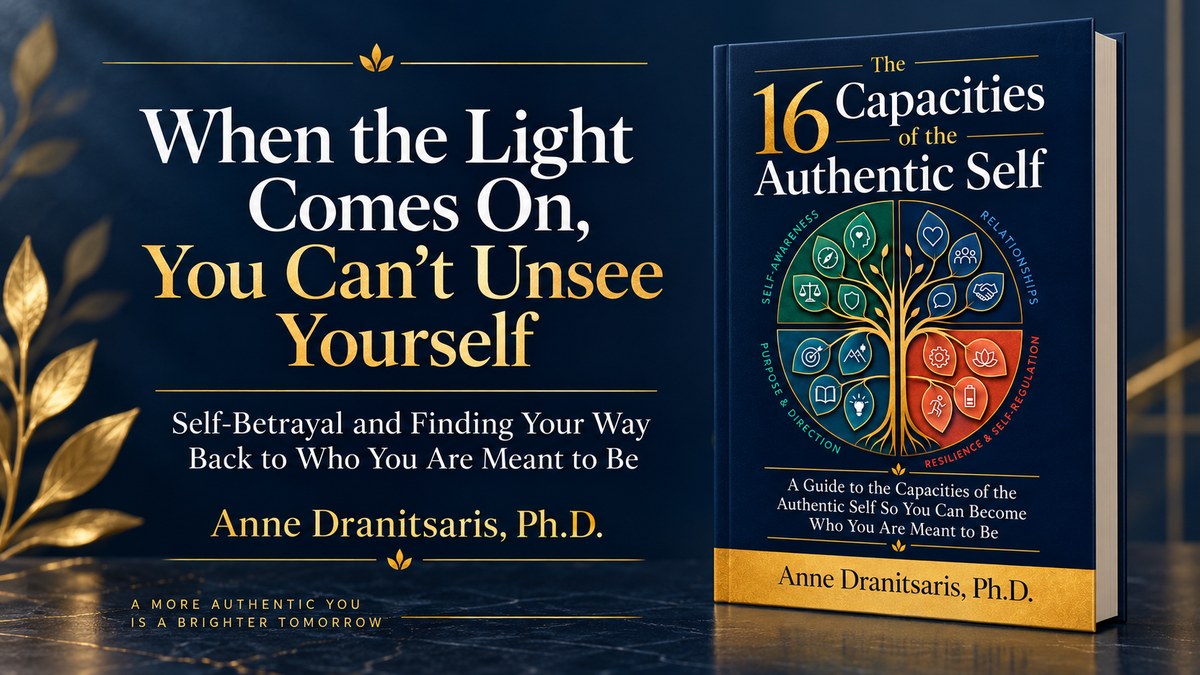
Self-Betrayal and Finding Your Way Back to Who You Are Meant to Be
For many of us, there comes a point when something about how we live our lives suddenly becomes clear in a way it never was before. You recognize how often you’ve kept quiet because someone else’s disappointment felt too uncomfortable, how many decisions you’ve made because financial security felt too important to risk, or how much of your life has been organized around being the dependable one who keeps everything going. What once seemed like personality, responsibility, or simply the way life had to be starts looking different.
You begin to see the behavioral pattern underneath it. You see the stories you’ve told yourself to make certain choices feel necessary, and you recognize how often you’ve put aside what you knew, felt, needed, or wanted because doing so helped you feel safe. That kind of awareness can feel both exciting and deeply uncomfortable. Once you see what you’re doing and understand why, it becomes much harder to keep telling yourself there’s nothing to see.
In my book, Who Are You Meant to Be?, I wrote about the idea that, at birth, we know what we came into the world to become. And then we forget. As we interact with our families and the world around us, our brain gets busy creating neural pathways based on what we experience, what gets reinforced, and what helps us feel secure and connected. That original knowing doesn’t disappear, but it moves outside conscious awareness and becomes what Christopher Bollas called the unthought known. Somewhere inside, we still know something about who we are, even when we no longer have easy access to it.
This is why it is so easy, in childhood, to abandon our authentic selves and, based on our conditioning, create an adaptive persona to ensure out psychological survival. Our authentic self knows who we are meant to be, but we are raised to become who others prefer us to be.
We Are Unaware That We’re Adapting
By adulthood, the person we’ve learned to be feels so natural that we don’t recognize how much adaptation is still at work. We say, “I’ve always been independent,” without wondering whether independence became necessary because depending on other people didn’t feel safe. We say, “I’m just ambitious,” without asking whether achievement became the way we learned to feel valuable. We describe ourselves as caring and generous without noticing how uncomfortable we become when our needs conflict with someone else’s.
None of those qualities is bad. Independence, ambition, generosity, competence, and responsibility are genuine strengths. The problem comes when we can’t step outside them because they’re no longer simply strengths. They’ve become part of the way we protect ourselves using our adaptive persona.
That’s how self-abandonment continues without us knowing it.
You may stay in a career you’ve outgrown because the income makes you feel secure and because being successful has become such a large part of how you know yourself. You may keep saying yes to family members because their disappointment still feels much harder to tolerate than your own resentment. You may repeatedly choose what makes sense on paper even when something inside you is telling you that the choice no longer fits.
For years, you may not experience any of this as self-betrayal. It simply feels normal.
Then the light of consciousness wakes you up.
The Moment You Know
I think there’s a real difference between doing something unconsciously and continuing to do it once you know what’s happening. This is the knowing-doing gap. Before the light of awareness, you may genuinely believe that you don’t have another choice. After awareness, the question changes. You may still make the same choice for a while, but you know now that it is a choice and that you are paying the price for self-abandonment.
You may be like many people who have spent years staying in a job because it gives you financial security. You’ve told yourself that leaving would be irresponsible, even though you haven’t felt alive in the work for a long time. Increasingly, you feel depleted. Then the light goes on, and you realize that you’ve compromised yourself because your salary has come to mean security, success, status, or recognition. It touches an old fear that you won’t be okay if you can’t control what comes next.
In my late thirties, I left a well-paying position as the director of a women’s clinic to open my own psychotherapy practice. By the time I finally decided, I could see the path clearly, but it took me more than a year to admit I had overstayed because the job felt safe. I knew my path was to strike out on my own, yet giving up a secure salary for a profession that wasn’t even widely recognized at the time brought up plenty of fear.
And it wasn’t only my own fear I had to deal with. Friends and family questioned why I would leave such a good job, along with the status that came with working in a Yorkville clinic in downtown Toronto. They were convinced I would never make the same amount of money on my own and couldn’t understand why I would give up something so secure to do something that wasn’t even to them legitimate.
Their fears landed in two very different ways. My authentic self pushed back hard because I knew this was my path. My inner rebel became even more determined to follow my own path and prove I could do it. At the same time, their certainty stirred up more doubt and anxiety, because they were voicing the very fears I was already struggling with myself. Fortunately for me, anxiety has always driven me to do it anyway, especially when it came to my career. It made me stop talking about what I was doing.
The choice, when we wake up and discover that we are living life from our adaptive persona and not our authentic self, is, “Who am I when I’m not being what other people want or need me to be?”
Who Am I When I’m Not Being What You Need Me to Be?
What resides outside of the safety of our comfort zone is uncertainty. Uncertainty triggers fear. And here is the choice. We can scurry back into the safety of our persona and our comfort zone, or we can tolerate uncertainty until it becomes our new normal. This means developing resilience, becoming curious about ourselves, and becoming less one-dimensional.
If you’ve spent your life being the dependable one, who are you when nobody needs you to fix anything? If you’ve organized yourself around achievement, what do you actually want when there’s no prize at the end? If you’ve spent years keeping everyone happy, what happens when your needs are inconvenient, or someone doesn’t like a decision you make?
I’ve seen people reach a stage in life where they’re very clear about what everyone else expects from them but surprisingly unclear about themselves. They know what their partner wants, what their children need, what their clients expect, and what their work demands. Ask them what they need, though, and the answer gets much harder.
That’s not because they don’t have needs. It’s because they’ve spent so long organizing themselves around the outside world that their own inner signals have become faint. This is where awakening becomes more than simply recognizing a pattern. It becomes a process of turning inward and asking what’s actually yours.
When Self-Abandonment Becomes Conscious
Once we become aware of how we have been abandoning and neglecting the development of our authentic self, we have the power to make different decisions, despite it creating anxiety. What once felt normal when we lived from our adaptive persona becomes recognizable as a repeated turning away from and betrayal of our authentic self and what we know, feel, need, or want in order to preserve security, approval, belonging, or a self-protective identity.
Growing pains aren’t just part of physical growth. Psychological development also comes with growing pains, and awareness can feel uncomfortable because it pushes us to behave in ways that aren’t natural or normal for our adaptive persona. We recognize that nobody is making us stay silent now, remain in the wrong job, keep pleasing everyone, or continue choosing security over what feels true. Developing agency and authority is our responsibility, not someone else’s. Just because we were disempowered as children, even through traumatic conditioning, doesn’t mean that we must keep projecting authority out onto others and wait to be told we are okay to be who we now know ourselves to be. The original adaptation began when we had very little choice, but as adults, we can eventually see that we have continued living by the same rules long after the circumstances changed.
This is where self-betrayal becomes a useful way of understanding what is happening. It isn’t about blaming ourselves for having adapted. It is about recognizing that once we know what we are doing, continuing to abandon the authentic self has a psychological cost.
Reparation and the Return to the Authentic Self
Once self-betrayal becomes conscious, reparation means resuming the development of the authentic self and gradually withdrawing the energy we’ve spent strengthening the adaptive persona. For years, sometimes decades, we may have become increasingly skilled at being the competent one, the responsible one, the achiever, the peacemaker, or the person who never needs much. Those ways of functioning may have helped us feel safe and successful, but they can also keep us investing in the same familiar parts of ourselves while other capacities remain underdeveloped.
What often gets in the way is how quickly awareness turns into self-attack. I hear people in my life, and clients I work with, become angry with themselves once they see their pattern. They ask, “Why do I keep doing this?” or “What’s wrong with me?” as though the answer is that they somehow failed to know better. But that kind of self-criticism only fuels the adaptive pattern. It keeps us focused on what is wrong with us instead of becoming curious about what still needs to develop.
The adaptive persona didn’t become dominant because there was something defective in us. It became dominant because it worked. It helped us navigate childhood, maintain attachment, get our needs met, and create enough psychological safety to function. The problem is that we kept strengthening it long after the original circumstances changed, while the self-actualizing capacities of the authentic self received far less attention.
Reparation means changing where the energy goes. Instead of getting better at pleasing, achieving, controlling, overfunctioning, or whatever our familiar strategy is, we begin developing the capacities of our authentic self that let us function differently. That is how the authentic self begins to take up more space in our lives. This doesn’t mean trying to recover an earlier version of ourselves or undo every choice we regret. It means recognizing that the authentic self still has capacities that are waiting for development.
For someone who has spent decades organizing life around other people’s expectations, that can lead to a very unfamiliar question: Who am I when I’m not being what everyone else wants or needs me to be?
That question goes much deeper than career, relationships, or lifestyle. It asks us to separate what is genuinely ours from what became necessary through adaptation. It also brings us back to the central idea in Who Are You Meant to Be?: becoming ourselves isn’t about inventing a new identity. It’s about becoming conscious of what has been left undeveloped and resuming the work of becoming more fully who we were meant to be.
Self-Awareness Is Where the Return to the Authentic Self Begins
The first step in ending self-abandonment is being able to see when it’s happening. We have to recognize when the adaptive persona is taking over, understand what we’re trying to protect, and become more aware of the needs, feelings, and capacities of the authentic self that have been pushed aside. That awareness changes our relationship with ourselves because we’re no longer automatically repeating a pattern without knowing why.
This is what the Striving Styles Personality System was designed to help us see. The assessment identifies the psychological needs that drive us, the strengths we rely on most naturally, what happens when we become self-protective, and which capacities of the authentic self need further development. Take the Striving Styles Personality Assessment.
I’ve also created a free guide, The 16 Capacities of the Authentic Self, with self-awareness questions that help you look more closely at the capacities you’ve already developed and the ones that may need more attention. Download The 16 Capacities of the Authentic Self
Remembering who you are meant to be isn’t enough if you continue investing all your energy in the adaptive persona. The deeper work is becoming aware of where you’ve been abandoning yourself, forgiving yourself for the ways you learned to survive, and resuming the development of the authentic self. That’s how you stop living only as the person you learned you had to be and begin becoming more of the person you were meant to become.