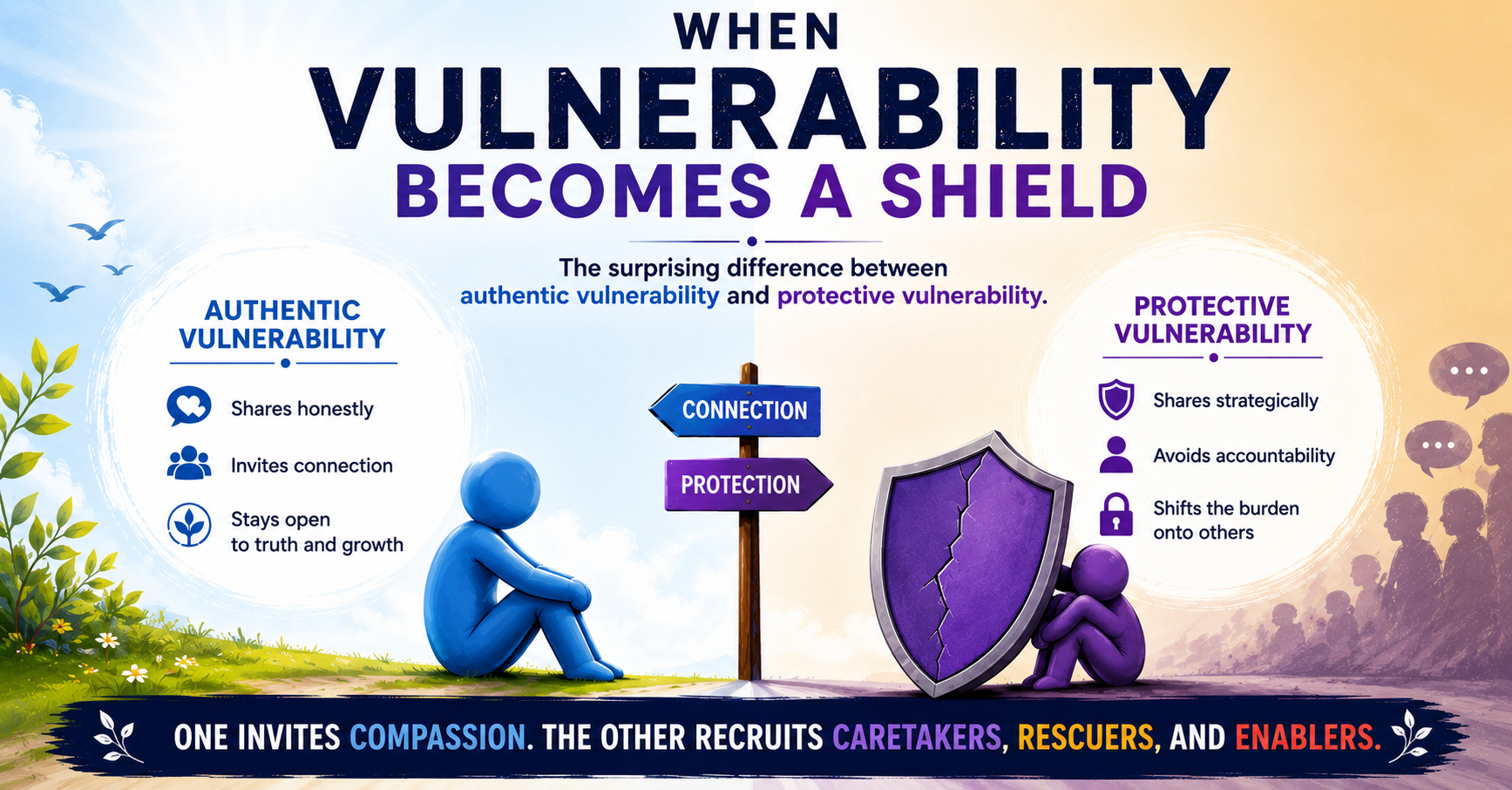
The surprising difference between authentic vulnerability and protective vulnerability.
Have you noticed how often the word “vulnerable” has entered our everyday conversations?
“I can’t have that conversation. It makes me feel too vulnerable.”
“I can’t come to the event. It feels too vulnerable.”
“I can’t tell them how I feel. I’m too vulnerable.”
“I can’t hear that feedback. It’s too triggering.”
On the surface, these statements sound emotionally aware. Sometimes they are. But increasingly, I wonder whether we have begun to confuse vulnerability with undeveloped capacity or self-protection.
The Dalai Lama said,
“To share your weakness is to make yourself vulnerable; to make yourself vulnerable is to show your strength.”
Notice what he didn’t say.
He didn’t say vulnerability excuses us from difficult conversations. He didn’t say vulnerability removes accountability. He didn’t say vulnerability requires other people to organize themselves around our discomfort.
Quite the opposite. He suggests that vulnerability is an expression of strength.
Yet I increasingly see vulnerability being used differently. Rather than revealing our humanity, it is sometimes used to signal that others must now protect us from discomfort. The message becomes, “I can’t do this; therefore, you need to adjust.”
That is a very different use of vulnerability.
One invites compassion.
The other expects caretaking, rescuing, enabling, and other adaptive behaviors.
Vulnerability Is Meant to Reveal, Not Protect
Real vulnerability is an act of strength. It takes courage to reveal what is tender, uncertain, afraid, or unfinished in us. To open ourselves up to uncomfortable emotions. It allows us to be seen without pretending we are more confident, capable, or unaffected than we are.
But notice what vulnerability requires.
Authentic vulnerability says, “This is hard for me, and I am willing to stay present.”
Protective vulnerability says, “This is hard for me, so you need to stop.”
The choice is between building tolerance to sharing intimately with another human being and closing the door to protect one’s humanity.
When Others Are Asked to Manage the Discomfort
This shift can happen quietly in relationships, families, friendships, and workplaces.
A partner raises a concern and suddenly has to reassure the other person instead of discussing the issue. A manager offers feedback and becomes responsible for calming the employee’s anxiety. A friend names a hurt and then apologizes for bringing it up. A family member sets a boundary and is made to feel cruel for having one.
In these situations, vulnerability no longer creates honesty. It redirects attention away from behavior, responsibility, or impact.
The person may genuinely feel exposed or overwhelmed. That part may be true. But when their vulnerability requires everyone else to edit themselves, lower expectations, avoid conflict, or become caretakers, the relationship stops being mutual.
Compassion becomes emotional management.
The Persona Can Co-Opt Vulnerability
This is where the adaptive persona comes in.
The adaptive persona is the part of us that learned how to self-regulate and manage difficult emotions to be loved, accepted, or in control. It may use pleasing, perfectionism, overfunctioning, withdrawal, control, helplessness, or emotional fragility to avoid shame, rejection, or discomfort.
Vulnerability can become one of its strategies for self-protection.
Instead of saying, “I don’t want to tolerate the discomfort,” the adaptive persona says, “You’re making me feel vulnerable.”
Instead of saying, “I don’t want to have this conversation,” the adaptive persona says, “It doesn’t feel emotionally safe.”
Instead of saying, “I don’t want to be accountable,” the adaptive persona says, “That feels too triggering.”
It sounds softer, but it still protects the self from responsibility, growth, or truth. The persona does not necessarily intend harm. It is trying to stay safe. But in doing so, it can place the burden of emotional regulation onto others.
The Authentic Self Develops Capacity
The authentic self relates to vulnerability differently.
It can say, “This is hard for me to hear,” without shutting down the conversation. It can say, “I feel exposed,” without requiring the other person to abandon their truth. It can say, “I don’t want to see what you are saying, because it means…,” without making someone else responsible for carrying what belongs to us.
This is why the capacities of the authentic self matter. We do not become authentic simply by sharing more. We become authentic by developing the inner capacities that allow us to stay grounded, emotionally steady, boundaried, expressive, and connected without abandoning ourselves or making others manage us.
These capacities are not automatic. They must be developed.
That is why I created The 16 Capacities of the Authentic Self, a free guide to help you recognize and strengthen the capacities that support real vulnerability, healthy boundaries, emotional steadiness, and honest connection.
Because vulnerability is not the problem.
The problem is when the adaptive persona uses vulnerability as a shield against the very growth the authentic self is trying to make possible.
Ready to become who you are meant to be in your relationships? Download the free guide today.