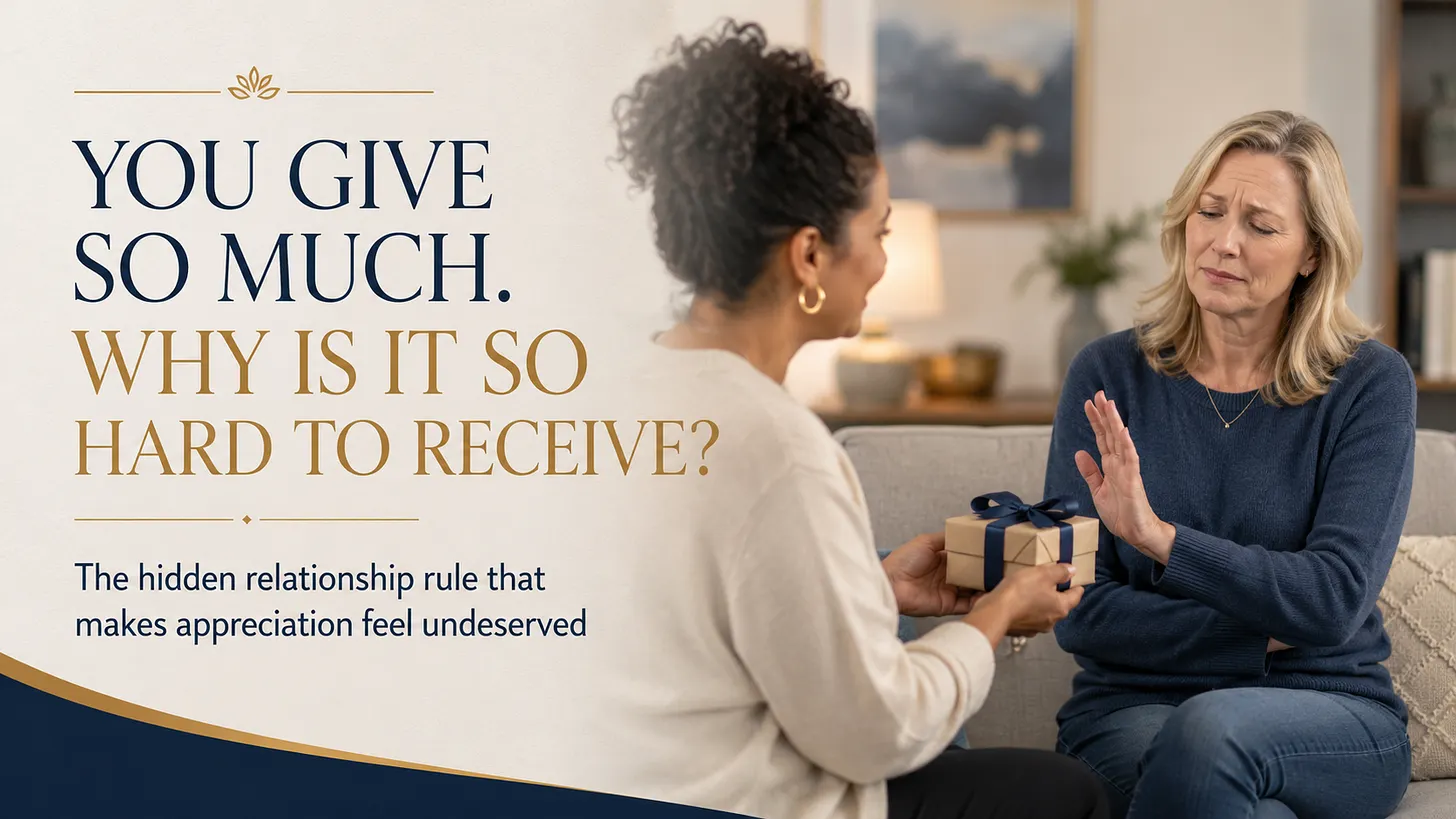
The hidden relationship rule that makes appreciation feel undeserved
Have you ever had this experience?
Someone tells you that you look beautiful, and you make a joke about the lighting.
Someone compliments your work, and you immediately point out what you could’ve done better.
Someone says they couldn’t have managed without you, and you respond, “Oh, it was nothing.”
Someone tells you how much you mean to them, and for a moment you feel touched. Then something in you shuts it down. You brush it off, give praise back, redirect the conversation, or quietly tell yourself they’re exaggerating.
You may spend years wanting to feel valued, appreciated, noticed, and loved, while being completely unable to receive those feelings when someone tries to give them to you. You feel hurt when people take you for granted, yet uncomfortable when they recognize how much you give. You long to matter, then shrink away the moment someone makes you the center of their attention.
It’s a painful contradiction: you’re starving for something you keep refusing to take in.
WHEN BEING LOVED MEANT BEING “GOOD”
Maybe you were the child who learned to be helpful. The one who didn’t make trouble. The one who could be counted on, who shared; adjusted; behaved; thought about other people’s feelings; and understood far more than a child should’ve had to understand.
Perhaps wanting attention got you called “selfish.” Perhaps feeling proud of yourself got you told not to get a big head. Perhaps needing reassurance, comfort, appreciation, or something just for you was treated as “demanding,” “ungrateful,” “spoiled,” “dramatic,” or “mean.”
So you learned to be “good.”
You learned to give instead of ask. You learned to praise others rather than draw attention to yourself. You learned to be useful, needed, dependable, supportive, generous, and undemanding. You learned that being loved meant making other people feel important and valued without asking them to make too much of you.
And you became very good at it.
You may be the person who remembers birthdays, notices when someone is struggling, encourages everyone else, gives thoughtful gifts, celebrates other people’s success, and makes sure they know how much they matter. You may be the colleague who contributes more than expected, the friend who is always there, the partner who carries the emotional load, or the mother who puts everyone first.
But what happens when someone tries to do the same for you?
WHY CAN EVERYONE ELSE BE SPECIAL EXCEPT YOU?
You know how to make other people feel important. You may be generous with compliments because you know exactly how hungry people are to be seen. You notice their strengths, beauty, courage, intelligence, and effort. You can say, with complete sincerity, “You should be proud of yourself,” and mean every word.
Yet when those words are directed at you, you can’t let them in.
Why?
Why can you recognize someone else’s gifts without thinking they’re “arrogant,” while acknowledging your own makes you feel “self-centered”? Why can someone else deserve appreciation simply because they matter, while you believe you have to earn yours through effort, generosity, usefulness, or sacrifice?
You may tell yourself you’re only being modest. You may insist you don’t need praise, don’t care about recognition, and don’t want attention. Yet there are moments when the hunger breaks through.
At these times, you let yourself feel the pain when your partner doesn’t acknowledge your tireless efforts. You acknowledge that you feel invisible when your family assumes you’ll keep giving without ever asking what you need. You might even share with a friend that you feel discouraged when your work is overlooked, your expertise is dismissed, or someone else receives the recognition you quietly hoped would come to you.
Often you find yourself judging and resenting people who seem comfortable receiving praise, attention, success, or admiration. They appear to take up space so easily, while something inside you still whispers that wanting to be seen is “selfish.”
YOU MAY BE TURNING AWAY THE VERY THING YOU WANT MOST
Perhaps someone has tried to love you in the ways you say you want.
They tell you how wonderful you are, and you don’t believe them. They appreciate what you bring, and you assume they’re simply being polite. They admire you, and you become embarrassed. They offer warmth, affection, recognition, or celebration, and rather than allowing yourself to feel it, you move quickly back into giving.
You cook the meal. You buy the gift. You provide the support. You help with the problem. You focus on them again.
Receiving praise can feel almost unsafe when your identity has been built around being the one who gives. The moment someone makes you important, your old relationship rules begin to protest:
Don’t be “selfish.”
Don’t think too much of yourself.
Don’t expect attention.
Don’t need applause.
Do something for them instead.
You may have become so identified with the person who gives that receiving feels like a betrayal of who you’re supposed to be. It’s easier to be needed than admired. Easier to be thanked for helping than loved for simply being you. Easier to feel deserving when you’ve exhausted yourself in service of someone else.
And so the praise never reaches the part of you that aches for it.
THE HUNGER THAT NEVER GOES AWAY
When you can’t receive appreciation, no amount of it ever feels like enough.
People may compliment you, value you, rely on you, admire you, or tell you how much you mean to them. Yet inside, you continue to feel unseen. Their words disappear before they have a chance to settle. You dismiss them, distrust them, or replace them with all the ways you believe you’re still falling short.
Criticism lands immediately. Praise barely touches the surface.
One unkind comment can stay with you for years. A hundred expressions of appreciation can be brushed aside in seconds.
Then you wonder why you keep feeling empty. You may decide people don’t care enough, don’t value you enough, or don’t understand what you bring. Sometimes that may be true. But sometimes people have been trying to tell you, and the adaptive persona that once protected you from being called “selfish” still won’t allow you to believe them.
This is one of the saddest consequences of living by the rule that love must be earned through giving. You may have people in your life who see your value, while you remain emotionally starved because being valued isn’t a role you’ve learned how to occupy.
WHAT IF YOU DIDN’T HAVE TO DEFLECT?
What would happen if, the next time someone praised you, you didn’t make yourself smaller?
What if you didn’t explain why your accomplishment wasn’t that impressive? What if you didn’t rush to return the compliment? What if you didn’t turn your beauty, talent, generosity, intelligence, courage, or success into something ordinary so no one could accuse you of being “full of yourself”?
What if you simply said, “Thank you. That means a lot to me.”
Would that feel warm? Or would it feel almost unbearable?
You might feel exposed, as though you’re standing in a light you were trained to avoid. You might feel guilty, embarrassed, or afraid that accepting praise means you’re “vain” or “self-important.” You might want to quickly prove that you’re still generous, still humble, still the person who gives more than she takes.
But receiving appreciation doesn’t make you “selfish.” Enjoying being seen doesn’t make you “vain.” Letting someone value you doesn’t take anything away from them.
You’ve spent enough of your life making room for everyone else to feel important.
There’s room for you too.
YOU’RE ALLOWED TO TAKE IT IN
You don’t have to stop being generous, caring, thoughtful, or supportive. These may be beautiful parts of who you are. The question is whether they come from your authentic self or from a rule that tells you your value depends on what you give to others.
You weren’t meant to live on emotional crumbs while offering everyone else a feast.
You weren’t meant to spend your life longing to be appreciated while apologizing whenever appreciation comes your way.
And you were never meant to believe that love requires you to make yourself smaller so other people can feel comfortable receiving all that you bring.
The next time someone offers you a compliment, resist the urge to make it disappear. Pause before the old rule takes over. Let yourself notice the discomfort. Let yourself feel the longing underneath it.
And perhaps, instead of saying, “It was nothing,” you can allow yourself to consider a very different possibility.
It was something.
You are someone worth noticing.
You can open up and delight in the praise you’ve been longing for.
Are Your Relationship Rules Ruining Your Happiness? explores the unconscious rules that shape what you give, what you accept, and what you continue to deny yourself in relationships. It helps you recognize the adaptive persona that keeps you living for others, so you can begin developing relationships where you no longer have to disappear to be loved.