Category: Relationship Rules

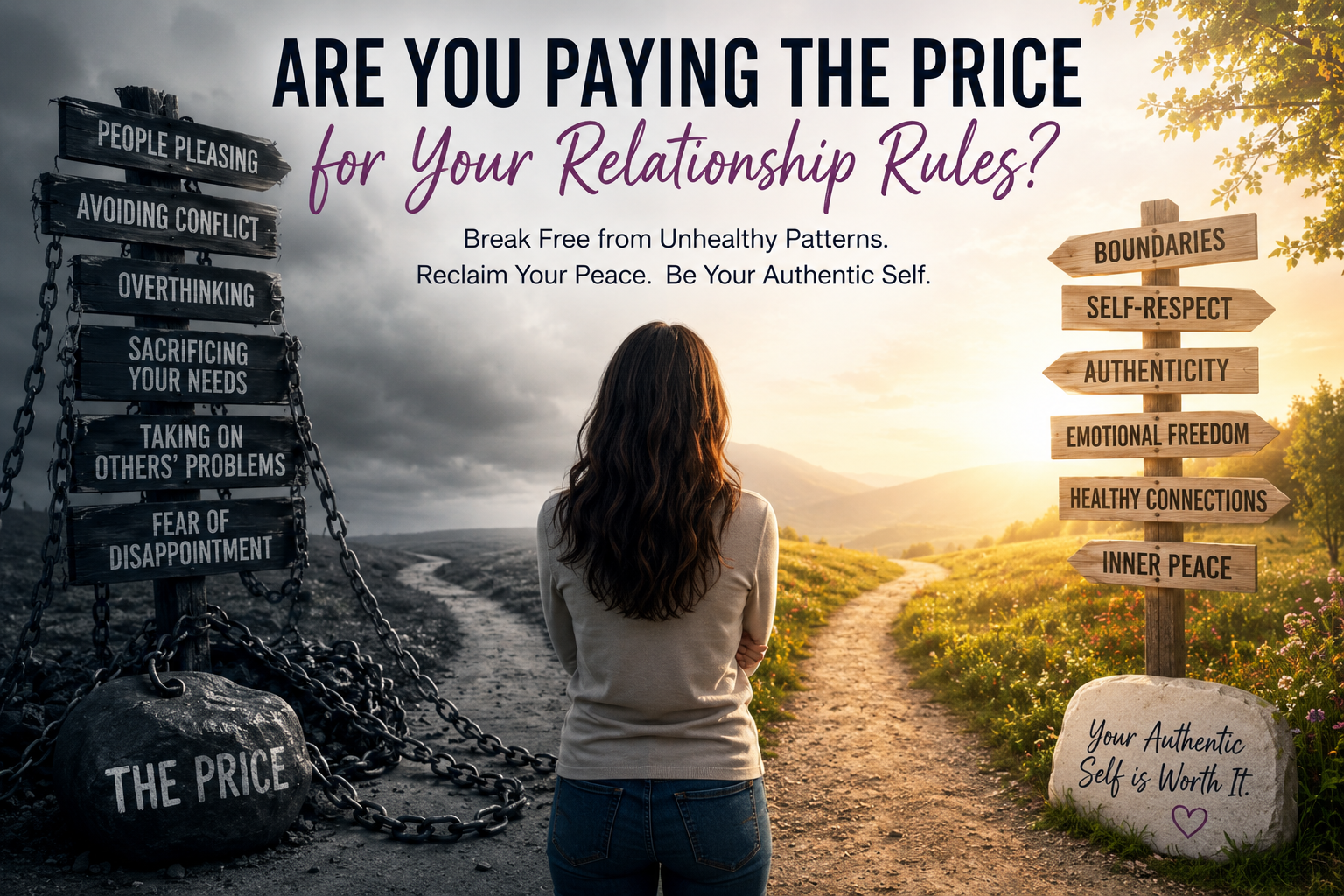
  • Stop Paying the Price for Your Relationship Rules!

    Stop Paying the Price for Your Relationship Rules!

    Most people never stop to ask what their relationships are costing them.

    Not financially. Emotionally.

    We become so accustomed to accommodating, overthinking, rescuing, avoiding conflict, walking on eggshells, or carrying the emotional weight of a relationship that it simply feels normal. We tell ourselves, “This is just who I am.”

    But what if it isn’t?

    What if the very relationship rules you developed to protect your relationships are quietly costing you your peace, confidence, health, and sense of self?

    The Hidden Costs You Don’t See

    Every relationship operates according to a set of unwritten rules.

    Some are healthy. They create trust, respect, and emotional safety.

    Others were formed years ago as survival strategies. They helped you gain approval, avoid rejection, reduce conflict, or feel needed. Over time, these strategies became automatic.

    You may not even realize you are living by relationship rules such as:

    I should keep everyone happy.
    This rule helps regulate anxiety by giving you something to manage. If everyone seems okay, you can feel okay. The cost is that you become responsible for the emotional climate around you, even when other people’s feelings are not yours to fix.

    I should never disappoint anyone.
    This rule reduces the anxiety of conflict, rejection, or disapproval. You avoid the discomfort of letting others down by overexplaining, overgiving, or saying yes when you mean no. The cost is that your own needs, limits, and preferences disappear.

    I should fix other people’s problems.
    This rule creates a sense of control when someone else is struggling. Helping may feel loving, useful, or necessary, but it can also be a way to calm your own discomfort. The cost is that others do not develop their own strength, accountability, or capacity.

    I should assume I have done something wrong if someone is upset.
    This rule helps you make sense of emotional tension quickly. Rather than tolerating uncertainty, you turn inward and blame yourself. The cost is that you may apologize, appease, or take responsibility for things that do not belong to you.

    I should put my needs last.
    This rule lowers the anxiety of being seen as selfish, demanding, or difficult. It may help you feel safe in relationships because you are not asking too much. The cost is resentment, exhaustion, and a quiet disconnection from your own authentic self.

    These rules don’t simply influence your relationships. They shape your identity.

    Following Relationship Rules at Your Expense

    Living by these relationship rules has other costs in addition to those mentioned above.

    You may find yourself:

    • Feeling emotionally exhausted after every interaction.
    • Becoming resentful while continuing to say yes.
    • Losing confidence in your own judgment.
    • Feeling responsible for everyone else’s emotions.
    • Staying in relationships that no longer feel healthy.
    • Constantly questioning yourself after conversations.
    • Struggling to know what you actually want.

    The greatest cost is often the loss of yourself.

    When your energy is devoted to managing other people’s feelings, there is very little left for discovering who you really are.

    Why It’s So Difficult to Change

    Many people believe they simply need stronger boundaries or more confidence.

    Those can certainly help, but they rarely solve the real problem.

    The behaviours are being driven by your adaptive persona, the part of you that learned how to gain acceptance, avoid rejection, and create emotional safety.

    As long as your persona believes these rules keep you safe, it will continue to follow them, even when they are creating pain.

    This is why insight alone rarely creates lasting change.

    There Is Another Way

    Healthy relationships do not require you to abandon yourself in order to maintain connection.

    As you strengthen the capacities of your authentic self, you become more comfortable allowing others to experience disappointment, frustration, or the natural consequences of their choices. You no longer feel compelled to regulate their emotions at the expense of your own wellbeing.

    Relationships become less about managing everyone else and more about showing up honestly, respectfully, and authentically.

    That is where genuine intimacy begins.

    If you have been wondering why the same relationship patterns keep repeating, perhaps it is time to ask a different question.

    Are you paying a price for the relationship rules you’ve been living by?

    Awareness is where change begins. Once you recognize the rules that have been shaping your relationships, you can begin replacing them with healthier ways of connecting that allow both you and the people you love to grow.

  • Who’s Showing Up in Your Relationships?

    Who’s Showing Up in Your Relationships?

    Do you know which version of you most often shows up in your relationships?

    It’s a simple question, but it isn’t an easy one to answer honestly. Most of us know who we are and even how we would prefer to behave. That doesn’t mean that it’s the person we form relationships with. The self who shows up in a relationship depends far more on whether we arrived in adulthood with a secure attachment.

    You may have noticed how quickly it happens. At home, at work, in friendships, with family, and even with clients, you can shift almost as quickly as you change your clothes. A familiar way of being takes over before you even realize what you are doing.

    You might have had a bad day at work and spent the whole drive home looking forward to unwinding with your partner. But the moment you walk through the door, you pick up the emotional tone in the room. Something feels off. Without stopping to ask what you need, you become the supportive one. You comfort them, reassure them, offer to make dinner, suggest they relax, and maybe even offer a massage. In a matter of minutes, your own need to decompress disappears behind the role your persona knows how to play.

    The same thing happens at work. You may walk into a meeting ready to contribute, but the moment someone questions your idea or seems unimpressed, your attention shifts. You stop being connected to what you know and start managing how you’re being received. You explain more than you need to. You soften your point. You look for approval. You offer to do extra work. You make yourself useful, so no one can question your value. By the time the meeting ends, you’ve survived the experience with your image intact instead of simply participating in it.

    Those familiar behaviors belong to your adaptive persona, and this is how it works. It doesn’t ask, “What do I feel?” “What do I want to express?” or “What do I need right now?” It asks, “What do I have to become to keep this emotionally safe?”

    THE AGENDA IS SAFETY, NOT AUTHENTICITY

    Your adaptive persona isn’t your authentic self. It is the version of you that developed to regulate your own emotions and manage others’. Its agenda is safety, not authenticity. It learned how to reduce tension, prevent escalation, stay acceptable, manage uncertainty, and keep you functioning when your nervous system didn’t feel secure.

    So the real question is not only, “Who am I in this relationship?” It is, “Who do I become when I don’t feel safe to be myself?”

    At home, do you become the one who keeps things calm because tension feels unbearable? Do you carry the emotional weight because it gives you a sense of control? Do you become overly responsible because someone has to hold everything together?

    At work, do you become the one who proves, performs, overdelivers, hides uncertainty, avoids asking for help, or waits for recognition to confirm that you matter?

    These patterns can look functional from the outside. Other people may even reward them. They may see you as dependable, capable, generous, professional, loyal, or easy to work with. But inside, you know when you are not fully there as yourself. You know when you are managing the room instead of being in the room.

    THE RULES RUNNING BENEATH THE SURFACE

    Your adaptive persona does not operate randomly. It is run by rules.

    These rules tell the persona what to do when emotional safety feels uncertain. They tell it when to become agreeable, when to stay quiet, when to rationalize, when to take care of everyone, when to withdraw, when to overfunction, and when to hide what you actually need.

    You may not consciously hear the rule in your mind, but you live it in your relationships. It shows up in the moment you soften your truth to avoid tension, offer help before anyone asks, work harder to be recognized, or become self-sufficient when you really want support.

    The rule is often disguised as responsibility, kindness, patience, independence, ambition, loyalty, or strength. But underneath the behavior, the persona is trying to keep you regulated. It is trying to lower anxiety, prevent conflict, manage another person’s reaction, avoid disappointment, and protect you from feeling emotionally exposed.

    That is why the same pattern follows you into different relationships. The people may change, but the rule remains active because it lives inside the adaptive persona. Until you can see the rule, the persona keeps deciding who you become.

    WHY YOU DON’T FEEL SAFE TO BE YOU

    If you’ve ever wondered what’s still holding you back after all the work you’ve done, the question is: Why does it still feel unsafe to be my authentic self in relationships?

    Most often, it is because more of your developmental energy went into staying safe during your formative years than into building the relationship capacities of your authentic self. You may have experienced trauma, have ADHD, or you may be a survivor of childhood neglect or abuse.

    Your persona learned how to change your behavior to self-regulate, manage others’ emotions, and preserve connections, but that does not mean you developed the inner capacities needed to show up as yourself in relationships.

    This all explains why your adaptive persona is so strong.

    It is also the call for you to pick up your development where it left off and become who you are meant to be in relationships.

    My book, Are Your Relationship Rules Ruining Your Happiness? will help you understand the rules your adaptive persona has been living by, why those rules keep shaping your relationships, and how to begin building the capacities that allow your authentic self to show up.

    NOW AVAILABLE ON AMAZON: Are Your Relationship Rules Ruining Your Happiness? How Unconscious Relationship Patterns Sabotage Love—and How to Break Free. 

  • Undeveloped Relationship Capacities Leave Us Vulnerable to Narcissists

    Undeveloped Relationship Capacities Leave Us Vulnerable to Narcissists

    You may not realize you’re being pulled back into an old relationship pattern at first. In the beginning, a narcissistic partner can feel exciting, certain, confident, and intensely focused on you. They may make you feel chosen in a way that satisfies something very young inside you, especially if you grew up working hard to be noticed by a narcissistic or emotionally self-absorbed mother.

    That early attention can feel like the moment you’ve been waiting for, the moment when you feel seen, desired, wanted, and special. But slowly, almost imperceptibly, their behavior shifts, attention is withdrawn, and your insecure attachment gets activated. You want the feeling back, and you are wired to adapt yourself to work at getting it.

    Now the relationship becomes organized around them. Their emotions regulate how you feel. Their needs become the priority. Their version of reality begins to crowd out your own. Before long, you’re explaining yourself, softening your words, apologizing for things you didn’t do, and trying to get back to the person they seemed to be at the beginning.

    Then one day, sometimes after years of trying harder, something inside you recognizes the pattern: This feels just like my relationship with my mother.

    THE RULES YOU LEARNED TO SURVIVE

    When you grow up with a narcissistic mother, you don’t simply learn about love. You learn the rules of attachment. You learn what keeps you safe and regulated and what puts it at risk. You learn your needs and feelings are secondary to theirs and what you must do to quiet the pervasive anxiety and fear of abandonment inside you.

    You may have learned to read her face before you spoke, to sense her mood before you asked for anything, and to make yourself useful before you asked to be seen. You may have learned that your role was to soothe, admire, agree, adapt, and not need too much. Over time, these adaptations become unconscious relationship rules. They tell you, without words, that a relationship requires you to manage the other person’s emotions while minimizing your own.

    So when a narcissistic partner appears, the pattern doesn’t necessarily feel wrong. It feels known. Your unconscious relationship pattern already knows what to do there.

    WHEN YOUR PARTNER BECOMES YOUR MOTHER

    This is the painful part. You’re no longer a child, yet you are living the relationship pattern you developed all those years ago. You try to make your partner proud the way you tried to make your mother proud. You try not to disappoint them the way you tried not to disappoint her. You keep hoping that if you explain yourself better, love them more carefully, give them more understanding, or carry more of the relationship, they’ll finally soften and see you.

    Instead, you feel smaller. You feel yourself shrinking around their reactions. You feel the old ache of trying to matter to someone who keeps making themselves the center. The adult relationship becomes a stage where the child in you keeps trying to finish the original story with a different ending.

    WHY BLAMING THEM ONLY TAKES YOU SO FAR

    Of course, you blame them. They may have dismissed your feelings, distorted conversations, withheld affection, blamed you for their behavior, or made you responsible for their unhappiness. Naming the harm matters because it helps you stop pretending the relationship was healthier than it was.

    But blame can also keep you attached to the narcissistic person. You keep studying them, their motives, their wounds, their behavior, and their capacity to change. Meanwhile, the deeper question waits beneath the surface: What relationship rule in me made this feel like something I had to keep working for?

    That question isn’t about self-blame. It’s about bringing the focus back to you, where your development can resume. It helps you see where the development of your authentic self was interrupted, where you learned to protect yourself through an adaptive persona, and where you began abandoning your own needs, feelings, limits, and truth in order to stay attached.

    This is the part that matters most. The work isn’t about understanding them better, excusing them, or waiting for them to become someone they’re not. It’s about understanding what happened inside you that made their pattern feel familiar, powerful, or necessary.

    When you begin developing the relationship capacities of your authentic self, you no longer have to organize yourself around another person’s moods, needs, approval, or version of reality. You stop using the adaptive persona to hold the relationship together, and you begin learning how to stay connected to yourself.

    It’s about you, not about them.

    BUILDING THE SELF THAT DOESN’T HAVE TO REPEAT THE PATTERN

    Undeveloped relationship capacities leave us vulnerable because they keep us organized around the other person instead of anchored in ourselves. When self-trust is underdeveloped, you doubt what you know. When healthy entitlement is underdeveloped, you feel guilty for having needs. When boundaries are underdeveloped, you confuse endurance with devotion. When emotional regulation is underdeveloped, the fear of losing the relationship can feel more frightening than the pain of staying in it.

    Changing your relationship pattern begins when you can see the pattern without shaming yourself for having lived it. You weren’t foolish. You were attached through survival strategies that helped you manage your fear and anxiety about being rejected or abandoned.

    The work now is to develop the authentic self-capacities that allow you to stay present to your needs, your limits, your truth, and your right to be in a relationship where you don’t have to disappear to be loved.

    Little by little, the familiar stops feeling like home. It starts feeling like the past, and that is when you become free to choose something different.

    Learn more about the 16 capacities of the authentic self in Are Your Relationship Rules Ruining Your Happiness?

  • ARE YOU CARRYING THE RELATIONSHIP INSTEAD OF BEING IN IT?

    ARE YOU CARRYING THE RELATIONSHIP INSTEAD OF BEING IN IT?

    How unconscious relationship rules keep you overfunctioning, waiting, and losing yourself

    A relationship can survive for years on the effort of one person. The devastating moment comes when we finally realize we are the only one keeping it alive.

    You are the competent one and don’t give up easily. You try to understand your partner’s behavior, make room for their limitations, and keep hoping the relationship will become more satisfying once they change their behavior.

    You initiate the important conversations because your partner avoids them. You monitor their moods so you know when it is safe to bring something up. You carefully choose your words, trying to prevent defensiveness or withdrawal. You explain away disappointing behavior because they have been stressed, hurt, busy, overwhelmed, or simply unable to give more. When conflict happens, you’re the one who reflects, apologizes, repairs, or tries again.

    Over time, what began as patience becomes a job. You aren’t in the relationship; you’re managing it. The relationship stays intact because you keep compensating for what is missing.

    And yet, you still believe it’s about a deficit in you. That if you just find the right words, become more understanding, lower your expectations, or remain patient a little longer, you will finally have the relationship you have been working so hard to create.

    WHEN YOU KEEP WAITING FOR THE PERSON THEY WERE AT THE BEGINNING

    You may look back and say, “I know they have it in them to be loving, attentive, interested, and emotionally available.” They were like this at the beginning of the relationship.” And they probably were. In the beginning, they may have listened intently, made you feel important, shown affection freely, pursued you with enthusiasm, and appeared to share your values and expectations about relationships. You did not imagine that version of them. You experienced it.

    The painful question is whether that person represented their capacity for a mature relationship or the image they needed you to believe in so you would choose them. For some partners, the beginning of the relationship is a period of heightened effort, when they are motivated to win your attention, admiration, loyalty, or commitment. Once they feel secure that you are invested, the attentiveness fades, the emotional effort declines, and you are left wondering what happened to the person you fell in love with. You keep waiting for them to return, because the relationship began with enough evidence to convince you that more is possible.

    This is what makes a bait-and-switch relationship so difficult to leave or even see clearly. You are not only attached to the relationship as it is; you are attached to the memory of how it felt in the beginning and the hope that, with enough patience, love, understanding, or effort, you can bring that person back. But a partner’s early behavior matters less than the pattern they sustain over time. The real relationship is not the one they offered as they drew you in. It is the one you are living in now.

    And you believe you must have done something for them to withdraw love and you set about to get it back.

    THE HIDDEN RULE THAT KEEPS YOU TRYING

    People who carry relationships don’t always recognize what they are doing at first. Their behavior can feel natural, responsible, loving, or mature. They may take pride in being the person who can forgive, understand, accommodate, remain calm, or see the other person’s perspective.

    Beneath that effort, however, is a belief that drives a number of unconscious relationship rules:

    “If I work hard enough at this relationship, they will love me again the way they did at the beginning.”e

    That rule may show up in many “should” statements:

    I should be more understanding.

    I should not expect too much.

    I should give them time.

    I should stay calm, and they will eventually listen.

    If I am patient enough, they should be interested in me again.

    I should stop pushing for what I want, and things will get better

    These rules don’t begin in adult relationships. They develop much earlier, when a child learns to manage their own emotional security by paying close attention to and managing others’ feelings, needs, reactions, and availability. Rather than developing the capacity to remain connected to their own emotional reality while expecting mutuality from others, they adopt an adaptive persona that helps them maintain stable relationships at the expense of their own happiness.

    They become the capable one, the accommodating one, the understanding one, the forgiving one, or the one who does not need very much.

    This persona may help them function successfully in many areas of life. They can be dependable, responsible, insightful, generous, and highly attuned to others. In intimate relationships, however, the same pattern can keep them invested in trying to make a one-sided relationship work.

    THE RESENTMENT THAT BUILDS WHEN YOU KEEP ACCOMMODATING

    People who carry relationships often feel guilty when resentment begins to surface. Rather than seeing their anger or disappointment as a response to an unequal relationship, they are pulled back into the conclusions they formed in childhood: I’m selfish for wanting more. I’m mean for being angry. I’m bad for having needs. I’m wrong for expecting anything from someone else. These are the beliefs that took hold when their needs were criticized, dismissed, or met with the same hurtful names they may still silently call themselves today.

    Once those old feelings are triggered, their unconscious relationship rules move quickly to silence their protest. They tell themselves they should be more loving, more compassionate, more patient, more accepting, and less demanding. Instead of questioning why the relationship requires so much effort while giving so little back, they turn the question on themselves. They interpret their irritability, withdrawal, criticism, or emotional exhaustion as evidence that they are becoming the problem.

    But resentment is a normal response when you have been giving more than you genuinely want to give while receiving less than you need to remain emotionally engaged. It is the feeling that emerges when your needs, limits, and disappointments have been pushed aside for too long. Yet the adaptive persona does not allow resentment to speak clearly. It silences the protest by repeating the same accusations you heard as a child, teaching you to feel ashamed of the very feelings that are trying to tell you something is wrong.

    Resentment is not healed by becoming better at tolerating deprivation or more skilled at explaining away another person’s lack of participation. It begins to change when you stop judging yourself for having reached your limit, face the imbalance honestly, and recognize that it is not your responsibility to keep making up for what the other person is unwilling or unable to bring to the relationship.

    WAITING FOR SOMEONE TO BECOME THE PARTNER YOU NEED

    There is often a great deal of waiting in a relationship carried by one person.

    You wait for your partner to mature, heal, become less defensive, prioritize the relationship, communicate more openly, show more affection, or finally understand how deeply their behavior has affected you.

    You may hold tightly to the moments when they do show up: a heartfelt conversation, an apology, an affectionate weekend, a thoughtful gesture, or a renewed promise. Those moments feel like evidence that the relationship you want is possible. They can sustain hope for months or years.

    The difficulty is that meaningful change does not consist of brief periods of increased effort after you have reached your limit. It is demonstrated through consistent participation, accountability, emotional engagement, and a willingness to develop the capacities required for a mutual relationship.

    When those things do not happen, waiting becomes another way of abandoning yourself. You remain loyal to the possibility of who your partner could become while becoming increasingly disconnected from the reality of what your relationship actually is.

    LOVE SHOULD NOT REQUIRE YOU TO DISAPPEAR

    Carrying a relationship slowly changes how you experience yourself. You may become more anxious, watchful, resentful, discouraged, or emotionally flat. You may lose confidence in your perceptions because your concerns are repeatedly dismissed or left unresolved. You may stop bringing up what matters because the effort feels pointless. You may become so accustomed to managing the relationship that you no longer ask whether it nourishes you, challenges both partners to grow, or allows you to exist as a full person within it.

    When you have carried a relationship for too long, you can lose sight of your own experience. You become focused on keeping the peace, avoiding disappointment, and getting through one more difficult conversation. Your needs grow quieter, while your resentment, loneliness, and exhaustion grow stronger.

    Love is not supposed to require you to disappear so the relationship can survive. It should not depend on you overlooking what hurts, accepting what never changes, or carrying responsibilities that belong to two people.

    You deserve more than being needed to keep a relationship functioning. You deserve a relationship in which you are seen, considered, responded to, and met with the same willingness to grow that you bring.

    There comes a point when the question is no longer, “How do I make this relationship work?” It becomes, “Why am I working so hard to sustain a relationship that is not giving me what I need?”

    Are Your Relationship Rules Ruining Your Happiness? helps you recognize the unconscious rules that keep you overfunctioning, tolerating, and waiting for change. It offers a path back to yourself so you can stop compensating, adapting, and abandoning yourself in the hopes your partner will become who you need them to be.

    The book helps you identify the unconscious rules that keep you overfunctioning, tolerating, compensating, and waiting so you can begin building relationships from your authentic self rather than an adaptive persona.

    Available now on Amazon.

  • How I Accidentally Trained My Partner to Underfunction

    How I Accidentally Trained My Partner to Underfunction

    Are you mothering your partner, then blaming him for needing a mother?

    Have you ever looked at your partner and thought, “I feel like I’m raising another child”?

    Or maybe you’ve said it out loud in frustration: “I feel more like your mother than your partner.”

    It’s a painful thing to admit when you love someone. You don’t want to sound superior. You don’t want to be critical. You don’t want the relationship to feel like one person is the adult and the other is being managed.

    Yet this is exactly where many relationships end up.

    One person, usually the woman, becomes the one who notices, remembers, organizes, reminds, anticipates, follows up, and keeps things moving. Their partner becomes dependent, avoidant, or disengaged. Then both people get locked into an unconscious relationship pattern neither of them likes. They are no longer relating from their authentic selves but from adaptive personas created in childhood to self-regulate and keep the relationship feeling safe.

    I write about this and other relationship patterns in Are Your Relationship Rules Ruining Your Happiness? because relationship unhappiness and conflict are rarely just about chores, forgetfulness, or who does more around the house. Beneath the pattern are unconscious relationship rules that tell us who we have to be and who our partner should be in order to feel secure, valued, needed, or loved.

    The Moment I Saw What I Was Doing

    I remember realizing this early in my own marriage. There were things my husband was perfectly capable of doing for himself, yet I kept stepping in. I reminded him, organized things for him, thought ahead for him, organized activities for his children, solved things before he had to deal with them, and then felt quietly resentful that he wasn’t carrying his weight.

    At first, I told myself I was being helpful. I was being loving. I was making life easier for everyone.

    But that wasn’t the whole truth.

    Underneath my helpfulness was an unconscious relationship rule:

    “I should step in because I have more capacity.”

    That rule sounded reasonable to me. I was organized. I could multitask. I could see what needed to be done before other people noticed. I was responsive, agile, and willing. I could get things moving quickly. I could prevent unnecessary problems. I could keep everything functioning.

    The trouble was that this rule didn’t just shape my behavior. It shaped the relationship.

    Without realizing it, I was participating in an unconscious relationship contract. In my contract, he was supposed to be my partner and match my skills, initiative, values, and capacities. The contract was unspoken; he had never agreed to it, and yet, I felt let down when he broke one of the rules.

    Instead of discussing the contract and rules (I didn’t know anything about unconscious contracts and relationship rules at the time), I stepped in more, and the relationship adapted to my capacity, which frustrated me even further. I increasingly took his behavior personally, became angry at him for not respecting me and using me, etc. Fortunately, I had an insightful therapist who pointed out that I was enabling instead of leading and that I needed to step up in a different way. Not expecting him to know without discussion. Not showing him what he should do, but actually telling him what he must do and what I would no longer do.

    That was challenging for me. To see how I had set him up to depend on me to be in charge. I was doing things for him that he could have done himself, then resenting him for letting me do them. I was treating him as though he needed managing, then feeling hurt that he wasn’t showing up as an adult.

    That’s when I saw how I had contributed to the parent-child dynamic I said I didn’t want.

    The Relationship Rule That Says, “I Should Step In”

    One of my unconscious relationship rules was, “It’s my responsibility to step in because I have more capacity.”

    That belief felt reasonable. I could organize quickly. I could multitask. I could see what needed to happen before other people noticed. I was highly responsive, agile, and willing.

    For many women, this is their normal. We step in because it’s faster than waiting. We do it ourselves because explaining takes too long. We prevent the problem because we don’t want to deal with the consequences later. When we’re honest with ourselves, we admit we do it because we can do it better and faster, which makes us feel strong, capable, and sometimes even superior.

    Before long, the relationship has quietly reorganized around our capacity.

    We become the one in charge, creating dependence on us to be the organizing principle in our relationship, filling the gap before our partner has had time to know there is one. Then we wonder why our partner doesn’t develop more initiative.

    This is how relationship rules ruin our happiness. We don’t realize that we are using an adaptive relationship pattern in which the persona says, “I’ll just take care of it,” while the authentic self is increasingly resentful and lonely. It feels familiar. Just like our childhood.

    The Harder Question

    When we say, “I feel like your mother,” we may be naming something real. Our partner may not be contributing to the partnership and may be breaking the unconscious relationship contract you thought he had agreed to.

    But the harder question is, “Why have I stepped into this role?”

    What do I believe will happen if I stop reminding, fixing, managing, or rescuing? What approval am I still trying to earn by being so capable? What part of me feels safer being needed than being known?

    These questions don’t excuse another adult’s lack of responsibility. They help us see the relationship rules that keep our adaptive persona participating in the pattern.

    That’s the central invitation of Are Your Relationship Rules Ruining Your Happiness? We don’t change relationship patterns simply by blaming ourselves, blaming our partner, or trying harder to behave differently. We change them by recognizing the unconscious rules that continue to drive what we do.

    When we understand the rule, we can rewrite it. We can stop confusing love with overfunctioning. We can stop mistaking being needed for being securely attached. We can stop calling emotional management intimacy.

    Then we can ask for something more honest.

    Because we can’t create adult intimacy while treating another adult like a child. We can’t feel fulfilled while carrying the relationship. We can’t keep doing everything and then feel surprised when the other person lets us.

    The shift begins when we stop compensating for the absence of partnership and start noticing what happens when we no longer play the mothering role.

    That’s when we finally get to see whether the relationship can grow.

    And that’s when we stop being the mother and ask to be met as a partner.

    ___________________________________________________________________________

    Get your copy of Are Your Relationship Rules Ruining Your Happiness? and find out more about unconscious relationship contracts, the relationship rules that keep the adaptive persona in charge, and the capacities of the authentic self that help us create more secure, mutual, and emotionally honest relationships.

  • Who’s Showing Up in Your Relationships?

    Who’s Showing Up in Your Relationships?

    Do you know which version of you most often shows up in your relationships?

    It’s a simple question, but it isn’t an easy one to answer honestly. Most of us know who we are and even how we would prefer to behave. That doesn’t mean that it’s the person we form relationships with. The self who shows up in a relationship depends far more on whether we arrived in adulthood with a secure attachment.

    You may have noticed how quickly it happens. At home, at work, in friendships, with family, and even with clients, you can shift almost as quickly as you change your clothes. A familiar way of being takes over before you even realize what you are doing.

    You might have had a bad day at work and spent the whole drive home looking forward to unwinding with your partner. But the moment you walk through the door, you pick up the emotional tone in the room. Something feels off. Without stopping to ask what you need, you become the supportive one. You comfort them, reassure them, offer to make dinner, suggest they relax, and maybe even offer a massage. In a matter of minutes, your own need to decompress disappears behind the role your persona knows how to play.

    The same thing happens at work. You may walk into a meeting ready to contribute, but the moment someone questions your idea or seems unimpressed, your attention shifts. You stop being connected to what you know and start managing how you’re being received. You explain more than you need to. You soften your point. You look for approval. You offer to do extra work. You make yourself useful, so no one can question your value. By the time the meeting ends, you’ve survived the experience with your image intact instead of simply participating in it.

    Those familiar behaviors belong to your adaptive persona, and this is how it works. It doesn’t ask, “What do I feel?” “What do I want to express?” or “What do I need right now?” It asks, “What do I have to become to keep this emotionally safe?”

    THE AGENDA IS SAFETY, NOT AUTHENTICITY

    Your adaptive persona isn’t your authentic self. It is the version of you that developed to regulate your own emotions and manage others’. Its agenda is safety, not authenticity. It learned how to reduce tension, prevent escalation, stay acceptable, manage uncertainty, and keep you functioning when your nervous system didn’t feel secure.

    So the real question is not only, “Who am I in this relationship?” It is, “Who do I become when I don’t feel safe to be myself?”

    At home, do you become the one who keeps things calm because tension feels unbearable? Do you carry the emotional weight because it gives you a sense of control? Do you become overly responsible because someone has to hold everything together?

    At work, do you become the one who proves, performs, overdelivers, hides uncertainty, avoids asking for help, or waits for recognition to confirm that you matter?

    These patterns can look functional from the outside. Other people may even reward them. They may see you as dependable, capable, generous, professional, loyal, or easy to work with. But inside, you know when you are not fully there as yourself. You know when you are managing the room instead of being in the room.

    THE RULES RUNNING BENEATH THE SURFACE

    Your adaptive persona does not operate randomly. It is run by rules.

    These rules tell the persona what to do when emotional safety feels uncertain. They tell it when to become agreeable, when to stay quiet, when to rationalize, when to take care of everyone, when to withdraw, when to overfunction, and when to hide what you actually need.

    You may not consciously hear the rule in your mind, but you live it in your relationships. It shows up in the moment you soften your truth to avoid tension, offer help before anyone asks, work harder to be recognized, or become self-sufficient when you really want support.

    The rule is often disguised as responsibility, kindness, patience, independence, ambition, loyalty, or strength. But underneath the behavior, the persona is trying to keep you regulated. It is trying to lower anxiety, prevent conflict, manage another person’s reaction, avoid disappointment, and protect you from feeling emotionally exposed.

    That is why the same pattern follows you into different relationships. The people may change, but the rule remains active because it lives inside the adaptive persona. Until you can see the rule, the persona keeps deciding who you become.

    WHY YOU DON’T FEEL SAFE TO BE YOU

    If you’ve ever wondered what’s still holding you back after all the work you’ve done, the question is: Why does it still feel unsafe to be my authentic self in relationships?

    Most often, it is because more of your developmental energy went into staying safe during your formative years than into building the relationship capacities of your authentic self. You may have experienced trauma, have ADHD, or you may be a survivor of childhood neglect or abuse.

    Your persona learned how to change your behavior to self-regulate, manage others’ emotions, and preserve connections, but that does not mean you developed the inner capacities needed to show up as yourself in relationships.

    This all explains why your adaptive persona is so strong.

    It is also the call for you to pick up your development where it left off and become who you are meant to be in relationships.

    My book, Are Your Relationship Rules Ruining Your Happiness? will help you understand the rules your adaptive persona has been living by, why those rules keep shaping your relationships, and how to begin building the capacities that allow your authentic self to show up.

    NOW AVAILABLE ON AMAZON: Are Your Relationship Rules Ruining Your Happiness? How Unconscious Relationship Patterns Sabotage Love—and How to Break Free. Take advantage of the book launch special price until May 15, 2026.

  • Has Struggle Become Your Identity?

    Has Struggle Become Your Identity?

    Time to stop glorifying struggle and start building relationship capacities.

    Somewhere along the way, struggle became a status symbol. We speak about our anxiety keeping us up at night, our trauma, and pushing through as if endurance itself were proof of growth. It is not. It is often a sign that your nervous system is stuck in hypervigilance, while the part of you that needs care waits in the hallway. The more we glorify struggle, the more we postpone development. Not the flashy kind of change, but the real work of building the capacity to live as your Authentic Self.

    Struggle is not interesting when it becomes a personality. It is the same story told at a higher volume. You brace. You try harder. You get praised for your pain, for having been a victim. Inside, not much moves. If you were taught that belonging is earned through effort, you will keep performing even when the performance costs you your voice. The problem is not that you are weak. The problem is that your survival habits are still running the show and calling it struggle.

    Yet this type of struggle has no beginning and no ending. It is a regulatory feedback loop that you created to keep you safe. While you struggle, you feel like you are doing something.

    We talk about our anxiety keeping us up at night, our trauma, our overthinking, and how hard we push through, as if endurance itself equals evolution. “It is hard” becomes the identity, and “I am trying” becomes the badge of honor.

    But trying hard does not always mean you are developing. Sometimes it means your brain is stuck in hypervigilance, and the part of you that needs care and development is still waiting for permission to emerge. Struggle can be real and seductive. While you struggle, you feel like you are doing something. It’s the same as when you worry, catastrophize, or become anxious about things that haven’t happened yet. You brace, you push, you endure. It looks like you are doing the work, yet it often keeps the deeper work postponed.

    When Struggle Becomes a Persona

    There is a point where struggle stops being something you do and becomes how you identify yourself. The story stays the same, just told with more intensity. You carry more. You explain more. You justify more. You get praised for surviving all of the hard things in your life, for being the one who can handle it, for being the one who keeps going. It is easy to mistake that praise for approval and recognition, and so you keep it going.

    The Developmental Delay No One Talks About

    When core childhood needs are not met, particularly psychological safety, mirroring, belonging, acceptance, and recognition, something very specific happens inside the psyche. The Authentic Self does not disappear, but it becomes less available. It steps back. In its place, you build a Persona that knows how to manage others by changing your behavior. That Persona becomes skilled at coping.

    This is where many adults are stuck in their relationships. They become high-functioning, capable, and outwardly successful, yet inwardly they remain insecure, overly vigilant, and unusually sensitive to relational threat. Their relationship pattern has been organized around survival. That is what a developmental delay looks like. It is not a flaw. It is not a weakness. It is simply the result of capacities that were never fully developed because the conditions for their development were not consistently present.

    The Shift That Changes Everything

    There is a turning point that I watch for. It happens when someone stops asking, “Why is this so hard?” and begins asking, “What capacity is missing here?” That single question moves you out of the theater of struggle and into the work of development. It brings you back to your personal agency. It brings you back to choice. It brings you back to the possibility that your self-protective behaviors are not your identity, and that the development of relationship capacities is possible at any age.

    This is exactly why I have written about the ten relationship capacities in my book, Are Your Relationship Rules Ruining Your Happiness? They are not “tips.” They are not personality traits. They are developmental capacities that allow love to become sustainable, conflict to become workable, and intimacy to become safe. When these capacities are weak, we default to familiar roles, such as martyrdom, victimhood, overfunctioning, perfectionism, or quiet resentment. When these capacities strengthen, the Persona loses its grip because you no longer need it to survive the ordinary tension of relationships.

    Your Challenge This Week

    Here is the challenge I want you to take seriously. The next time you find yourself telling a struggle story, pause before you finish it. Notice what you are trying to prove. Notice what you are hoping the story will earn you. Then ask yourself what development would look like right there, in that exact moment, in that exact pattern. If you brought agency, not disempowerment, to the conversation.

    If your default is overexplaining, development may be learning to speak plainly. If your default is overgiving, development may be learning to set a limit without guilt. If your default is withdrawing, development may be learning to stay present and name what you feel. If your default is escalating, development may be learning to regulate before you respond. Struggle will always have a storyline. Capacity has a direction.

    Where the Authentic Self Actually Shows Up

    The authentic self does not arrive with a dramatic announcement. It shows up quietly, in ordinary moments, when you stop performing and start relating from truth. It shows up when you do not abandon yourself to keep the peace. It shows up when you tolerate discomfort without turning it into a crisis. It shows up when you let your needs into the room early, rather than waiting until they come out sideways.

    That is development. Not the glamour of surviving. The dignity of becoming.

  • Living from Your Authentic Self Is Not Something You Decide to Do, It Is Something You Develop

    Living from Your Authentic Self Is Not Something You Decide to Do, It Is Something You Develop

    Discover the 16 Capacities of the Authentic Self

    Everyone talks about being authentic. We tell people to be true to themselves, trust their inner knowing, stop people-pleasing, speak their truth, stop abandoning themselves, and live more authentically.

    It all sounds right. It even sounds simple.

    But when you are in the middle of a relationship that feels uncertain, sitting across from an overbearing boss, dealing with a reactive mother, or trying to stay grounded with someone who insists you’re a bully or narcissistic, being authentic does not feel like a simple choice. It does not feel like something you can simply decide to do because you read a book, listened to a podcast, or promised yourself that next time would be different.

    It is one thing to look back after the fact and know you were not connected to yourself. You can see that you overexplained, conceded when you knew you were right, took responsibility for someone else’s feelings, or said yes when something inside you was clearly saying no.

    You know you lost yourself.

    The Aftermath of Losing Yourself

    And then comes the familiar aftermath. You spend hours going over what happened, replaying what you should have said, asking why you keep doing this, wondering what is wrong with you, trying to figure yourself out, fix yourself, and promising that next time you will do it differently.

    But what is wired into the brain and nervous system does not change because we shame ourselves, analyze ourselves, make new vows, or try harder to “be authentic.”

    That is why so many people feel defeated by their own reactions. They are not lacking insight. They are not unaware. They may understand their patterns better than anyone. But understanding a pattern is not the same as having the internal capacity to respond differently when fear, threat, conflict, disappointment, or rejection gets activated.

    This Is Not About Being Inauthentic

    The truth is, this is not really about being inauthentic.

    Not at all.

    It is about being triggered. It is about feeling threatened. It is about your self-protective adaptive persona taking over before your authentic self has enough strength, steadiness, and internal capacity to lead.

    That is the part most people miss.

    We tend to focus on the behavior we want to stop. Stop caretaking. Stop overexplaining. Stop people-pleasing. Stop freezing. Stop saying yes. Stop needing approval. Stop reacting. Stop abandoning yourself.

    But rarely do we ask the more important question:

    What capacity of my authentic self was not available to me in that moment?

    That question changes the conversation.

    The Missing Question in Authentic Self Development

    A capacity begins as a seed within the authentic self. We are born with the potential for these capacities, but they must be developed through experience. Childhood is meant to provide the emotional safety, support, mirroring, guidance, and relational conditions that allow these seeds to take root and begin to grow.

    This is why authenticity is more complex than most people realize.

    Being authentic is not only about speaking your truth, saying no, being honest, or doing what scares you. Those behaviors depend on any of the capacities having been developed. When those capacities are developed, the authentic self has enough internal strength to stay present.

    When they are not developed enough, the adaptive persona moves in automatically and predictably, without being invited.

    That is why the behavior keeps returning. You can understand the pattern. You can name the trigger. You can know exactly what you wish you had done. But when the nervous system perceives a threat, the adaptive persona will still move in to protect you because it is stronger, faster, and more familiar than the undeveloped capacity you needed in that moment.

    This is why so many people remain stuck, even after years of insight. They are trying to eliminate adaptive behaviors rather than develop the inner capacities that allow the authentic self to remain present under pressure.

    16 Capacities of the Authentic Self

    Most people do not even know that the authentic self is made up of capacities. Through my work, I have identified at least 16 of them.

    These capacities allow you to know what you feel, stay grounded in your worth, regulate emotional distress, test reality, set limits, act on your own behalf, express what is true, receive love, and remain connected without abandoning yourself.

    What This Guide Will Help You See

    The authentic self is not just a feeling, a concept, or a hidden version of you waiting to be uncovered. It is made up of capacities.

    These are the inner abilities that help you know what you feel, stay grounded in your worth, regulate emotional distress, test reality, set limits, act on your own behalf, express what is true, receive love, and stay connected without disappearing into someone else’s needs, moods, or reactions.

    Through my work, I have identified 16 of these capacities.

    And once you understand them, you begin to see your relationship patterns in a completely different way.

    Instead of asking, “Why did I do that again?” you can begin asking, “What capacity was not available to me in that moment?”

    That question changes everything.

    This Is Not About Fixing Yourself

    If you want to change the way you do relationships, you need more than insight into your patterns.

    You need to know what needs to develop.

    That is why I created The 16 Capacities of the Authentic Self, a free guide drawn from my book, Are Your Relationship Rules Ruining Your Relationship? The 12 Capacities of the Authentic Self gives you a practical way to understand why you may keep repeating relationship patterns you already recognize and what capacities need strengthening so your authentic self can begin to lead.

    What You Will Discover Inside the Guide

    In The 16 Capacities of the Authentic Self, you will learn about the inner capacities that allow you to know what you feel, stay grounded in your worth, regulate emotional distress, test reality, set limits, act on your own behalf, express what is true, receive love, and stay connected without disappearing into someone else’s needs, moods, or reactions.

    You will also complete a mini self-assessment for each of the 16 capacities so you can begin to see where your authentic self is already strong, where development may still be needed, and where your adaptive persona may still be stepping in to protect you. They show you where your authentic self still needs strengthening and where the adaptive persona has been doing a job it was never meant to keep doing forever.

    Start Changing the Way You Do Relationships

    If you are tired of trying to understand your behavior and relationship patterns yet still repeating them, this guide will give you a new way to begin.

    Download The 16 Capacities of the Authentic Self and start seeing your relationship patterns through the lens of development, not failure.

    Because you are not broken and don’t need to be fixed. Your development was just delayed.

    You may simply be ready to develop the capacities that allow you to stay grounded, boundaried, expressive, emotionally steady, and connected without abandoning who you are.

    Anne Dranitsaris, Ph.D.

  • Every Couple Needs a Relationship Vision!

    Every Couple Needs a Relationship Vision!

    Without a shared vision, your relationship garden will still grow, but it may not grow into something you both want to live in.

    What kind of relationship are you actually trying to create? Not just what are you trying to fix, avoid, explain, or get through, but what are you building together?

    Do you know what safety feels like between the two of you? Do you know how you want to handle conflict before you are in the middle of it? Do you know what traditions, touch points, freedoms, responsibilities, and forms of reassurance matter most? Do you know how each of you wants to feel inside the relationship, not just what each of you expects the other person to do?

    Many couples never ask these questions.

    They talk about schedules, family obligations, finances, irritations, disappointments, and what went wrong last weekend. They talk about who forgot what, who needs to change, who feels hurt, and who is not doing enough. Or they go in the other direction and avoid talking about the relationship at all, hoping that if they do not disturb anything, nothing will fall apart.

    Some couples believe the best way to protect the relationship is not to talk about it at all. They are afraid that naming needs will create conflict, that asking questions will sound critical, or that revisiting patterns will make things worse. Silence becomes the strategy. Keep things pleasant. Do not ask for too much. Do not rock the boat.

    Other couples talk the relationship to death. They process every feeling, revisit every wound, and analyze every exchange, but the conversation never seems to move them toward something larger. The relationship becomes a loop of problem-solving without direction. They are talking, but they are not necessarily creating.

    A relationship vision asks a different question: What do we want this relationship to become?

    It moves the couple beyond managing problems and into consciously creating the emotional home they both want to live inside.

    A Relationship Vision Gives Love a Place to Thrive

    A relationship vision is different. It is not another argument about what is wrong. It is not a list of complaints, demands, or corrections. It is a shared picture of the relationship you want to create and live inside.

    Think of your relationship as a garden. Without a vision, something will still grow, but it may not be what you want. The strongest weeds will take over. Old patterns will spread. Unspoken expectations will root themselves deeply. Habits of avoidance, reactivity, resentment, over-functioning, distance, or control can grow quietly until they become the landscape of the relationship.

    A garden does not become beautiful because someone loves it in theory. It becomes beautiful because there is intention, care, attention, pruning, protection, and seasonal renewal. The same is true in a relationship. Love may be the seed, but vision gives it shape.

    A relationship vision asks: What kind of emotional home are we creating? How do we want to communicate? What do we protect? How do we handle conflict? How do we support each other’s individual dreams? What traditions matter? How do we stay connected when life is busy? How do we repair when we become reactive? What does safety feel like between us?

    These questions move a couple out of unconscious survival patterns and into conscious creation.

    Every Couple Has an Unconscious Relationship Contract

    Every couple has an unconscious relationship contract, whether they know it or not. It is the set of unspoken agreements that quietly governs the relationship. Some of these agreements are healthy and supportive. Others are inherited, defensive, or based on old relationship rules.

    Relationship rules are not usually conscious. They show up as “shoulds,” and we bring them from family history, attachment patterns, past hurt, and the adaptive persona we developed to stay safe. One person may have learned to keep closeness by pleasing. Another may have learned to protect themselves by withdrawing. One may pursue reassurance. Another may experience that pursuit as pressure.

    The rules in the unconscious contract might say: “We shouldn’t criticize or give feedback. That isn’t supportive.” “Their needs matter more than mine. I shouldn’t be needy.” “We shouldn’t say things that create conflict.” “I expect reassurance to be automatic.” “We should always do things together. Independence is a sign the relationship is in trouble.” “If one of us is upset, the other person should fix it.” There are many, many relationship rules based on beliefs formed in childhood that ruin relationship happiness.

    Before long, both people are not just relating to each other. They are relating through the rules they learned long before the relationship began and each trying to get the other person to adhere to theirs.

    Relationship Rules Shape What Couples Expect From Each Other

    This is why a relationship vision matters. It gives the couple a chance to ask, “Are we living by old rules, or are we choosing the relationship we want to build?”

    Relationship rules remain invisible until they are made conscious. A partner needs space, and the rule says, “My partner should not need space from me.” Someone asks for reassurance, and the rule says, “If my partner loves me, I should not have to ask.” One person raises a concern, and the rule says, “We should not have conflict if we are okay.” Another person becomes quiet, and the rule says, “My partner should not pull away from me.”

    These rules can make ordinary relationship moments feel threatening. They turn needs into accusations, differences into danger, and emotional discomfort into proof that something is wrong.

    A relationship vision helps couples step back and ask a better question: “What was triggered in me that belongs in the past? What is the actual issue that needs to be addressed?”

    Your Relationship Vision Becomes a New Set of Agreements

    For example, a couple may decide that home is not only a place but also an internal sense of safety, comfort, and belonging they create with each other wherever they are. That becomes part of the vision.

    They may decide that communication will protect the relationship, not be used so one person wins and the other loses. They may agree that when emotions run high, they will use “I” statements, take time to regulate, de-escalate, and return to the issue when they can listen with more care.

    These are not just nice ideas. They are new agreements.

    A couple may decide to honor family and traditions while also protecting the privacy and priority of the partnership. They may choose to identify special dates, rituals, and touch points that help the relationship feel continuous and alive. They may name affection, support, reassurance, and adventure as essential parts of the relationship, not extras to fit in after everything else is handled.

    They may also recognize that a strong relationship needs both togetherness and separation. A couple can be deeply connected while still supporting different dreams, individual goals, and separate growth. In a conscious relationship, separation does not have to mean abandonment, and closeness does not have to mean losing oneself.

    The power of the vision is that it turns vague dissatisfaction into shared direction. Instead of saying, “We need to communicate better,” the couple can say, “We want communication that is protective, curious, emotionally steady, and respectful of both people.” Instead of saying, “We never spend time together,” they can say, “We want to create regular touch points that help the relationship feel alive and continuous.” Instead of saying, “You always react,” they can say, “We want to practice pausing, using ‘I’ statements, and returning to the conversation when we are regulated.”

    Take the Next Step

    If this article helped you recognize some of the old rules or unconscious agreements operating in your relationship, the next step is to understand the inner capacities that allow you to relate from your authentic self instead of your adaptive persona.

    Download my free guide, The 16 Capacities of the Authentic Self, to begin identifying the capacities that help you stay grounded, honest, emotionally regulated, boundaried, receptive, and connected in your relationships.

    And if you want to go deeper into the relationship rules that quietly shape your expectations, reactions, conflicts, and attachment patterns, my book, Are Your Relationship Rules Ruining Your Happiness?, will help you uncover the unconscious rules that may be running your relationships and show you how to begin creating something more conscious, secure, and true.

  • YOU GIVE SO MUCH. WHY IS IT SO HARD TO RECEIVE?

    YOU GIVE SO MUCH. WHY IS IT SO HARD TO RECEIVE?

    The hidden relationship rule that makes appreciation feel undeserved

    Have you ever had this experience?

    Someone tells you that you look beautiful, and you make a joke about the lighting.

    Someone compliments your work, and you immediately point out what you could’ve done better.

    Someone says they couldn’t have managed without you, and you respond, “Oh, it was nothing.”

    Someone tells you how much you mean to them, and for a moment you feel touched. Then something in you shuts it down. You brush it off, give praise back, redirect the conversation, or quietly tell yourself they’re exaggerating.

    You may spend years wanting to feel valued, appreciated, noticed, and loved, while being completely unable to receive those feelings when someone tries to give them to you. You feel hurt when people take you for granted, yet uncomfortable when they recognize how much you give. You long to matter, then shrink away the moment someone makes you the center of their attention.

    It’s a painful contradiction: you’re starving for something you keep refusing to take in.

    WHEN BEING LOVED MEANT BEING “GOOD”

    Maybe you were the child who learned to be helpful. The one who didn’t make trouble. The one who could be counted on, who shared; adjusted; behaved; thought about other people’s feelings; and understood far more than a child should’ve had to understand.

    Perhaps wanting attention got you called “selfish.” Perhaps feeling proud of yourself got you told not to get a big head. Perhaps needing reassurance, comfort, appreciation, or something just for you was treated as “demanding,” “ungrateful,” “spoiled,” “dramatic,” or “mean.”

    So you learned to be “good.”

    You learned to give instead of ask. You learned to praise others rather than draw attention to yourself. You learned to be useful, needed, dependable, supportive, generous, and undemanding. You learned that being loved meant making other people feel important and valued without asking them to make too much of you.

    And you became very good at it.

    You may be the person who remembers birthdays, notices when someone is struggling, encourages everyone else, gives thoughtful gifts, celebrates other people’s success, and makes sure they know how much they matter. You may be the colleague who contributes more than expected, the friend who is always there, the partner who carries the emotional load, or the mother who puts everyone first.

    But what happens when someone tries to do the same for you?

    WHY CAN EVERYONE ELSE BE SPECIAL EXCEPT YOU?

    You know how to make other people feel important. You may be generous with compliments because you know exactly how hungry people are to be seen. You notice their strengths, beauty, courage, intelligence, and effort. You can say, with complete sincerity, “You should be proud of yourself,” and mean every word.

    Yet when those words are directed at you, you can’t let them in.

    Why?

    Why can you recognize someone else’s gifts without thinking they’re “arrogant,” while acknowledging your own makes you feel “self-centered”? Why can someone else deserve appreciation simply because they matter, while you believe you have to earn yours through effort, generosity, usefulness, or sacrifice?

    You may tell yourself you’re only being modest. You may insist you don’t need praise, don’t care about recognition, and don’t want attention. Yet there are moments when the hunger breaks through.

    At these times, you let yourself feel the pain when your partner doesn’t acknowledge your tireless efforts. You acknowledge that you feel invisible when your family assumes you’ll keep giving without ever asking what you need. You might even share with a friend that you feel discouraged when your work is overlooked, your expertise is dismissed, or someone else receives the recognition you quietly hoped would come to you.

    Often you find yourself judging and resenting people who seem comfortable receiving praise, attention, success, or admiration. They appear to take up space so easily, while something inside you still whispers that wanting to be seen is “selfish.”

    YOU MAY BE TURNING AWAY THE VERY THING YOU WANT MOST

    Perhaps someone has tried to love you in the ways you say you want.

    They tell you how wonderful you are, and you don’t believe them. They appreciate what you bring, and you assume they’re simply being polite. They admire you, and you become embarrassed. They offer warmth, affection, recognition, or celebration, and rather than allowing yourself to feel it, you move quickly back into giving.

    You cook the meal. You buy the gift. You provide the support. You help with the problem. You focus on them again.

    Receiving praise can feel almost unsafe when your identity has been built around being the one who gives. The moment someone makes you important, your old relationship rules begin to protest:

    Don’t be “selfish.”

    Don’t think too much of yourself.

    Don’t expect attention.

    Don’t need applause.

    Do something for them instead.

    You may have become so identified with the person who gives that receiving feels like a betrayal of who you’re supposed to be. It’s easier to be needed than admired. Easier to be thanked for helping than loved for simply being you. Easier to feel deserving when you’ve exhausted yourself in service of someone else.

    And so the praise never reaches the part of you that aches for it.

    THE HUNGER THAT NEVER GOES AWAY

    When you can’t receive appreciation, no amount of it ever feels like enough.

    People may compliment you, value you, rely on you, admire you, or tell you how much you mean to them. Yet inside, you continue to feel unseen. Their words disappear before they have a chance to settle. You dismiss them, distrust them, or replace them with all the ways you believe you’re still falling short.

    Criticism lands immediately. Praise barely touches the surface.

    One unkind comment can stay with you for years. A hundred expressions of appreciation can be brushed aside in seconds.

    Then you wonder why you keep feeling empty. You may decide people don’t care enough, don’t value you enough, or don’t understand what you bring. Sometimes that may be true. But sometimes people have been trying to tell you, and the adaptive persona that once protected you from being called “selfish” still won’t allow you to believe them.

    This is one of the saddest consequences of living by the rule that love must be earned through giving. You may have people in your life who see your value, while you remain emotionally starved because being valued isn’t a role you’ve learned how to occupy.

    WHAT IF YOU DIDN’T HAVE TO DEFLECT?

    What would happen if, the next time someone praised you, you didn’t make yourself smaller?

    What if you didn’t explain why your accomplishment wasn’t that impressive? What if you didn’t rush to return the compliment? What if you didn’t turn your beauty, talent, generosity, intelligence, courage, or success into something ordinary so no one could accuse you of being “full of yourself”?

    What if you simply said, “Thank you. That means a lot to me.”

    Would that feel warm? Or would it feel almost unbearable?

    You might feel exposed, as though you’re standing in a light you were trained to avoid. You might feel guilty, embarrassed, or afraid that accepting praise means you’re “vain” or “self-important.” You might want to quickly prove that you’re still generous, still humble, still the person who gives more than she takes.

    But receiving appreciation doesn’t make you “selfish.” Enjoying being seen doesn’t make you “vain.” Letting someone value you doesn’t take anything away from them.

    You’ve spent enough of your life making room for everyone else to feel important.

    There’s room for you too.

    YOU’RE ALLOWED TO TAKE IT IN

    You don’t have to stop being generous, caring, thoughtful, or supportive. These may be beautiful parts of who you are. The question is whether they come from your authentic self or from a rule that tells you your value depends on what you give to others.

    You weren’t meant to live on emotional crumbs while offering everyone else a feast.

    You weren’t meant to spend your life longing to be appreciated while apologizing whenever appreciation comes your way.

    And you were never meant to believe that love requires you to make yourself smaller so other people can feel comfortable receiving all that you bring.

    The next time someone offers you a compliment, resist the urge to make it disappear. Pause before the old rule takes over. Let yourself notice the discomfort. Let yourself feel the longing underneath it.

    And perhaps, instead of saying, “It was nothing,” you can allow yourself to consider a very different possibility.

    It was something.

    You are someone worth noticing.

    You can open up and delight in the praise you’ve been longing for.

    Are Your Relationship Rules Ruining Your Happiness? explores the unconscious rules that shape what you give, what you accept, and what you continue to deny yourself in relationships. It helps you recognize the adaptive persona that keeps you living for others, so you can begin developing relationships where you no longer have to disappear to be loved.