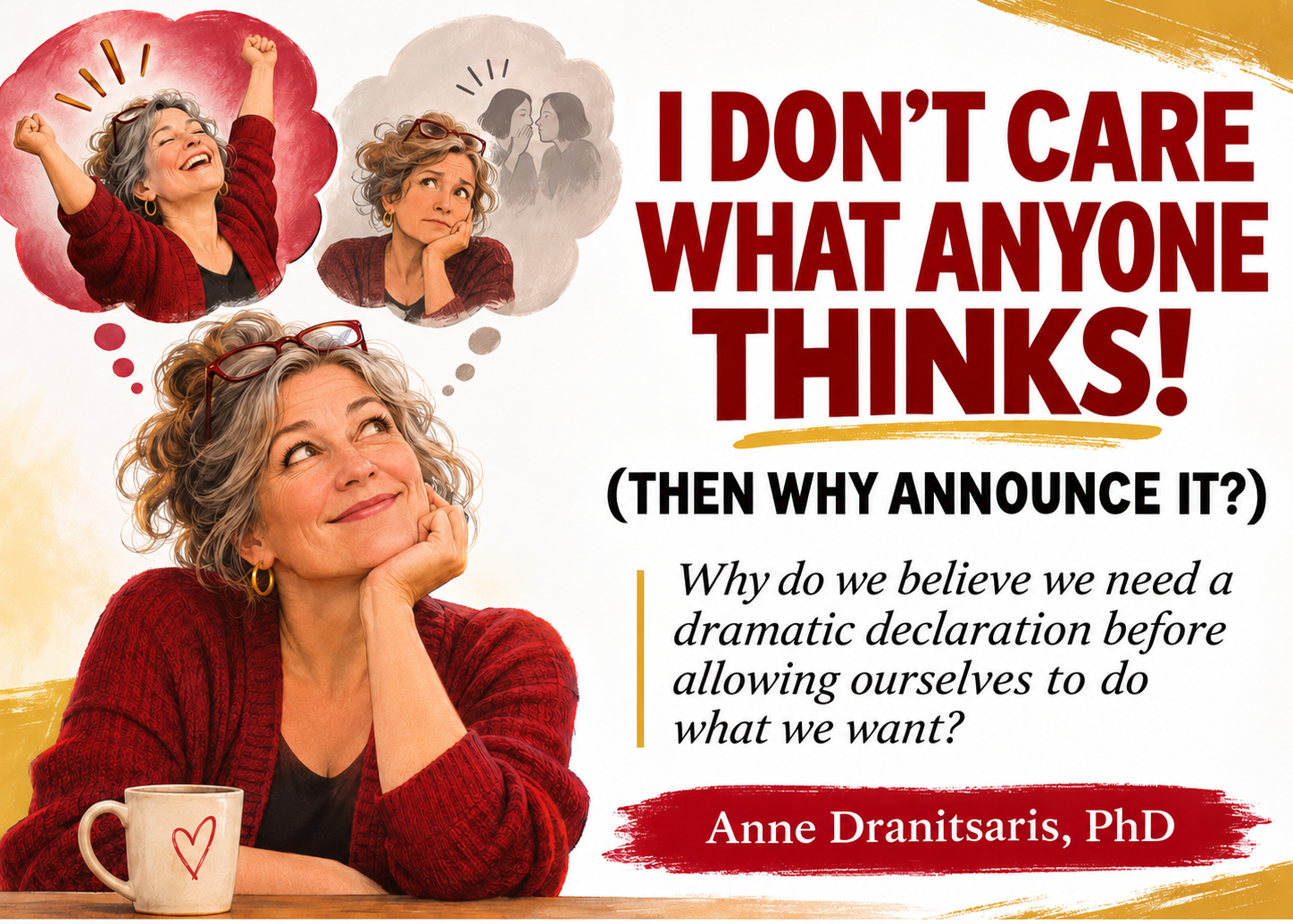
Why do we believe we need a dramatic declaration before allowing ourselves to do what we want?
There’s a particular tone people use when they announce they’ve stopped caring what anyone thinks. It’s usually delivered with the conviction of someone who’s just made a major breakthrough in life, perhaps after years of putting up with other people’s opinions, expectations, and unsolicited advice.
“I’ve decided I don’t care anymore. I’m going to say what I think and do what I want.”
Well, good for you! Although I have to admit, whenever I hear this, I’m tempted to ask why you’ve had to become indifferent to the entire human race before allowing yourself to have an opinion.
I’ve heard variations of this declaration from friends, colleagues, and clients for years. Sometimes it comes after a particularly frustrating experience with a family member. Other times, it’s a coworker who’s finally had enough of keeping quiet in meetings or someone who’s reached an age where they’ve apparently decided that worrying about what other people think is no longer a worthwhile use of their remaining years.
There’s often a sense of relief, triumph, and just a touch of defiance in the announcement. You can almost imagine the person mentally tearing up the rule book they’ve been following since childhood and tossing the pieces into the air.
But here’s what strikes me as funny. Even when we’re declaring that we no longer care what other people think, we’re still making our decisions about other people. We haven’t necessarily freed ourselves from their influence. We’ve simply decided to take the opposite position.
And I’m not sure why we have to stop caring before we can give ourselves permission to be who we are.
Apparently, We Need a Formal Declaration
I’ve always been fascinated by how much energy people put into announcing that they’re no longer concerned about other people’s opinions. There’s something wonderfully contradictory about wanting everyone to know that you couldn’t care less what anyone thinks.
It’s a little like announcing that you’ve decided to stop seeking attention and then checking to see who noticed.
Of course, I understand what people are trying to say. They’re tired of censoring themselves, accommodating other people’s preferences, and second-guessing every decision. They’ve spent years being agreeable, reasonable, understanding, and considerate, often at their own expense. Now they’ve had enough.
But instead of saying, “I’ve decided to start making my own choices,” they announce that they don’t care anymore, as though caring itself has been the problem. And that raises an interesting question.
Why does it feel easier to reject other people’s opinions than to simply recognize that we’re entitled to have opinions of our own?
Perhaps because saying we don’t care gives us the emotional permission to do something we’ve never quite felt entitled to do. We can finally say no, express a preference, or make an unpopular decision because we’ve convinced ourselves that nobody else’s feelings matter.
It’s a rather extreme solution to the problem of wanting to choose what to have for dinner without consulting the family.
The Trouble With Being a Good Person
Many of us grew up learning that being a good person meant being considerate of others. We were encouraged to share, cooperate, avoid hurting people’s feelings, and behave in ways that made life pleasant for everyone around us.
Somewhere along the way, however, we confused being considerate with being responsible for how other people felt about us.
We learned to anticipate disappointment, recognize disapproval, and adjust ourselves accordingly. We became sensitive to the raised eyebrow, the disappointed sigh, and that particularly effective parental observation, “Well, if that’s what you want to do.”
Anyone who’s heard that sentence knows it rarely meant enthusiastic support for their decision.
Eventually, we became so accomplished at monitoring other people’s reactions that we no longer needed them to say anything. We could anticipate their objections before they had a chance to express them.
We knew Aunt Margaret would be offended if we didn’t attend the family dinner, our friend would be disappointed if we declined her invitation, and our colleague would be annoyed if we disagreed with his brilliant idea. We could conduct an entire imaginary conversation with these people, complete with their objections and our apologies, without any of them being present. And then we’d make our decisions accordingly.
It’s remarkable how many people we can accommodate without actually speaking to them.
The Rebellion Isn’t Quite the Freedom We Think It Is
Eventually, all that accommodating can become exhausting. We begin resenting the expectations we’ve worked so hard to meet, particularly when nobody seems to appreciate how much effort we’re putting into keeping everyone happy.
Then comes the breakthrough.
“I don’t care what anyone thinks anymore! I have to speak my truth!”
Suddenly, we’re saying no, speaking our minds, and making decisions without seeking approval. It can feel wonderfully liberating, particularly if we’ve spent years worrying that someone might be upset with us.
But there’s a catch.
When we decide to act because we’ve blamed others for keeping us quiet and have had enough of other people’s expectations, we’re still reacting to those expectations. We’ve moved from doing what people want to proving that they can’t tell us what to do.
The people whose opinions once shaped our choices still influence us. They’re simply getting a different reaction.
I see this as one way our adaptive persona operates. When we’re concerned about approval, it protects us by encouraging us to accommodate others. When we’ve had enough and feel resentful, it can protect us by becoming defiant. In both cases, our behavior is organized around other people and what they might think, want, or do.
Our authentic self doesn’t need us to rebel against anyone to express what we want. It needs us to develop the capacity to listen to ourselves and exercise personal authority.
And that’s where things become interesting, because many of us have learned to be accommodating or defiant without ever learning how to simply choose.
What If We Actually Do Care?
Here’s the part I find particularly amusing about the whole business of not caring. Most of us do care, and there’s absolutely nothing wrong with that.
We care about the people in our lives. We want to maintain relationships, be considerate, and avoid unnecessarily hurting people’s feelings. We value the opinions of people we respect, and sometimes their disappointment genuinely matters to us.
Why should we have to pretend otherwise?
I can care that my friend is disappointed because I’ve declined her invitation and still decided that I’d rather stay home. I can care that someone disagrees with my opinion without changing it to make them comfortable. I can even care that a family member is annoyed with me and allow them the pleasure of being annoyed.
After all, I’m sure I’ve provided plenty of opportunities for people to be annoyed with me over the years. It seems only fair that they should be allowed to enjoy the experience without my rushing in to make everything better.
The problem isn’t that we care. It’s that we’ve confused caring about someone’s feelings with being responsible for preventing them. And that confusion can keep us extraordinarily busy making decisions to please others and blaming them for not letting us have any space.
We explain why we can’t attend something, provide elaborate justifications for decisions that don’t require them, and reassure people that our choices aren’t personal. Sometimes we offer so much explanation that we practically invite the other person to negotiate.
“I’d love to come, but I’m really tired, and I’ve had a busy week, and I need to catch up on a few things, although perhaps if I finish early…”
At which point, we’ve handed them several perfectly good reasons to explain why we should come anyway.
Sometimes “Thanks, but I’m going to stay home tonight” is a complete and perfectly considerate response.
The Real Challenge Is Giving Ourselves Permission
I think one of the reasons people announce that they don’t care anymore is that they’ve never really learned to give themselves permission to want what they want, leading to an undeveloped capacity for healthy entitlement. They’ve learned to seek approval, anticipate objections, and justify their decisions. When they finally become frustrated enough, declaring that they don’t care provides a way around the internal resistance. It’s almost as though they’ve discovered a loophole in their own psychological rule book.
If I care what people think, I have to accommodate them. But if I declare that I don’t care, I’m finally allowed to do what I want.
Unfortunately, this leaves us with the rather ridiculous idea that personal freedom requires emotional indifference. It doesn’t. And announcing that we no longer care doesn’t magically give us the psychological capacities we need to make our own choices.
We have to develop two very important capacities of the authentic self: healthy entitlement, agency & authority. Healthy entitlement allows us to recognize that our needs, wants, and preferences matter just as much as anyone else’s. Agency gives us the capacity to act on our own behalf, while authority allows us to make decisions without requiring someone else’s permission or approval.
These are capacities of our authentic self that need to be developed. Without them, we can spend years swinging between accommodating everyone and defiantly announcing that we’re finished accommodating anyone. Either way, our adaptive persona is still running the show.
You Can Care and Do It Anyway
There’s something wonderfully freeing about being able to care what someone thinks without having to do what they want. We can listen to their opinions, understand their disappointment, and even feel a little uncomfortable about our choices without rushing to apologize, justify ourselves, or change our minds.
And sometimes we’ll choose to accommodate someone because we genuinely want to. That’s the beauty of having personal authority. We get to decide when to say yes and when to say no, without making either choice a declaration of independence.
So perhaps the next time we’re tempted to announce that we don’t care what anyone thinks anymore, we could try something a little less dramatic: I care what you think, but what I think matters too.
Of course, it doesn’t have quite the same theatrical impact, and nobody is likely to raise a glass to celebrate our newfound independence. But it reflects something far more important. We’re developing the capacity to be ourselves while remaining connected to others.
We don’t have to stop caring. We have to develop the capacities of our authentic self so we don’t continue to abandon ourselves.
Want to Develop These Capacities?
Healthy entitlement, agency, and personal authority are among the 16 psychological capacities of the authentic self that help us move beyond self-protective patterns of behavior and become who we are meant to be.
Download my free guide to the 16 Capacities of the Authentic Self to learn more about the capacities we need to develop rather than continuing to struggle to change the behaviors of our adaptive perso