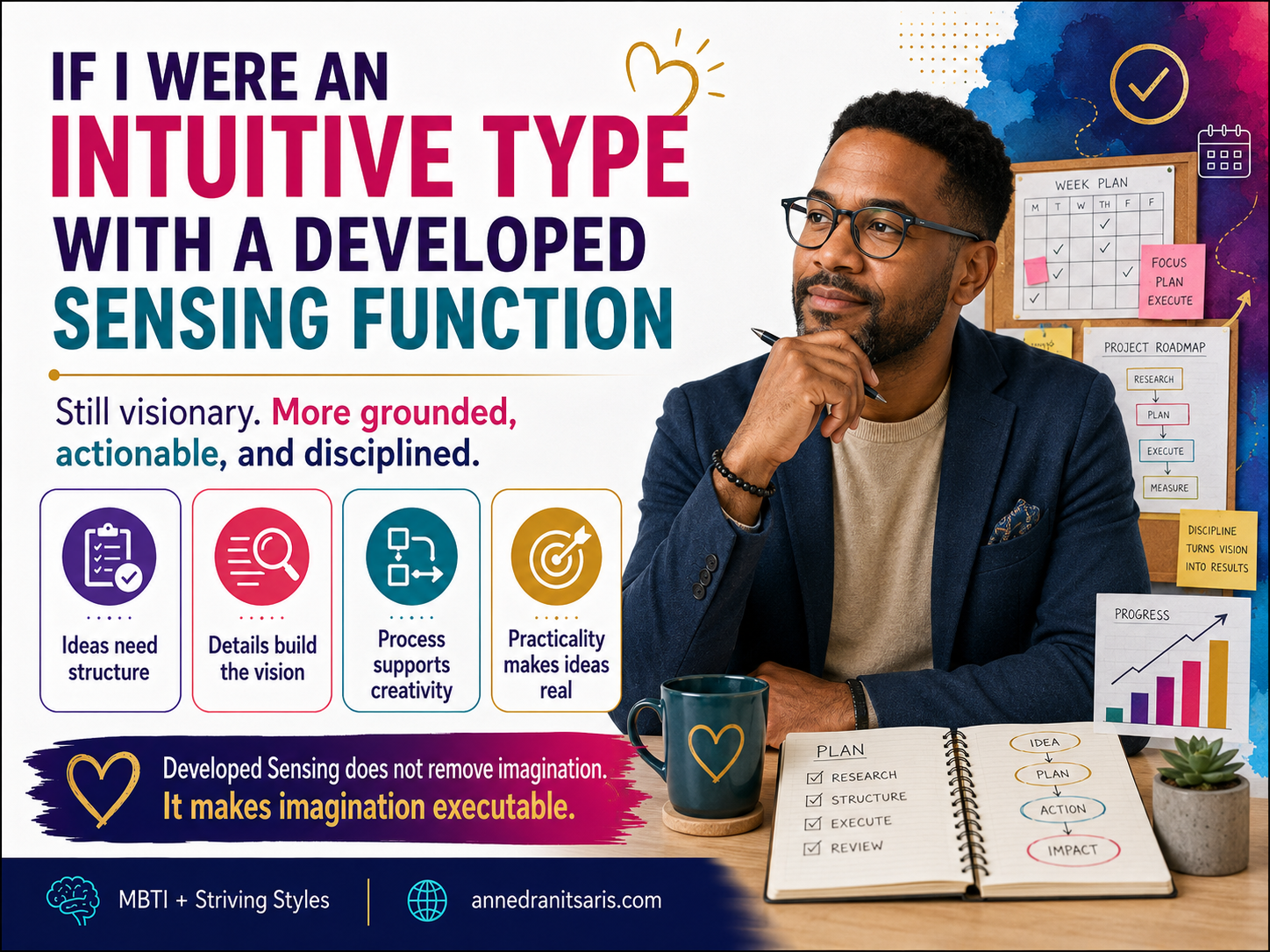
1. I’d Still Have Big, Visionary Ideas
Let’s get one thing out of the way: developing my Sensing function wouldn’t suddenly turn off my ability to spot grand patterns, imagine transformative futures, or brainstorm 15 possibilities before breakfast.
- I’d still see the hidden potential in a half-baked concept.
- I’d still connect two completely unrelated industries to predict a market shift.
- And yes, I would still get excited about abstract theories that don’t have a name yet.
What would change is my default assumption that having a brilliant vision is the same thing as accomplishing it.
A developed Sensing function would act like a reality check, prompting me to ask: This overarching strategy sounds amazing on paper, but what does step one actually look like on Tuesday morning?
I might even do something radical: map out a realistic timeline and budget before declaring the project effectively finished in my mind. It would feel unnatural at first—like voluntarily putting lead weights on a kite—but apparently, groundbreaking ideas need an anchor if they’re ever going to land.
2. I’d Discover That Details Are the Pathway to the Future
As an Intuitive type, I am deeply comfortable living at 30,000 feet, painting with broad strokes, and building conceptual frameworks.
What I tend to forget is that execution details are the bricks that actually build the castle.
- Concrete data points are essential validation.
- Clear logistics prevent total operational collapse.
- Physical, present-moment reality is where human beings actually live and work.
Developing my Sensing function wouldn’t make me narrow-minded—it would make my vision buildable. I could still map out a ten-year transformation for an organization while saying, “Let’s check the current inventory levels and actual budget before we launch.”
Details aren’t killing the dream. They’re giving it a foundation.
3. I’d Stop Treating Routine and Process Like Personal Attacks
When someone hands me an operational manual, a strict template, or a spreadsheet of daily tasks, my brain’s default response is Suffocation Mode:
Why are we obsessing over these details right now? It’s just administrative busywork! Where is the creativity? Who built this cage?
With a developed Sensing function, I might finally realize that processes aren’t designed to destroy innovation—they’re designed to sustain it.
Sometimes, routine is just the engine that keeps the lights on while you invent the future.
This requires me to adopt a mindset that initially feels wildly mundane:
“Let’s document this workflow so we don’t have to reinvent the wheel every single week.”
And then—here’s the real hero’s journey—I have to actively suppress the urge to completely redesign the system halfway through just because I got bored.
Progress.
4. I’d Realize That the Present Moment Is Where Results Happen
Intuitive types love to live in the theoretical future: Once this new model is fully realized and everyone catches up to the vision, the current mess will solve itself!
Enter Sensing, bringing along a deeply inconvenient variable: The Present.
If your current operations are falling apart, telling people about your brilliant three-year roadmap doesn’t fix today’s customer service crisis. Explaining how amazing the concept could be doesn’t compensate for missed deadlines right now.
Vision isn’t automatically “progress,” and “I’m a big-picture person; I don’t do details” is usually what people say right before handing off an unexecutable mess for someone else to clean up.
5. I’d Upgrade My Execution Framework
Undeveloped Intuitive types operate on a very specific internal policy:
“Once I’ve solved the problem conceptually, the interesting part is over. Someone else can figure out how to do it.”
Developing Sensing means respecting the craft of execution. It means tracking metrics, honoring physical constraints, and paying attention to details and sensory facts.
And doing so before an overlooked detail completely derails a project at launch.
6. I’d Stop Confusing Practicality with a Lack of Imagination
The biggest fear for an Intuitive type is that paying attention to concrete facts, data, and immediate realities means surrendering your creative spark.
It doesn’t.
- I can respect operational rules without losing my strategic edge.
- I can double-check the budget without abandoning the big idea.
- I can ground my ideas in reality while still aiming for the stars.
Practicality isn’t the enemy of inspiration. Developed Sensing gives you access to both the sky and the soil—no trade-offs required.
7. I’d Still Maintain My Preference for Intuition
Developing your Sensing function doesn’t mean swapping your vision board for a filing cabinet.
I’d still challenge the status quo. I’d still ask “What if?” fifty times a day. I’d still spot subtle trends long before they show up on the evening news.
The difference is weight and precision. Instead of only asking, “What could this become?” I can also ask:
- “What are the exact facts right now?”
- “What resources do we actually have on hand?”
- “What is the most practical step to make this concept real today?”
That doesn’t weaken my vision—it makes my vision unstoppable. Because the ultimate sign of a developed Intuitive type isn’t just dreaming up a brilliant new world.
It’s having the patience and discipline to actually build it.
Is Your Preferred Decision-Making Function Intuition?
If you are an ENTP, ENFP, INTJ, or INFJ, Intuition is your dominant function. If you are an ENTJ, ENFJ, INTP, or INFP, Intuition is your auxiliary function—meaning possibilities, underlying patterns, and big-picture strategy form your natural baseline for perceiving the world.
Discovering your MBTI type and Striving Style reveals the core operating system behind those choices. But Striving Styles takes it a step further: it uncovers the emotional needs driving your behavior, highlights where your focus on the future turns into self-protection, impatience with details, or impracticality under stress, and maps out the exact capacities you need to develop next.
Real growth isn’t about sacrificing your vision, creativity, or strategic mindset. It’s about knowing when abstract concepts are enough—and when a situation calls for concrete execution, present-moment focus, and grounded reality.
Ready to discover your next stage of development?
Learn more about individual assessments, coaching, and team development at annedranitsaris.com.