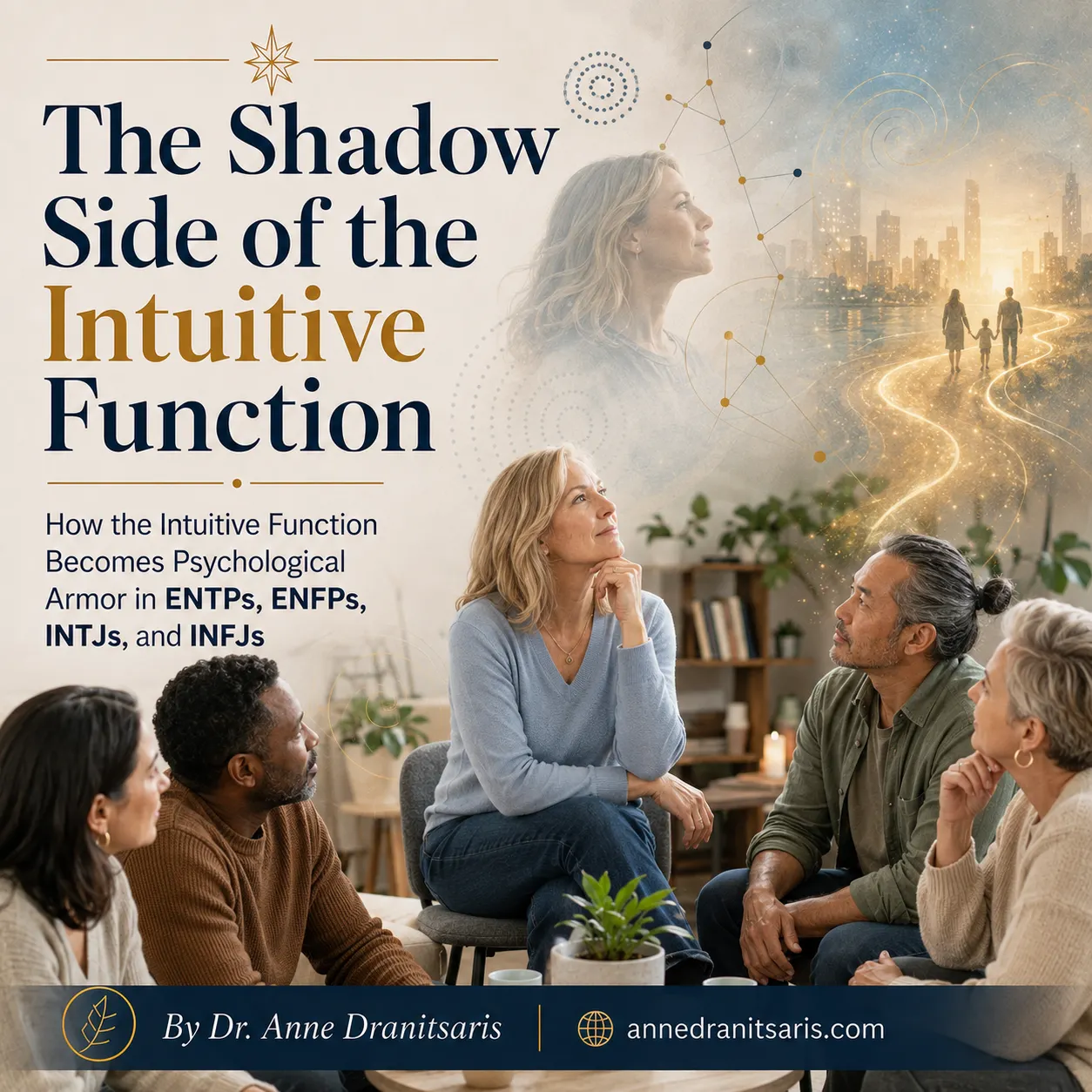
Does this sound like you? Your mind is constantly racing toward what could be next. A new project feels irresistible even though three others remain unfinished. You stay invested in a relationship because you can see the person your partner might become. Or you spend hours imagining every possible outcome while the reality in front of you goes untouched.
While some of us escape into possibility from time to time, for people who prefer the Intuitive function, seeing potential, patterns, and future possibilities is central to how they understand the world.
If your dominant mental function, based on Jung’s personality type theory, MBTI, or Striving Styles, is Intuition, your natural superpower is seeing beyond what is immediately visible. You can recognize patterns other people miss, imagine what something might become, anticipate future implications, connect seemingly unrelated ideas, and create a vision for what could happen next.
But there is another side to this gift.
When a child grows up in an unstable, restrictive, intrusive, or emotionally unsafe environment, that extraordinary capacity to imagine and anticipate can become woven into the creation of a self-protective adaptive persona. Possibility becomes an escape from reality. Anticipation becomes a way of preventing emotional pain. Insight becomes a substitute for direct experience.
Instead of using your Intuitive function for self-actualization, you begin using it for self-regulation and to meet your emotional needs. Energy that could have supported the development of your authentic self gets directed toward developing an adaptive persona.
The Subconscious Rules of Engagement
When we are growing up, our brains write a hidden “instruction manual” for relationships. The main goal of this manual is simple: keep us safe, connected, and protected from emotional pain.
For people who naturally navigate the world through the Intuitive function, gathering information through patterns, possibilities, meanings, and future implications, that instruction manual often contains three relationship rules:
“I should remain interesting, adaptable, and full of possibilities so people continue to recognize and value me.”
For a child with Extraverted Intuition, being noticed and responded to can feel essential to connection. The child learns to generate excitement, adapt quickly, entertain possibilities, or become what the moment seems to require. Remaining interesting feels safer than risking being overlooked, ordinary, or rejected.
“I should understand what is really happening and anticipate what will happen next.”
Children who prefer Introverted Intuition often look beneath the surface for meaning. When their environment is confusing or emotionally unpredictable, they may become intensely focused on interpreting behaviour, recognizing hidden patterns, and anticipating future outcomes. The brain learns that insight provides protection: “If I can figure this out before anyone else, I won’t be caught off guard.”
“I should focus on what could be rather than accept a reality that feels painful, disappointing, or limiting.”
The Intuitive function naturally perceives potential. In an unsafe environment, that strength can become a way of avoiding the present. Instead of accepting who someone is, the child focuses on who they might become. Instead of feeling disappointment, they imagine a better future. Instead of making a difficult choice, they keep every possibility open.
Essentially, the brain learns to live in possibility because possibility feels safer than reality. While this may help a child preserve hope and emotional distance, it can leave the adult chasing potential, avoiding commitment, or relating to imagined futures rather than what is actually happening.
The Two Faces of the Intuitive Persona: Ne vs. Ni
When the Intuitive function is used by the adaptive persona, it produces two distinct behavioural patterns based on whether you lead with Extraverted Intuition, or Ne, or Introverted Intuition, or Ni.
The Performer Persona Extraverted Intuition, Ne
Ne meets its need to be recognized by noticing what is possible, generating exciting ideas, and drawing others into new ways of seeing. When the Performer Persona takes over, they scan for what will capture attention, adjust their energy or presentation to fit the audience, and continually reinvent themselves to remain interesting and valued to protect themselves from being overlooked, devalued, or abandoned.
Fragmented Identity and Unfinished Potential: The Performer Persona causes you to initiate exciting projects, make ambitious promises, or imagine dramatic new directions, then lose interest when novelty turns into responsibility. The constant search for recognition can leave you at the mercy of becoming whoever others want and need you to be, disconnecting from your needs, authentic desires, and motivations.
The Rationalizer Persona
Introverted Intuition, Ni
Ni has a predominant need to be perceptive, which it meets by synthesizing information, identifying underlying patterns, anticipating future implications, and forming a cohesive vision. When the Rationalizer Persona takes over, they manage anxiety by idealizing another person’s potential, explain away troubling behavior, and trust their intuitive insights without checking them against reality, protecting themselves from uncertainty, emotional exposure, and the possibility of being blindsided.
Certainty, Projection, and Emotional Distance: The Rationalizer Persona can cause you to become attached to your interpretation of reality and your self-protective story. You may remain invested in relationships, careers, or situations because you can see their future potential, even when the evidence in front of you tells a different story. Your insight is treated as unquestionable truth, protecting you from emotional ambiguity, the discomfort of not knowing, and direct emotional experience.
When Possibility Replaces Reality
The Performer and Rationalizer Personas appear different on the surface.
The Performer moves outward, generating ideas, seeking stimulation, attracting attention, and discovering new possibilities. The Rationalizer moves inward, interpreting patterns, constructing meaning, anticipating outcomes, and developing a private vision.
Yet both personas use possibility to avoid the vulnerability of the present.
The Performer may leave when excitement fades, shift direction when recognition decreases, or reinvent themselves when commitment begins to feel limiting. The Rationalizer may withdraw into interpretation, become convinced they already know what something means, or stay emotionally invested in what a person could become.
Both can struggle to remain present when possibility narrows into reality.
Reality requires choices. It asks us to tolerate limits, finish what we begin, accept disappointment, test our assumptions, and see people as they are. It asks us to remain emotionally present even when the future is uncertain, and the outcome cannot be controlled.
For the adaptive Intuitive persona, that can feel deeply threatening.
Breaking Free: Moving from Self-Protection to Self-Actualization
Your adaptive persona is not your true identity. It is an intelligent strategy your childhood brain developed by recruiting one of your greatest natural strengths.
But you are no longer a child, and imagining possibilities does not have to remain a means of escape from reality.
To step out of the Performer or Rationalizer Persona, you have to rewrite the internal rules directing your Intuitive function.
Rule Example: Ne Performer Persona
Adaptive Persona Rule: Self-Protection
I should adapt my behavior and reinvent myself to be pleasing to others. I should be interesting, enthusiastic, adaptable, and full of possibilities so others don’t abandon me.
Authentic Self Rule: Self-Actualization
I do not have to perform or continually reinvent myself to be worthy of recognition. I can choose, commit, follow through, and allow people to know me when I am uncertain, imperfect, quiet, or ordinary. True recognition comes from being seen as I am, not from maintaining an appealing image of who I might become.
Rule Example: Ni Rationalizer Persona
Adaptive Persona Rule: Self-Protection
I should anticipate what is coming, understand what everything means, and remain several steps ahead so I am not surprised, disappointed, or emotionally overwhelmed. My interpretation will protect me from uncertainty.
Authentic Self Rule: Self-Actualization
My insights are valuable, but they are perceptions to be explored rather than facts that cannot be questioned. I can check my interpretations, ask others about their experience, and remain open when reality does not match my vision.
Reclaiming the Gift of Intuition for Your Development
The goal is not to stop imagining, anticipating, dreaming, or seeing potential. It is to separate these natural gifts from the survival strategies of your adaptive persona.
For Extraverted Intuitive types, this means learning to remain present after the excitement fades. It means choosing among possibilities, tolerating limits, following through, and allowing recognition to come from authentic expression rather than performance.
For Introverted Intuitive types, it means treating insight as the beginning of a conversation rather than the final conclusion. It means testing assumptions, asking questions, accepting present reality, and allowing other people to define themselves instead of relating to an internal interpretation of who they are.
When you step out of the self-protective roles of the Performer or Rationalizer Persona, you free your Intuitive function to do what it was always meant to do: create meaningful possibilities, recognize emerging patterns, inspire growth, anticipate future needs, and envision new ways forward while remaining grounded in reality.
You no longer have to escape into what might happen. You can use your intuition to build what matters.
Are You Ready to Stop Playing Defense and Decode the Hidden Rules Running Your Life?
Subscribe and stay tuned for the upcoming podcast series Your MBTI Personality Type Is Not the Whole Story: How Jungian Functions and Emotional Needs Shape the Adaptive Persona. A 10-Week Podcast Series with Dr. Anne Dranitsaris coming in October 2026.
Learn more about how your personality type shapes your protective armor in my latest book, Are Your Relationship Rules Ruining Your Happiness?, or check out the full breakdown in my recent article on How Jungian Functions Shape Your Adaptive Persona.
Resources on the Feeling Function
Explore the article and video series to learn how the Feeling function can become psychological armor and shape self-protective patterns in relationships, leadership, and everyday life.
- Watch: An Introduction to the Feeling Function
- Watch: Extraverted Feeling and the Caretaker Persona
- Watch: Introverted Feeling and the Pleaser Persona
Resources on the Thinking Function
Explore the article and video series to learn how the Thinking function can become psychological armor and shape self-protective patterns in relationships, leadership, and everyday life
Watch: Introverted Thinking and the Avoider Persona