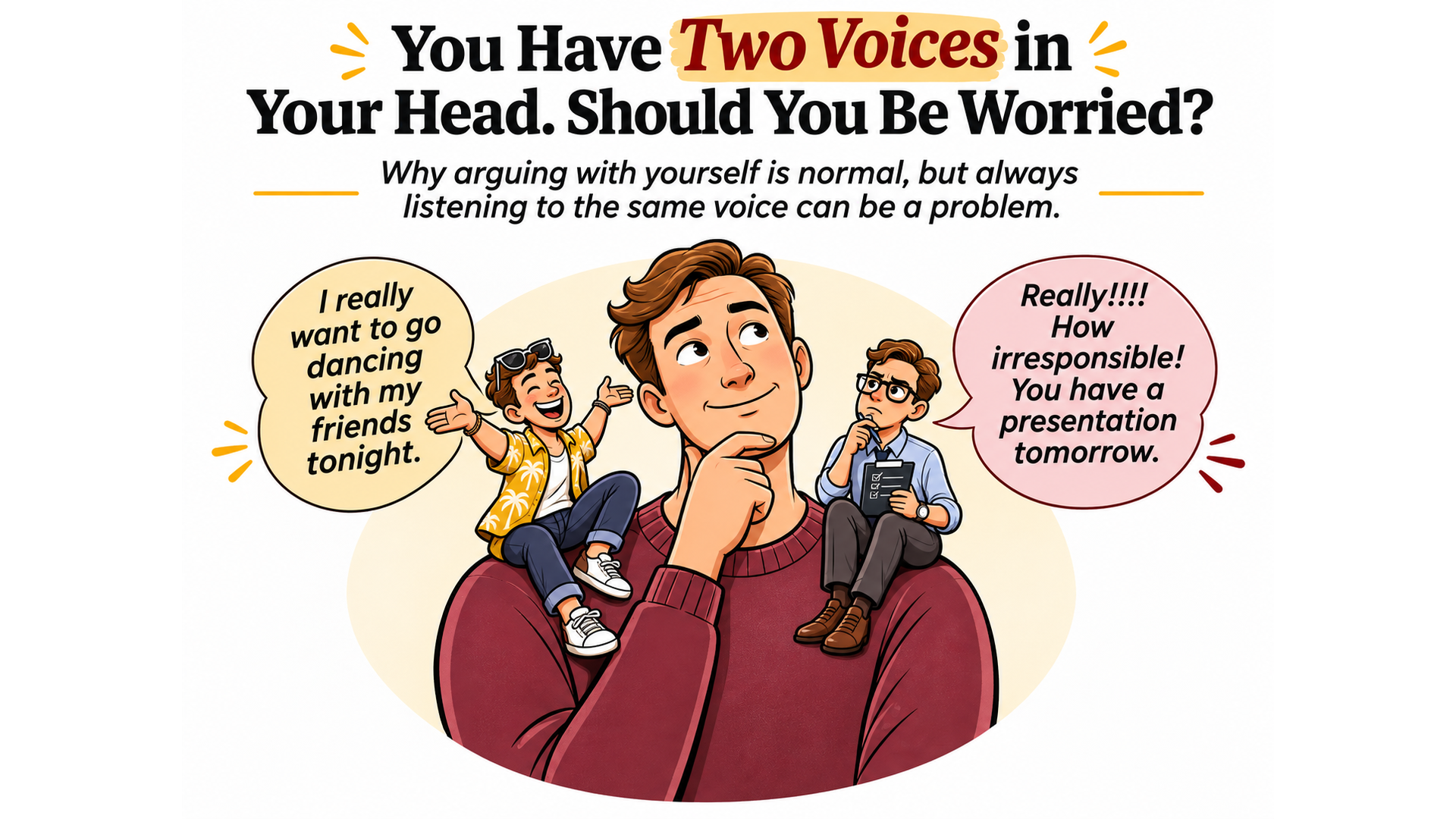
Why arguing with yourself is normal, but always listening to the same voice can be a problem.
How often have you heard yourself say, “There’s a part of me that really wants to do it, but there’s another part of me that thinks I shouldn’t”? Or perhaps you’re more familiar with, “Part of me wants to tell him exactly what I think, but another part says I should keep my mouth shut.” Sometimes the disagreement is about something harmless, like having another piece of cake, while other times it’s about leaving a relationship, changing careers, or finally doing something you’ve wanted to do for years.
Have you ever stopped to consider what you’re actually saying? Apparently, there are at least two of you in there, and they don’t agree on much. One wants to explore possibilities, while the other insists on reviewing everything that could go wrong. One gets excited about an opportunity, and the other immediately starts calculating the financial implications, imagining the disapproval of relatives, and reminding you of that unfortunate decision you made in 1997.
And somehow, we’re expected to make sensible decisions with these two carrying on in our heads.
We talk about these internal disagreements as though they’re perfectly normal, which, fortunately, they are. We casually announce that part of us wants one thing and another part wants something else, without giving much thought to who’s speaking, who’s listening, or which one of these apparent residents is authorized to make decisions.
Does Talking to Yourself Mean You’re Losing Your Mind?
If we were to say, “I’ve been having an ongoing argument with someone who lives inside my head, and frankly, they’re becoming rather difficult,” we might get some concerned looks. Someone might suggest therapy, which would be an awkward recommendation to make to a psychotherapist who’s been listening to these arguments, both her own and everyone else’s, for decades.
Before you start wondering whether your internal conversations mean you’re schizophrenic, have borderline personality disorder, or are developing some other psychiatric condition, you can relax. Having conflicting thoughts and talking to yourself internally are ordinary human experiences. They are not, by themselves, symptoms of either disorder.
In fact, if having contradictory thoughts were a psychiatric disorder, we’d have to build considerably more hospitals. We’d probably need to reserve an entire wing for people trying to decide whether to retire, another for those debating whether to end their marriages, and a particularly large facility for anyone attempting to make a major life decision while considering what their mother would think.
The real question isn’t whether you’re normal for having these conversations. It’s why the same two voices keep showing up, why they so often disagree, and why one of them seems to have considerably more influence over your decisions.
Meet the Two Voices That Have Been Running Your Life
The first voice comes from what I call your adaptive persona. This is the identity you developed as you learned how to function in your family, navigate relationships, meet expectations, and protect yourself from experiences that threatened your sense of safety, acceptance, and belonging. Its sole agenda is to keep you safe and emotionally regulated.
Your adaptive persona has been on duty since childhood, and it takes its responsibilities very seriously. It remembers what happened when you disappointed your parents, spoke your mind, made a mistake, or tried something others considered foolish. Over time, it developed a fairly elaborate system for keeping you out of trouble.
Unfortunately, nobody ever told it that you grew up and no longer needed protection.
Consequently, it still offers advice based on circumstances that may no longer exist. It warns you against upsetting people who no longer have authority over you, reminds you to seek approval from people whose opinions shouldn’t matter, and encourages you to maintain relationships that stopped being good for you somewhere around the invention of the smartphone.
Its favorite words are “should,” “must,” “have to,” and “what if.” It specializes in worst-case scenarios and has a remarkable ability to turn a perfectly reasonable desire into a potential catastrophe. You can be sitting peacefully at home, considering something you’ve always wanted to do, and within minutes your adaptive persona has constructed a detailed presentation explaining why it’s financially irresponsible, socially inappropriate, and quite possibly evidence that you’ve lost your mind.
The second voice comes from your authentic self, the part of you connected to your natural abilities, emotional needs, values, interests, and deeper sense of purpose. It’s the voice that expresses what you genuinely want, what feels meaningful, and what you recognize as right for you, even when following it would require making changes.
This voice doesn’t necessarily speak in complete sentences or provide a five-year business plan. Sometimes it communicates through curiosity, excitement, longing, dissatisfaction, or a persistent feeling that something in your life isn’t right. And unlike your adaptive persona, which reacts immediately with an impressive collection of arguments, your authentic self often has a rather inconvenient habit of simply knowing what it wants.
Unfortunately, One of Them Has Had Much More Practice
If these two voices had equal influence, making decisions might be relatively straightforward. Unfortunately, your adaptive persona has a significant advantage. It’s been rehearsing its arguments for years, and many have become so automatic that you don’t even recognize them as reactions.
Your authentic self might say, “I’d really love to take that course,” and before you’ve had time to look at the registration information, your adaptive persona reminds you that you’re too old, too busy, too inexperienced, or too financially responsible to indulge in such nonsense.
You might feel an unmistakable desire to leave a job that’s making you miserable, only to hear an internal lecture about stability, benefits, loyalty, and the alarming possibility that you might never find another job. By the end of the discussion, you’ve decided to stay another five years, even though nobody outside your own head has actually asked you to.
Your adaptive persona often sounds like the voice of reason. It presents its arguments with confidence, refers to previous experiences, and produces convincing evidence. Your authentic self, meanwhile, may be offering little more than a persistent desire and the uncomfortable feeling that you’re betraying yourself. Naturally, we tend to favor the voice that sounds as though it knows what it’s talking about.
This is how people end up spending years doing things they don’t want to do, maintaining relationships they no longer enjoy, and postponing experiences that matter to them. They aren’t necessarily confused about what they want. They’ve simply learned to treat their protective reactions as more credible than their authentic desires.
The Problem with Giving Your Adaptive Persona the Final Vote
There’s nothing inherently wrong with having a protective voice. We need the ability to anticipate consequences, recognize danger, and make sensible decisions. Nobody wants their authentic desire for adventure to lead them into purchasing a motorcycle, quitting their job, and moving to Costa Rica without checking whether they can afford groceries.
The problem arises when protecting ourselves becomes more important than living our lives.
Your adaptive persona isn’t particularly interested in whether you’re fulfilled, developing your potential, or living in a way that’s consistent with who you are meant to be. Its primary concern is keeping you safe from experiences that resemble earlier threats. And because emotional safety is often associated with familiarity, it tends to prefer the life you already know, even when that life is making you unhappy.
I’ve always found it interesting how much energy people devote to persuading themselves that they don’t really want what they clearly want. They’ll explain why the opportunity isn’t practical, why the relationship isn’t that bad, or why pursuing a long-held dream would be selfish. They’ll provide an exhaustive account of the obstacles, complete with supporting documentation, while barely mentioning the desire that started the conversation.
It’s rather like having an enthusiastic traveler and an overprotective insurance adjuster sharing an office, except the insurance adjuster controls the budget, approves the holidays, and has the authority to cancel everything.
Eventually, the traveler stops making suggestions.
Learning to Recognize Who’s Speaking
The first step in changing this pattern is recognizing that not every thought in your head deserves the same authority. Just because a thought is familiar, persistent, or delivered in a convincing tone doesn’t mean it reflects your best interests.
When you notice yourself saying, “Part of me wants to, but another part says I shouldn’t,” become curious about what each voice is trying to accomplish. Is the voice telling you not to act identifying a genuine problem, or is it reacting to the possibility of disapproval, failure, conflict, or uncertainty? Is the desire you’re experiencing connected to something meaningful, or is it an attempt to escape discomfort without considering the consequences?
These distinctions matter because listening to your authentic self doesn’t mean abandoning judgment. It means developing the capacity to respond consciously rather than allowing automatic self-protective reactions to determine your choices.
Your adaptive persona will continue to react, particularly when you contemplate doing something unfamiliar or emotionally risky. You don’t have to silence it or persuade it to agree with you. You simply have to stop assuming that its objections are instructions you must follow.
So, Which Voice Is Running Your Life?
Perhaps the most revealing question isn’t whether you have two voices. It’s which one you’ve spent most of your life obeying. Think about the decisions you’ve made over the years. How often have you abandoned something you genuinely wanted because it seemed too risky, too inconvenient, or too likely to disappoint someone? How often have you said yes when you wanted to say no, stayed when you wanted to leave, or convinced yourself to be grateful for circumstances that were quietly draining the life out of you?
Of course, your self-protective voice will have something to say about those questions. It will remind you that things turned out reasonably well, that you made the best decisions you could, and that there’s little point in questioning the past. It may even suggest that reading articles about your inner voices is a rather self-indulgent way to spend your time when there are dishes in the sink.
But your authentic self may have a different need and is saying something completely different. It reminds you of something you’ve wanted for years, something you’ve repeatedly postponed because the seemingly practical, responsible, sensible part of you keeps finding reasons to wait.
The task isn’t to get rid of the voice that wants to protect you. It’s to recognize when that self-protection keeps you from living as who you are meant to be. Developing awareness, agency, and personal authority allows you to consider legitimate risks while making choices that honor your authentic needs and desires.
Your adaptive persona can have an opinion. It doesn’t have to have the final vote.
And if it objects to that arrangement, which it almost certainly will, you can thank it for its concern and remind it that you’ve been an adult for quite some time.