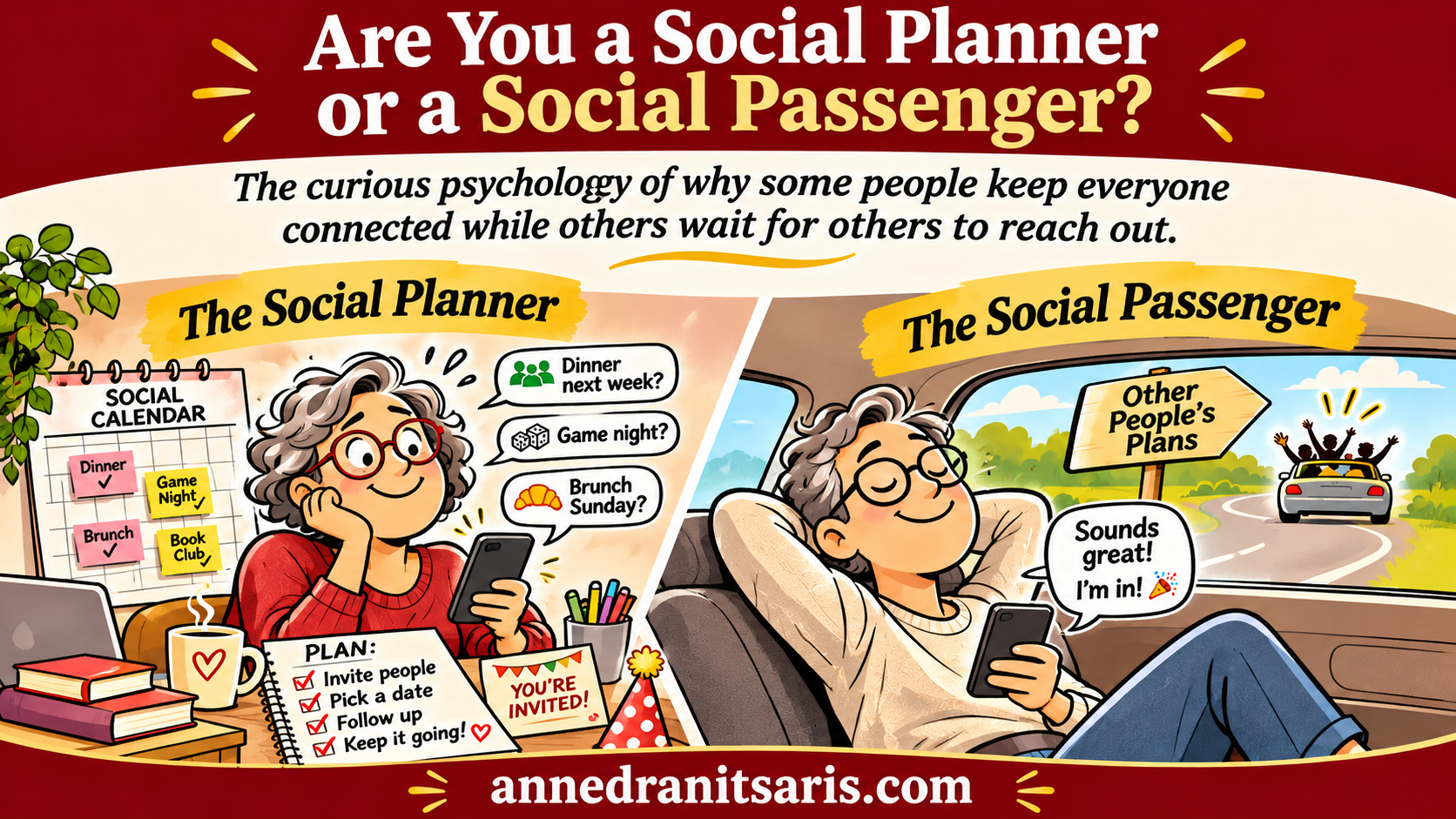
The curious psychology of why some people keep everyone connected while others wait for others to reach out.
One person is utterly exhausted from keeping relationships on life support. The other has no idea there’s even a patient in the hospital.
Look closely at any family tree, friend group, or extended circle of acquaintances, and you will find they are neatly partitioned into two distinct species: The Initiators and The Non-Initiators.
The Initiators are the tireless architects of connection. They organize holiday dinners, orchestrate group chats, track birthdays, and carry the heavy mental load of making sure nobody drifts off into the abyss. The Non-Initiators are the delighted passengers. They love turning up, eating the food, and enjoying the company, provided someone else took care of the logistics.
Both groups believe they are entirely reasonable. Neither can understand why the other makes such a massive, dramatic fuss about something as simple as picking up a phone.
The Exasperated Initiator (And the Fear of Being Forgotten)
Initiators keep the social world spinning on its axis. They are the ones who call to check in, suggest a weekend away, and remember that it has been three months since the extended family last breathed the same air. If there is a gathering happening anywhere on planet Earth, an Initiator started a group chat for it three weeks ago and is currently staring at their phone wondering why three people have left them on “Read.”
Naturally, Initiators have a running internal monologue of grievance:
- “Why am I always the one making the calls?”
- “If I stopped planning Thanksgiving, we’d all end up eating takeout alone in the dark.”
- “We’ve been friends for twenty years, and I’m pretty sure she’s never suggested a single activity.”
The Fear Behind It: Beneath the righteous anger of the Initiator lies a quiet, nagging terror. If I stop doing this, will anyone care? For the Initiator, taking charge isn’t just about organizing logistics; it is an unconscious bid for validation. They worry that if they drop the rope, the relationship vanishes, proving they were the only ones holding it together.
This leads to the classic Initiator ritual: The Silent Experiment.
Fed up, the Initiator announces, usually to a spouse, a pet, or a sympathetic barista, that they are going on a social strike. They are going to stop reaching out, stay completely silent, and see how long it takes for the other person to notice.
It is a fascinating psychological experiment, mostly because the Initiator expects the other person to experience a sudden epiphany of guilt, realize the cosmic imbalance of the relationship, and call in a panic of remorse.
Instead, what actually happens is that weeks pass. Then months. By month two, the Initiator has mentally rewritten the entire history of the friendship, casting themselves as a tragic, unappreciated martyr. By month three, they snap under the pressure, pick up the phone, and call.
The Non-Initiator answers with cheerful, booming enthusiasm: “Oh, it is so good to hear from you! I was just thinking about you!”
Which, of course, makes the Initiator want to throw their phone into a lake.
The Blissfully Unconcerned Non-Initiator (And the Fear of Getting It Wrong)
Non-Initiators operate on an entirely different plane of reality. They love their friends, adore their families, and are genuinely thrilled when someone reaches out. They just don’t experience the biological or psychological urgency to maintain a rigid maintenance schedule.
For a Non-Initiator, relationships come with an automatic, lifetime warranty. Once you establish that you like each other, the friendship continues indefinitely in a state of suspended animation. You can go six months or six years without speaking, and they expect to pick up the sentence right where you left off.
Ask a Non-Initiator why they never call, and you will receive a perfectly innocent, bulletproof excuse: they were busy, they lost track of time, or they assumed you had a million things going on. They also possess an Olympic-level talent for saying, “We really should get together soon!” with absolute sincerity, completely lacking any follow-up plan.
When an Initiator finally confronts them with a breathless, “Why don’t you ever call me?!” the Non-Initiator is genuinely startled. From their vantage point, the relationship was fantastic. They accepted the dinner invite, they laughed at the jokes, and they brought a nice bottle of wine.
What more does this person want? A blood oath?
The Fear Behind It: Non-Initiators often resist reaching out because of a quiet fear of imposition, rejection, or doing it wrong. They worry about bothering a busy person, picking the wrong venue, or triggering a calendar review that requires too much friction. It is much safer, and vastly less stressful, to wait for an expert (the Initiator) to handle the steering wheel.
Family Dynamics and the Extended Acquaintance Trap
This dynamic gets even more hilarious, and dangerous, when you scale it up from close friends to family members and extended acquaintances.
In family groups, the Initiator role is often handed down like an heirloom, usually to the person who proved early on that they could organize a birthday party without a meltdown. Soon, they are managing aunts, uncles, siblings, and second cousins who treat holiday planning like a hotel booking service.
- “Are we doing Christmas at your place this year?”
- “What time should we show up?”
- “Can you make sure Uncle Greg doesn’t sit near the radiator?”
Meanwhile, the Non-Initiator family members treat the event calendar like an incoming weather report: they check it to see if they need an umbrella, show up, eat the turkey, and vanish back into the wild.
When Two of a Kind Collide
What happens when these personalities cross paths in the wild?
- Two Initiators Collide: Their social life turns into a competitive sport. Both have distinct ideas about where to eat, both want to drive, and neither knows how to be a passenger. The friendship survives, but eventually, one accuses the other of being a control freak.
- Two Non-Initiators Collide: The friendship exists entirely in theory. They love each other dearly, but neither has initiated contact since the previous decade. If they accidentally bump into each other at the grocery store, they will spend twenty minutes hugging in the produce aisle, promising to grab coffee next week, and then happily vanish for another three years.
- The Classic Match: The Initiator and the Non-Initiator. This actually forms the most stable relationship on earth—provided both accept their casting. One loves organizing; the other loves being included. They can happily run this machinery for decades.
So, Who Is Responsible for Keeping Us Connected?
The truth is, both groups are driven by their own invisible anxieties. Initiators fear being invisible and forgotten; Non-Initiators fear being a burden or stepping on toes. But they get into trouble when they judge the other person by their own internal playbook.
Maybe the solution isn’t a dramatic breakup or a passive-aggressive social strike.
Initiators might discover that if they dial back the control freak tendencies just a notch, relationships won’t shatter—they’ll just find out who actually cares to lift a finger. And Non-Initiators might realize that picking up the phone to suggest a casual coffee once in a blue moon makes an Initiator feel like they’ve won the lottery.
Of course, if every Initiator on earth truly went on strike tomorrow and every Non-Initiator kept waiting for the phone to ring… society as we know it would likely grind to a halt. Families would stop gathering, dinner parties would cease, and we’d all communicate exclusively via mutual Instagram likes.
Fortunately, the Initiators will eventually get bored of sulking, decide that somebody has to adult around here, and start organizing everyone again.
They’ll just have plenty of juicy complaints while they do it.