Category: Uncategorized

  • Has Struggle Become Your Identity?

    Has Struggle Become Your Identity?

    Time to stop glorifying struggle and start building relationship capacities.

    Somewhere along the way, struggle became a status symbol. We speak about our anxiety keeping us up at night, our trauma, and pushing through as if endurance itself were proof of growth. It is not. It is often a sign that your nervous system is stuck in hypervigilance, while the part of you that needs care waits in the hallway. The more we glorify struggle, the more we postpone development. Not the flashy kind of change, but the real work of building the capacity to live as your Authentic Self.

    Struggle is not interesting when it becomes a personality. It is the same story told at a higher volume. You brace. You try harder. You get praised for your pain, for having been a victim. Inside, not much moves. If you were taught that belonging is earned through effort, you will keep performing even when the performance costs you your voice. The problem is not that you are weak. The problem is that your survival habits are still running the show and calling it struggle.

    Yet this type of struggle has no beginning and no ending. It is a regulatory feedback loop that you created to keep you safe. While you struggle, you feel like you are doing something.

    We talk about our anxiety keeping us up at night, our trauma, our overthinking, and how hard we push through, as if endurance itself equals evolution. “It is hard” becomes the identity, and “I am trying” becomes the badge of honor.

    But trying hard does not always mean you are developing. Sometimes it means your brain is stuck in hypervigilance, and the part of you that needs care and development is still waiting for permission to emerge. Struggle can be real and seductive. While you struggle, you feel like you are doing something. It’s the same as when you worry, catastrophize, or become anxious about things that haven’t happened yet. You brace, you push, you endure. It looks like you are doing the work, yet it often keeps the deeper work postponed.

    When Struggle Becomes a Persona

    There is a point where struggle stops being something you do and becomes how you identify yourself. The story stays the same, just told with more intensity. You carry more. You explain more. You justify more. You get praised for surviving all of the hard things in your life, for being the one who can handle it, for being the one who keeps going. It is easy to mistake that praise for approval and recognition, and so you keep it going.

    The Developmental Delay No One Talks About

    When core childhood needs are not met, particularly psychological safety, mirroring, belonging, acceptance, and recognition, something very specific happens inside the psyche. The Authentic Self does not disappear, but it becomes less available. It steps back. In its place, you build a Persona that knows how to manage others by changing your behavior. That Persona becomes skilled at coping.

    This is where many adults are stuck in their relationships. They become high-functioning, capable, and outwardly successful, yet inwardly they remain insecure, overly vigilant, and unusually sensitive to relational threat. Their relationship pattern has been organized around survival. That is what a developmental delay looks like. It is not a flaw. It is not a weakness. It is simply the result of capacities that were never fully developed because the conditions for their development were not consistently present.

    The Shift That Changes Everything

    There is a turning point that I watch for. It happens when someone stops asking, “Why is this so hard?” and begins asking, “What capacity is missing here?” That single question moves you out of the theater of struggle and into the work of development. It brings you back to your personal agency. It brings you back to choice. It brings you back to the possibility that your self-protective behaviors are not your identity, and that the development of relationship capacities is possible at any age.

    This is exactly why I have written about the ten relationship capacities in my book, Are Your Relationship Rules Ruining Your Happiness? They are not “tips.” They are not personality traits. They are developmental capacities that allow love to become sustainable, conflict to become workable, and intimacy to become safe. When these capacities are weak, we default to familiar roles, such as martyrdom, victimhood, overfunctioning, perfectionism, or quiet resentment. When these capacities strengthen, the Persona loses its grip because you no longer need it to survive the ordinary tension of relationships.

    Your Challenge This Week

    Here is the challenge I want you to take seriously. The next time you find yourself telling a struggle story, pause before you finish it. Notice what you are trying to prove. Notice what you are hoping the story will earn you. Then ask yourself what development would look like right there, in that exact moment, in that exact pattern. If you brought agency, not disempowerment, to the conversation.

    If your default is overexplaining, development may be learning to speak plainly. If your default is overgiving, development may be learning to set a limit without guilt. If your default is withdrawing, development may be learning to stay present and name what you feel. If your default is escalating, development may be learning to regulate before you respond. Struggle will always have a storyline. Capacity has a direction.

    Where the Authentic Self Actually Shows Up

    The authentic self does not arrive with a dramatic announcement. It shows up quietly, in ordinary moments, when you stop performing and start relating from truth. It shows up when you do not abandon yourself to keep the peace. It shows up when you tolerate discomfort without turning it into a crisis. It shows up when you let your needs into the room early, rather than waiting until they come out sideways.

    That is development. Not the glamour of surviving. The dignity of becoming.

  • Why More Self-Improvement Does Not Always Lead to Growth

    Why More Self-Improvement Does Not Always Lead to Growth

    Have you ever looked back and thought, “I have done so much work. Why do I still feel stuck in the same place?”

    You have read the books. Taken the courses. Listened to the podcasts. Followed the teachers, therapists, coaches, and spiritual leaders who offered language for what you were experiencing. Maybe you have gathered enormous insight into your patterns, your wounds, your relationship history, and your emotional reactions.

    And still, something in you may feel untouched.

    This is one of the most confusing parts of personal growth. From the outside, it can look as though you are doing everything right. You are learning. Reflecting. Trying. Healing. Improving. But inside, it can feel as though the deepest part of you is still waiting for something different.

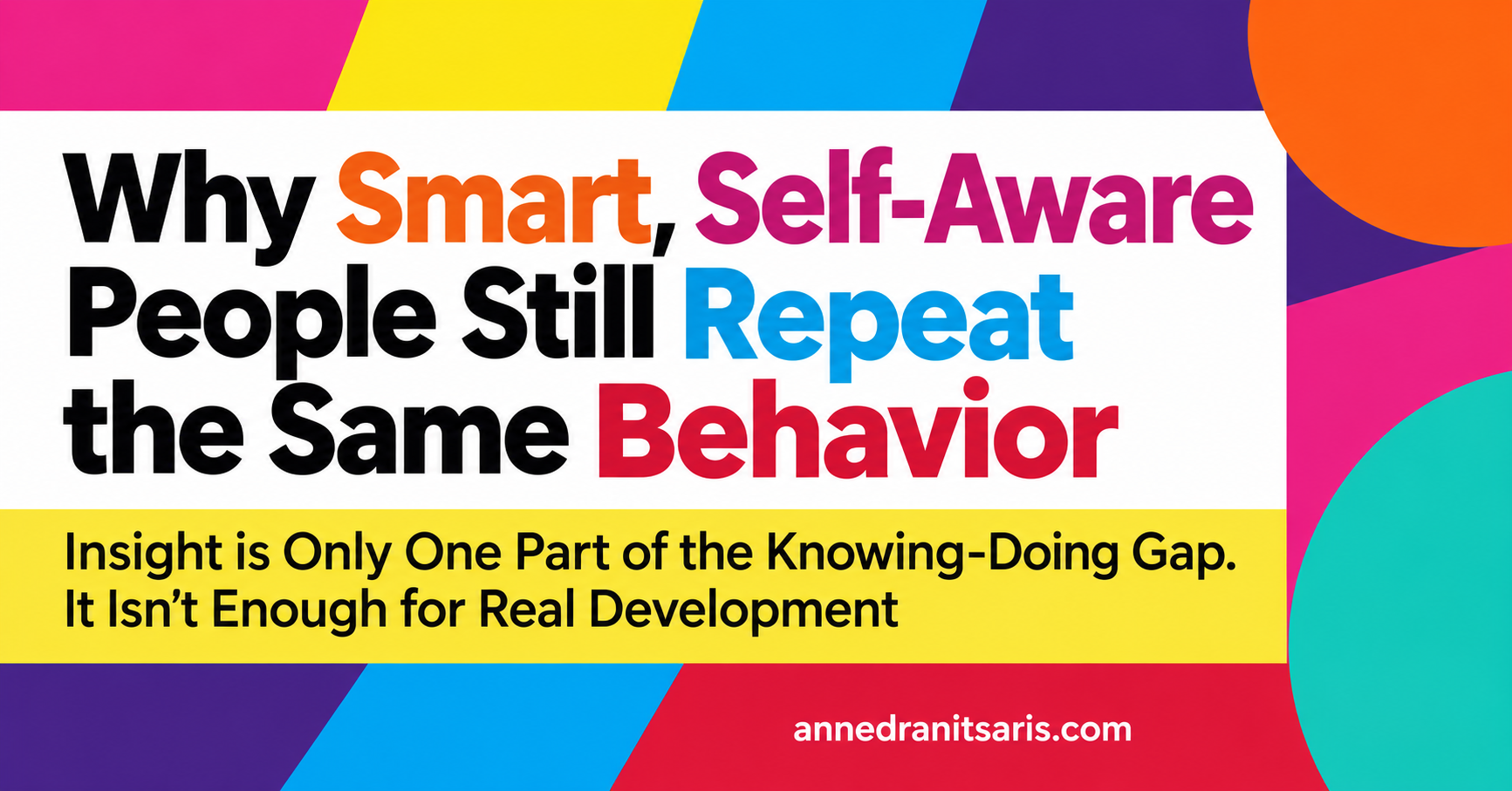
    That is because insight is not the same as development.

    The Persona Loves Self-Improvement

    The adaptive persona is the part of us that formed early to help us stay emotionally safe. It learned how to belong, adapt, perform, please, manage, achieve, avoid rejection, and reduce the risk of disapproval. It helped us survive environments where being fully ourselves may not have felt safe, welcome, or possible.

    The persona is not bad. It had a job. It helped us self-regulate and protect our authentic self.

    The persona is highly invested in self-improvement because self-improvement leads to perfection, which equals safety. It also gives it something to do. It can keep learning, searching, analyzing, fixing, and striving. It can stay busy gathering insight while still avoiding the deeper vulnerability of being with the undeveloped capacities of the authentic self.

    This is why more information alone does not create lasting change. Information is processed through the rational brain. It can help us understand our patterns, explain our reactions, and manage ourselves more consciously, but it does not necessarily move us out of the adaptive persona.

    In fact, too much information can strengthen the persona’s ability to understand itself without actually transforming the self. We may become better at naming our behavior, analyzing our history, and explaining why we react the way we do, while still repeating the same protective patterns.

    Developing the authentic self requires more than insight. It requires new behavior, emotional practice, and the gradual development of capacities that may have been delayed or underused. We need to build tolerance for uncomfortable emotions, practice different responses in real relationships, strengthen boundaries, express our needs more directly, and learn to stay connected to ourselves when old fears are activated.

    Change happens when awareness becomes embodied capacity. It is not simply what we understand about ourselves. It is what we are able to do differently when our nervous system, emotions, and relationship patterns are under pressure.

    Busyness Can Feel Like Safety

    Many of us confuse movement with development. When we are busy, we feel productive. When we are learning, we feel hopeful. When we are working on ourselves, we feel as though we are doing something useful.

    And sometimes we are.

    But busyness can also be a socially approved way of regulating anxiety. It gives the persona reassurance: “I am trying. I am improving. I am doing something. I am okay for now.”

    The problem is that the relief does not last. The course ends. The insight fades. The journal entry is written. The podcast is over. Then the old feeling returns, and we begin searching again for the next thing that might finally make us feel whole.

    This is how self-improvement can become a loop. We keep reaching for more insight, more strategies, more healing, and more answers, while the authentic self waits for the one thing the persona finds hardest to offer: presence.

    Development Requires a Different Pace

    The authentic self does not develop through pressure. It does not emerge because we shame ourselves into being better, force ourselves to change, or chase one more breakthrough.

    It develops through attention, safety, practice, and presence.

    This is quieter work. It often begins when we stop asking, “What is wrong with me?” and begin asking, “What in me did not get the support it needed to develop?”

    That question changes everything.

    It moves us out of the fixing mindset and into a developmental mindset. Instead of treating ourselves as broken, defective, or endlessly in need of repair, we begin to see that many of our patterns began as adaptations. They were ways of staying safe, preserving connection, and regulating emotions before the authentic self had the capacities it needed to respond differently.

    The goal is not to get rid of the persona. It is there to serve the authentic self, not to keep protecting it when no protection is necessary. The goal is to stop letting it lead your life and relationships.

    A New Resource Is Coming

    Next week, my new ebook, The 16 Capacities of the Authentic Self, will be available on my website.

    This ebook is a companion to what I introduced in my book, Are Your Relationship Rules Ruining Your Happiness? It includes chapters on the 16 developmental capacities that strengthen the authentic self, enabling us to shift from living from the adaptive persona to living from the authentic self.

    If you have spent years trying to fix yourself and still feel stuck, this framework may help you see yourself differently. The issue may not be that you have failed to fix yourself. It may be that the capacities of your authentic self are still waiting to develop.

    In my next article, I will explore why the fixing mindset keeps us trapped and how developing the capacities of the authentic self offers a more compassionate and effective path forward.

    You are not broken.

    You are developing.

  • Before You Get Mad at Yourself Again for Giving In . . .

    Before You Get Mad at Yourself Again for Giving In . . .

    Take the Are Your Relationship Rules Ruining Your Happiness? quiz to discover the hidden rule that may be making self-abandonment feel like love.

    There is a funny thing that happens when people start looking honestly at their relationships. They begin by talking about the other person. The partner who shuts down. The friend who takes too much. The adult child who only calls when they need something. The parent who still knows how to make one sentence feel like a guilty verdict on all your failings.

    And to be fair, sometimes the other person really is doing the thing. They are avoiding, demanding, withdrawing, criticizing, overstepping, or expecting you to bend yourself into whatever shape makes their life easier.

    But then comes the more interesting question. Why do you keep playing the same part?

    It’s not because you are weak. Not because you are foolish. Not because you “attract” narcissistic, toxic, or difficult people, which are phrases that sound insightful until they become another way to blame yourself. Usually, you keep playing the same part because somewhere along the way, you learned a rule about what being in a relationship requires you to do.

    When Being Easy Costs Too Much

    Maybe the rule is that you should always think of others first. “You shouldn’t ask for what you want, because it’s selfish.” “Expressing needs is a no-no, because you should never be needy.” “You should be pleasant, manageable, understanding, and low maintenance.”

    The only difficulty with following these unconscious rules in your relationship is that you may eventually discover you have been making everyone else happy at your own expense.

    When the rules revolve around being useful and having to “earn” love, you become the helper, the fixer, or the rescuer. “You should always offer to help, even when you are busy.” “You should anticipate what others need and make sure they aren’t doing without.” “You should be the one who notices, organizes, remembers, follows up, smooths things over, and keeps everything from falling through the cracks.”

    The only difficulty with following these unconscious rules is that you may eventually discover you are no longer being loved for who you are but relied on for what you do.

    These rules keep you disconnected from your needs, and the capacities of the authentic self needed to self-regulate, assert yourself, and negotiate in relationships remain undeveloped.

    Your Rules Feel Like Common Sense

    These rules belong to the brain’s self-protective system and to the adaptive persona that learned how to keep you regulated and safe in relationships. Because you have followed your “shoulds” for so long, they just seem like common sense. You might even see them as proof that you are being loving, loyal, mature, kind, patient, or responsible. But that’s just trying to be good to get approval from others.

    That is why most people do not realize they are living by relationship rules at all. In fact, when I ask clients about the rules they follow in relationships, I am often met with a blank stare. They tell me they do not have any rules. And they are telling the truth, at least from their conscious awareness.

    But we all have unconscious relationship rules. If I ask someone whether they believe they should put others first, avoid disappointing people, keep the peace, be understanding, or help when someone is struggling, most people will not hear those as rules. They will hear them as common sense or evidence that they are a good person. It is only when we begin exploring the hidden “shoulds” behind our choices that the rules become visible.

    Once clients start paying attention, they are often surprised by how many of these rules are operating in the background. And how they expect others to follow the same rules without ever having acknowledged them, let alone spoken about them.

    If a rule arrived with flashing lights and a warning label saying, “You are about to abandon yourself in order to self-regulate and manage your partner,” most of us would at least pause. But this isn’t the way it happens. When the adaptive self is triggered and believes it needs to protect you, the rule shows up as guilt, urgency, anxiety, overthinking, resentment, or the familiar pressure to do what you have always done.

    What the Quiz Helps You See

    This is why I created the “Are Your Relationship Rules Ruining Your Happiness?” quiz. The quiz is designed to help you see the invisible instructions that operate beneath your relationship patterns. It helps you notice the rules that may be informing how you give, tolerate, react, protect, please, explain, withdraw, or overfunction.

    For example, someone may believe they are simply being understanding when they repeatedly excuse behavior that hurts them. But underneath that pattern may be a rule that says, “I should always be empathetic and understanding. If I don’t, I will be mean and selfish.” Someone else may think they are just conflict-avoidant, when what is really happening is that their nervous system has learned to treat disagreement as a threat to self-regulation. Another person may pride themselves on being independent while quietly living by the rule, “I should never need anyone, because needing people makes me weak and needy.”

    Resuming the Development of Your Authentic Self

    Once you begin to see the rule, the whole pattern looks different. You are no longer asking, “Why do I keep doing this?” as though the answer is another reason to judge yourself. You are asking, “What did this once help me survive?” That question comes from curiosity, not criticism, and it opens the door to far more compassion and far more power. A rule that was once necessary may have protected you in the past, but that does not mean it still belongs in the relationships you are trying to create now.

    This is the purpose of the quiz. It gives you a way to explore the shoulds and rules that are operating in the present so you can begin to rewrite them. Instead of seeing yourself as broken, needy, too sensitive, too much, too giving, too guarded, or too difficult, you begin to recognize the adaptive pattern. You begin to understand why certain situations activate you so quickly, and you notice the moment when your authentic self is pushed aside, and the adaptive persona takes over.

    The quiz is not about magically changing every relationship in your life. That would be a very suspicious quiz. It is about identifying where you may be showing up in relationships from your adaptive persona because the capacities of your authentic self have remained underdeveloped.

    Once you can see your pattern clearly, you can make different choices. You may start to notice when you are responding from truth and when you are responding from fear. You may begin to ask whether the rule you are following actually belongs to the adult you are now or to a younger part of you that learned to self-regulate by being good, competent, independent, or easy-going.

    And once you can see that, you can begin the work of becoming who you are meant to be.

    Ready to find out what rules have been running your relationship behavior from behind the scenes?

    Take the Are Your Relationship Rules Ruining Your Happiness? quiz. Take the quiz and start uncovering the hidden “shoulds” shaping your choices, reactions, and happiness.

    Ready to develop the capacities of the authentic self that keep you stuck in adaptive patterns of behavior in your relationships?

    My free guide, The 16 Capacities of the Authentic Selfwith its mini self-assessment questions, helps you identify and begin building the inner capacities that help you love, speak, choose, set limits, and stay connected without abandoning yourself.

  • Why Relationship Patterns Keep Repeating and How to Begin Changing Them

    Why Relationship Patterns Keep Repeating and How to Begin Changing Them

    Understanding the Pattern

    Many people come to therapy or coaching with the same painful question: Why does this keep happening in my relationships? The details may change, but the emotional experience often feels familiar. You may find yourself overgiving, avoiding conflict, choosing emotionally unavailable partners, or feeling responsible for everyone else’s well-being while your own needs go unmet.

    These repeating dynamics are rarely random. They are often rooted in early emotional development, learned relationship rules, and adaptive strategies that once helped you cope but no longer support the life or relationships you want today. What once protected you may now be limiting your ability to connect, communicate, and lead from your authentic self.

    Why Old Patterns Feel So Strong

    Relationship patterns are powerful because they operate beneath conscious awareness. Over time, people develop internal rules about love, safety, conflict, worth, and belonging. These rules can sound like: be strong, do not need too much, keep the peace, prove your value, or never disappoint anyone. Even when these beliefs create distress, they can still feel familiar and therefore safe.

    Lasting change begins when you understand not only what you do in relationships, but why those patterns developed in the first place.

    This is why insight alone is not always enough. You may recognize a pattern intellectually and still feel pulled to repeat it. Real change requires a deeper process of emotional understanding, self-awareness, and developmental growth.

    Signs a Relationship Pattern May Be Running Your Life

    • You repeatedly choose relationships that leave you feeling unseen or emotionally depleted.
    • You struggle to set boundaries without guilt or fear of rejection.
    • You feel responsible for managing other people’s emotions.
    • You avoid difficult conversations until resentment builds.
    • You tie your worth to being needed, productive, or pleasing.
    • You feel disconnected from your own needs, preferences, or voice.

    If any of these feel familiar, it does not mean you are broken. It means there is a pattern worth understanding with compassion and clarity.

    How Change Becomes Possible

    Healing relationship patterns is not about blaming the past. It is about recognizing how your emotional development shaped the ways you protect yourself, seek connection, and respond under stress. With the right support, you can begin to identify the hidden rules guiding your choices and develop new ways of relating that are healthier, more grounded, and more authentic.

    Through psychotherapy, relationship coaching, and developmental work, it becomes possible to strengthen self-awareness, build emotional capacity, and create relationships that reflect who you truly are rather than who you learned you had to be.

    A More Authentic Way Forward

    Whether you are navigating recurring relationship challenges, codependency, imposter syndrome, or the pressure to hold everything together, meaningful change starts with understanding your patterns at their root. When you begin to see yourself more clearly, you can make different choices with greater confidence, self-trust, and emotional freedom.

    Anne Dranitsaris, Ph.D. helps individuals explore the deeper dynamics shaping their relationships, emotional development, and leadership. This work is designed to support lasting transformation, not just symptom relief, so you can move toward healthier relationships and a more authentic life.