Author: 1055119pwpadmin

  • Who’s Showing Up in Your Relationships?

    Who’s Showing Up in Your Relationships?

    Do you know which version of you most often shows up in your relationships?

    It’s a simple question, but it isn’t an easy one to answer honestly. Most of us know who we are and even how we would prefer to behave. That doesn’t mean that it’s the person we form relationships with. The self who shows up in a relationship depends far more on whether we arrived in adulthood with a secure attachment.

    You may have noticed how quickly it happens. At home, at work, in friendships, with family, and even with clients, you can shift almost as quickly as you change your clothes. A familiar way of being takes over before you even realize what you are doing.

    You might have had a bad day at work and spent the whole drive home looking forward to unwinding with your partner. But the moment you walk through the door, you pick up the emotional tone in the room. Something feels off. Without stopping to ask what you need, you become the supportive one. You comfort them, reassure them, offer to make dinner, suggest they relax, and maybe even offer a massage. In a matter of minutes, your own need to decompress disappears behind the role your persona knows how to play.

    The same thing happens at work. You may walk into a meeting ready to contribute, but the moment someone questions your idea or seems unimpressed, your attention shifts. You stop being connected to what you know and start managing how you’re being received. You explain more than you need to. You soften your point. You look for approval. You offer to do extra work. You make yourself useful, so no one can question your value. By the time the meeting ends, you’ve survived the experience with your image intact instead of simply participating in it.

    Those familiar behaviors belong to your adaptive persona, and this is how it works. It doesn’t ask, “What do I feel?” “What do I want to express?” or “What do I need right now?” It asks, “What do I have to become to keep this emotionally safe?”

    THE AGENDA IS SAFETY, NOT AUTHENTICITY

    Your adaptive persona isn’t your authentic self. It is the version of you that developed to regulate your own emotions and manage others’. Its agenda is safety, not authenticity. It learned how to reduce tension, prevent escalation, stay acceptable, manage uncertainty, and keep you functioning when your nervous system didn’t feel secure.

    So the real question is not only, “Who am I in this relationship?” It is, “Who do I become when I don’t feel safe to be myself?”

    At home, do you become the one who keeps things calm because tension feels unbearable? Do you carry the emotional weight because it gives you a sense of control? Do you become overly responsible because someone has to hold everything together?

    At work, do you become the one who proves, performs, overdelivers, hides uncertainty, avoids asking for help, or waits for recognition to confirm that you matter?

    These patterns can look functional from the outside. Other people may even reward them. They may see you as dependable, capable, generous, professional, loyal, or easy to work with. But inside, you know when you are not fully there as yourself. You know when you are managing the room instead of being in the room.

    THE RULES RUNNING BENEATH THE SURFACE

    Your adaptive persona does not operate randomly. It is run by rules.

    These rules tell the persona what to do when emotional safety feels uncertain. They tell it when to become agreeable, when to stay quiet, when to rationalize, when to take care of everyone, when to withdraw, when to overfunction, and when to hide what you actually need.

    You may not consciously hear the rule in your mind, but you live it in your relationships. It shows up in the moment you soften your truth to avoid tension, offer help before anyone asks, work harder to be recognized, or become self-sufficient when you really want support.

    The rule is often disguised as responsibility, kindness, patience, independence, ambition, loyalty, or strength. But underneath the behavior, the persona is trying to keep you regulated. It is trying to lower anxiety, prevent conflict, manage another person’s reaction, avoid disappointment, and protect you from feeling emotionally exposed.

    That is why the same pattern follows you into different relationships. The people may change, but the rule remains active because it lives inside the adaptive persona. Until you can see the rule, the persona keeps deciding who you become.

    WHY YOU DON’T FEEL SAFE TO BE YOU

    If you’ve ever wondered what’s still holding you back after all the work you’ve done, the question is: Why does it still feel unsafe to be my authentic self in relationships?

    Most often, it is because more of your developmental energy went into staying safe during your formative years than into building the relationship capacities of your authentic self. You may have experienced trauma, have ADHD, or you may be a survivor of childhood neglect or abuse.

    Your persona learned how to change your behavior to self-regulate, manage others’ emotions, and preserve connections, but that does not mean you developed the inner capacities needed to show up as yourself in relationships.

    This all explains why your adaptive persona is so strong.

    It is also the call for you to pick up your development where it left off and become who you are meant to be in relationships.

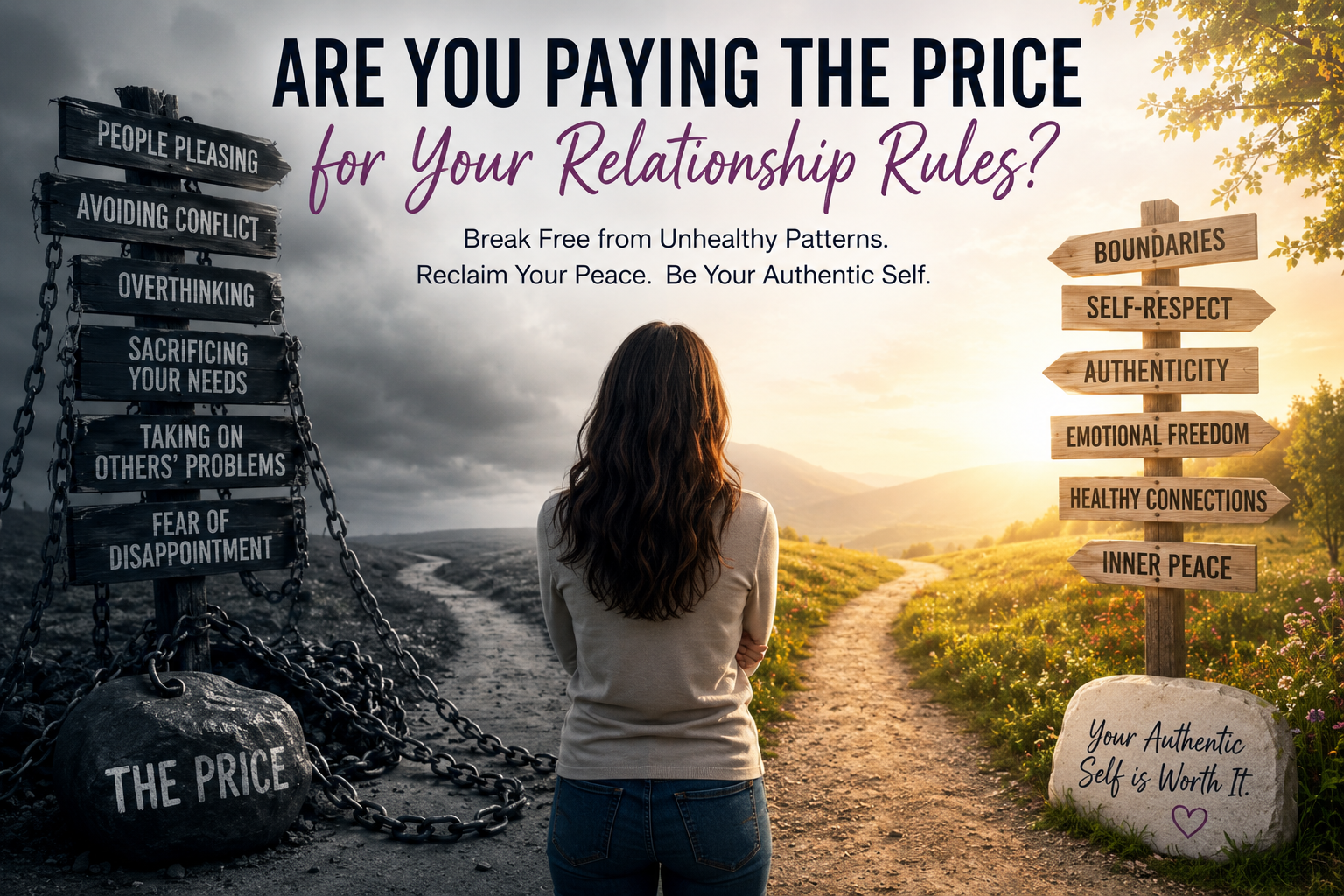
    My book, Are Your Relationship Rules Ruining Your Happiness? will help you understand the rules your adaptive persona has been living by, why those rules keep shaping your relationships, and how to begin building the capacities that allow your authentic self to show up.

    NOW AVAILABLE ON AMAZON: Are Your Relationship Rules Ruining Your Happiness? How Unconscious Relationship Patterns Sabotage Love—and How to Break Free. Take advantage of the book launch special price until May 15, 2026.

  • Why You Keep Repeating the Same Emotional Patterns

    Why You Keep Repeating the Same Emotional Patterns

    Your Brain Is Not Trying to Ruin Your Life. It Is Trying to Protect the Story It Already Knows.

    Have you ever watched yourself react and wondered, “Why am I doing this again?”

    You know you’re overreacting. You know you’re getting pulled into the same argument, the same relationship dynamic, the same shutdown, the same caretaking, the same need to explain, prove, defend, rescue, withdraw, control, or make everything okay. You can see the pattern clearly after the fact, yet when it’s happening, something takes over. It’s like your brain has been hijacked, and your body tenses. Your mind races. Your emotions surge. Your old story becomes the only story that you listen to.

    This is why people feel so ashamed of their patterns. They think, “I should know better by now.” But the problem is not that you don’t know better. The problem is that the part of your brain responsible for survival does not care what you know when it believes you are under threat. Our instinctual brain doesn’t remember; it reacts.

    The instinctual brain does not wait for a thoughtful discussion before it reacts. It scans for danger, compares the present moment to what it has already lived through, and decides almost instantly whether you are safe or not. The threat may not be physical. It may be emotional. A look, a tone, a delay in response, someone’s disappointment, a criticism, a partner pulling away, a child’s anger, a client’s disapproval, or the possibility of conflict can be enough to activate your self-protective survival system.

    Once that happens, you aren’t responding to the situation in front of you. You are reacting to the story your nervous system believes is happening.

    The story driving the reaction may be, “They’re angry that I don’t agree, and I’m going to get in trouble.” It may be, “I’m not safe unless I keep everyone happy.” It may be, “If I stop managing their emotions, I am going to be blamed for their feelings.” It may be, “If I ask for what I want, I’ll be shamed for being needy. I’d better not say anything.”

    These stories are not intellectual ideas. They are survival conclusions formed in childhood experience and repeated enough times that your brain and body learned to treat them as truth. They are the rules you live by in relationships.

    The Adaptive Persona Is the Brain’s Survival Strategy

    The adaptive persona is the version of you that developed when you needed to survive emotionally. It was built around what was necessary at the time. If being pleasing reduced conflict, pleasing became part of the strategy. If being capable brought approval, capability became armor. If taking responsibility for everyone’s feelings created a sense of control, overfunctioning became automatic. If staying quiet kept you from being criticized, silence became protection. If rescuing others made you feel needed, rescuing became part of this adaptive identity.

    The adaptive persona is not a flaw. It is evidence of intelligence, sensitivity, and adaptation. It shows how hard your self-protective system worked to keep you emotionally regulated, accepted, useful, and safe. The difficulty is that the adaptive persona does not know when the original danger is over. It continues to organize your reactions long after the circumstances have changed.

    This is why you may be a mature, capable, insightful adult and still feel like a frightened, angry, ashamed, rejected, or desperate younger part of yourself when you are triggered. The adaptive persona does not operate from your current age, wisdom, or adult capacity. It operates from the emotional age at which the pattern was formed. Its development stalled there and remains delayed.

    When that part of you takes over, you do not simply think differently. You become different. Your voice changes. Your posture changes. Your assumptions change. Your ability to listen changes. Your capacity for choice narrows. The old story becomes louder than the present truth.

    Why the Same Pattern Keeps Repeating

    Most people try to change patterns by focusing on behavior. They tell themselves they will stop caretaking, stop reacting, stop chasing, stop avoiding, stop exploding, stop apologizing, stop explaining, or stop choosing unavailable people. They make sincere promises to themselves. They mean every word. Then the next emotionally charged situation arrives, and the same response returns.

    This happens because the behavior is not the root of the pattern. The behavior is the outcome of a threat response from the instinctual brain.

    A person does not overgive simply because they are generous. They may overgive because their brain has learned that giving prevents rejection, anger, guilt, or emotional distance. A person does not control everything simply because they like control. They may control because uncertainty activates helplessness. A person does not avoid conflict simply because they prefer peace. They may avoid conflict because disagreement once felt dangerous, humiliating, destabilizing, or impossible to repair.

    This is why advice often fails. “Set a boundary” sounds simple until the body reacts as if setting a boundary will cost you connection. “Speak up” sounds empowering until your nervous system interprets honesty as danger. “Stop rescuing” sounds obvious until another person’s distress activates the old rule that you are responsible for fixing it.

    The pattern continues because the brain is trying to prevent the old pain from recurring. It does not ask, “Is this good for my growth?” It asks, “Have I survived this before, and what did I do then?”

    That is the power of the old story. The brain repeats what it knows because familiarity feels safer than freedom.

    Your Trigger Is a Doorway Into the Pattern

    A trigger is often misunderstood as a sign that something is wrong with you. It is more useful to see it as a doorway. It reveals where the nervous system has attached meaning to a situation. The trigger tells you that your brain has connected what is happening now with something it already knows.

    When someone does not respond quickly, the story becomes “I don’t matter.” Someone is disappointed, and the story becomes, “I have failed.” Someone disagrees, and the story becomes, “I’m under attack.” Someone needs something from you, and the story becomes, “I have no choice.” Someone praises you, and the story becomes, “They don’t really mean it.” Someone offers care, and the story becomes, “I don’t deserve this.”

    Once the story is activated, your body begins to behave as if it were true. You may feel anxious, defensive, resentful, ashamed, guilty, responsible, frozen, or desperate to make things right. You may start explaining yourself before anyone has accused you. You may apologize when you have done nothing wrong. You may say yes while your whole body is saying no. You may become critical or controlling because vulnerability feels too exposed. You may shut down because staying present feels unbearable.

    This is not random. It is organized. The brain is not inventing a reaction in the moment. It is following a pathway laid down during the formative years, then strengthened each time the same emotional threat appeared. What began as a narrow path became a well-traveled road, and over time, a survival superhighway. When the brain senses a familiar threat, it does not pause to ask whether the old story is still true. It takes the fastest route it knows.

    Insight Helps, But It Doesn’t Rewire the Pattern

    Many people who come to this work already understand a great deal about themselves. They know their childhood history. They know they have abandonment wounds, codependent tendencies, perfectionistic standards, trauma responses, attachment injuries, or difficulty setting boundaries. They may have read the books, listened to the podcasts, attended therapy, and developed language to describe what happened to them.

    Yet the same pattern still shows up.

    That can feel discouraging, but it actually reveals something important. Insight gives you language. It helps you name the pattern, understand where it came from, and stop blaming yourself for reactions that once made sense. But insight belongs largely to the rational brain. It helps you understand the story; it does not automatically reach the instinctual survival brain that is still scanning for threat.

    When the survival brain is activated, it does not stop to consider what you have learned, what you have read, or what you now understand about yourself. It reacts from the old pathway, the one built through repeated emotional experience. To that part of the brain, the old story still feels true. The threat still feels real. The old response still feels necessary.

    To change a survival pattern, you have to work with the system that is running it. That means slowing down the automatic reaction, identifying the underlying emotional rule, recognizing the adaptive persona that has taken over, and building enough internal safety to choose a different response.

    You cannot shame a survival pattern into changing. You cannot lecture it into disappearing. You cannot bypass it with positive thinking. The part of you that developed the pattern needs to be understood, regulated, strengthened, and given a new experience of safety.

    The Emotional Rule Beneath the Reaction

    Underneath every repeated pattern is an emotional rule. Rules began as a child’s conclusions, became beliefs, and emerged as adult relationship rules. These rules are often unconscious, but they shape how you relate, love, work, lead, parent, and protect yourself.

    The rule may be, “I have to be useful to be valued.” It may be, “I must not upset people.” It may be, “I have to be strong because no one will help me.” It may be, “If someone is unhappy, it is my job to fix it.” It may be, “I cannot trust myself unless others approve.” It may be, “I should not need too much.” It may be, “If I relax, something will go wrong.” It may be, “If I let people see the real me, they will leave, criticize, or reject me.”

    These rules are so familiar that they feel obvious and right. People say, “This is just how I am.” But often, it is not who you are. It is who you became in order to manage emotional threat.

    This distinction matters because if you believe the adaptive persona is your authentic self, you will keep trying to improve it. You will become a better pleaser, a more polished overfunctioner, a more impressive performer, a more controlled rescuer, or a more acceptable version of the person who keeps abandoning herself internally.

    Healing begins when you can say, “This is a pattern. This is a rule. This is a survival reaction. This is not my authentic self.”

    Relationship Patterns Are Where the Old Story Shows Itself Most Clearly

    Relationships activate our deepest survival patterns because relationships touch our earliest needs for attachment, safety, recognition, autonomy, comfort, repair, and belonging. You may function well professionally, appear confident socially, and manage responsibilities effectively, yet still become highly reactive in intimate or emotionally important relationships.

    This is because relationships do not simply ask us to behave well. They ask us to stay connected to ourselves while also staying connected to another person. That requires self-awareness, emotional development, and the ability to identify the developmental delays of the capacities of the authentic self needed for secure attachment. Without those capacities, the adaptive persona steps in and does what it has always done. Keep you safe by reacting by submitting, controlling your emotions, or becoming defensive. It may try to avoid vulnerability by intellectualizing everything. It may try to feel powerful by withdrawing first. It may try to feel needed by rescuing.

    In the moment, these reactions feel necessary. Afterward, they often feel painful, confusing, or self-betraying. I often hear clients say, “Why do I keep acting like that when I know better?”

    The problem is that trying to figure yourself out from the rational mind leads you in the wrong direction. The simplest answer is often the most important one: your brain perceived a threat. Once that happened, your adaptive persona reacted through the old survival pathway wired to protect you. In that moment, the survival brain hijacked the rational brain, making logic, insight, and choice much harder to access.

    That reaction is the signal. It tells you that the adaptive persona has been running the relationship instead of the authentic self.

    How I Work With These Patterns

    The way I work is designed to get beneath the surface behaviour and into the inner system that keeps the pattern alive. We do not simply talk about what happened this week and then come up with a strategy to do better next time. We slow the pattern down so you can observe it as it is happening, rather than being taken over by it.

    We identify what triggers you, what story gets activated, what your body does in response, what adaptive persona takes over, and what emotional rule begins directing your behaviour. We explore where the pattern began, why it once made sense, and how it continues to shape your relationships, choices, boundaries, leadership, communication, and sense of self.

    This work is grounded in mindfulness. It helps you develop an observing self, the part of you that can notice what is happening inside you without immediately reacting from it. This is compassionate work, but it is not passive. It asks you to stay present when you are triggered into self-protection, especially when there is no real threat in the present moment. It asks you to pause, notice, breathe, and anchor yourself in what is happening now, rather than being pulled automatically into the old survival story.

    Mindfulness also helps you recognize the inner conflict between the brain’s self-protective and self-actualizing systems. The adaptive persona is trying to protect you by reacting from the instinctual brain and following the old rules. The authentic self is trying to develop, relate, choose, and respond from the rational brain and from who you are now. The work is to observe both without judgment.

    The goal is not to blame the past or stay endlessly focused on the wound. The goal is to develop the emotional capacity, self-awareness, and nervous system regulation needed to respond from your authentic self, rather than from the survival story your brain keeps repeating.

    In practical terms, this means learning how to recognize the pattern before it takes over. It means pausing long enough to notice the threat response. It means identifying the relationship rule rather than obeying it. It means tolerating the discomfort of doing something different. It means developing boundaries that are not driven by anger or guilt. It means communicating with clarity rather than defensively. It means remaining present when your old pattern wants to rescue, retreat, appease, control, explain, collapse, or attack.

    This is how the brain begins to lay down new pathways. Not because you forced yourself to be different, but because you created enough awareness, presence, and internal safety to practice a new response.

    You Are Not Doomed to Repeat the Story

    The story your brain has been protecting is not the final truth of your life. It is a survival map created from earlier experiences. At one time, it may have helped you navigate emotional uncertainty, avoid conflict, earn approval, maintain connection, or protect yourself from disappointment. But a survival map is not the same as a life path. It simply shows you where the developmental delay occurred and where you need to resume your development.

    You can understand the pattern without being controlled by it. You can respect the adaptive persona without letting it lead your relationships. You can honor what protected you while choosing to develop beyond it. You can learn to recognize the moment when your brain says, “This is dangerous,” and ask whether the danger is real or whether the old story has been activated again.

    That is where development resumes. It begins in the space between trigger and reaction. It begins when you can feel the old pull without automatically obeying it. It begins when you can say, “I know this story, but I do not have to live from it.”

    A Call to Begin the Work

    If you keep finding yourself in the same reactive relationship pattern, the answer is not another promise to try harder. Trying harder often strengthens the adaptive persona because it keeps you working from the same relationship rules.

    The deeper work is to understand what your brain is protecting, what your nervous system is reacting to, what emotional rule is directing your behavior, and what part of you needs to develop so the old story no longer takes over.

    This is the work I do with clients. We go beneath the behavior, beneath the repeating relationship dynamic, beneath the guilt, anger, fear, overgiving, shutdown, control, perfectionism, and self-doubt. We work with the pattern at its root so you can begin responding from your authentic self rather than from the adaptive persona that has been trying to keep you safe.

    If this conversation feels uncomfortably familiar, it may be because you are ready to stop explaining the pattern and start changing it. You do not have to keep living from the same story, reacting to the same threat response, and calling it who you are.

    Book a discovery call, and let’s begin the work of understanding the relationship pattern that has been running your life, so you can finally develop the freedom to respond differently and become who you are meant to be.

    ___________________________________________________________________________

    Not ready to chat yet? If you recognize yourself in these patterns, my book, Are Your Relationship Rules Ruining Your Happiness? How Unconscious Relationship Patterns Sabotage Love—and How to Break Free will help you understand the hidden rules, survival responses, and adaptive persona that keep you repeating the same relationship story.

    This book is for you if you’re ready to stop blaming yourself, stop trying to “figure it out” from the same old mindset, and begin seeing the deeper pattern that has been running beneath your choices. It will help you understand why you react the way you do, why insight alone hasn’t been enough, and what needs to change so you can begin relating from your authentic self instead of from fear, guilt, overgiving, control, or self-protection.

    Order your copy today and begin the work of breaking the relationship rules that have been keeping you stuck.

  • Has Struggle Become Your Identity?

    Has Struggle Become Your Identity?

    Time to stop glorifying struggle and start building relationship capacities.

    Somewhere along the way, struggle became a status symbol. We speak about our anxiety keeping us up at night, our trauma, and pushing through as if endurance itself were proof of growth. It is not. It is often a sign that your nervous system is stuck in hypervigilance, while the part of you that needs care waits in the hallway. The more we glorify struggle, the more we postpone development. Not the flashy kind of change, but the real work of building the capacity to live as your Authentic Self.

    Struggle is not interesting when it becomes a personality. It is the same story told at a higher volume. You brace. You try harder. You get praised for your pain, for having been a victim. Inside, not much moves. If you were taught that belonging is earned through effort, you will keep performing even when the performance costs you your voice. The problem is not that you are weak. The problem is that your survival habits are still running the show and calling it struggle.

    Yet this type of struggle has no beginning and no ending. It is a regulatory feedback loop that you created to keep you safe. While you struggle, you feel like you are doing something.

    We talk about our anxiety keeping us up at night, our trauma, our overthinking, and how hard we push through, as if endurance itself equals evolution. “It is hard” becomes the identity, and “I am trying” becomes the badge of honor.

    But trying hard does not always mean you are developing. Sometimes it means your brain is stuck in hypervigilance, and the part of you that needs care and development is still waiting for permission to emerge. Struggle can be real and seductive. While you struggle, you feel like you are doing something. It’s the same as when you worry, catastrophize, or become anxious about things that haven’t happened yet. You brace, you push, you endure. It looks like you are doing the work, yet it often keeps the deeper work postponed.

    When Struggle Becomes a Persona

    There is a point where struggle stops being something you do and becomes how you identify yourself. The story stays the same, just told with more intensity. You carry more. You explain more. You justify more. You get praised for surviving all of the hard things in your life, for being the one who can handle it, for being the one who keeps going. It is easy to mistake that praise for approval and recognition, and so you keep it going.

    The Developmental Delay No One Talks About

    When core childhood needs are not met, particularly psychological safety, mirroring, belonging, acceptance, and recognition, something very specific happens inside the psyche. The Authentic Self does not disappear, but it becomes less available. It steps back. In its place, you build a Persona that knows how to manage others by changing your behavior. That Persona becomes skilled at coping.

    This is where many adults are stuck in their relationships. They become high-functioning, capable, and outwardly successful, yet inwardly they remain insecure, overly vigilant, and unusually sensitive to relational threat. Their relationship pattern has been organized around survival. That is what a developmental delay looks like. It is not a flaw. It is not a weakness. It is simply the result of capacities that were never fully developed because the conditions for their development were not consistently present.

    The Shift That Changes Everything

    There is a turning point that I watch for. It happens when someone stops asking, “Why is this so hard?” and begins asking, “What capacity is missing here?” That single question moves you out of the theater of struggle and into the work of development. It brings you back to your personal agency. It brings you back to choice. It brings you back to the possibility that your self-protective behaviors are not your identity, and that the development of relationship capacities is possible at any age.

    This is exactly why I have written about the ten relationship capacities in my book, Are Your Relationship Rules Ruining Your Happiness? They are not “tips.” They are not personality traits. They are developmental capacities that allow love to become sustainable, conflict to become workable, and intimacy to become safe. When these capacities are weak, we default to familiar roles, such as martyrdom, victimhood, overfunctioning, perfectionism, or quiet resentment. When these capacities strengthen, the Persona loses its grip because you no longer need it to survive the ordinary tension of relationships.

    Your Challenge This Week

    Here is the challenge I want you to take seriously. The next time you find yourself telling a struggle story, pause before you finish it. Notice what you are trying to prove. Notice what you are hoping the story will earn you. Then ask yourself what development would look like right there, in that exact moment, in that exact pattern. If you brought agency, not disempowerment, to the conversation.

    If your default is overexplaining, development may be learning to speak plainly. If your default is overgiving, development may be learning to set a limit without guilt. If your default is withdrawing, development may be learning to stay present and name what you feel. If your default is escalating, development may be learning to regulate before you respond. Struggle will always have a storyline. Capacity has a direction.

    Where the Authentic Self Actually Shows Up

    The authentic self does not arrive with a dramatic announcement. It shows up quietly, in ordinary moments, when you stop performing and start relating from truth. It shows up when you do not abandon yourself to keep the peace. It shows up when you tolerate discomfort without turning it into a crisis. It shows up when you let your needs into the room early, rather than waiting until they come out sideways.

    That is development. Not the glamour of surviving. The dignity of becoming.

  • Why More Self-Improvement Does Not Always Lead to Growth

    Why More Self-Improvement Does Not Always Lead to Growth

    Have you ever looked back and thought, “I have done so much work. Why do I still feel stuck in the same place?”

    You have read the books. Taken the courses. Listened to the podcasts. Followed the teachers, therapists, coaches, and spiritual leaders who offered language for what you were experiencing. Maybe you have gathered enormous insight into your patterns, your wounds, your relationship history, and your emotional reactions.

    And still, something in you may feel untouched.

    This is one of the most confusing parts of personal growth. From the outside, it can look as though you are doing everything right. You are learning. Reflecting. Trying. Healing. Improving. But inside, it can feel as though the deepest part of you is still waiting for something different.

    That is because insight is not the same as development.

    The Persona Loves Self-Improvement

    The adaptive persona is the part of us that formed early to help us stay emotionally safe. It learned how to belong, adapt, perform, please, manage, achieve, avoid rejection, and reduce the risk of disapproval. It helped us survive environments where being fully ourselves may not have felt safe, welcome, or possible.

    The persona is not bad. It had a job. It helped us self-regulate and protect our authentic self.

    The persona is highly invested in self-improvement because self-improvement leads to perfection, which equals safety. It also gives it something to do. It can keep learning, searching, analyzing, fixing, and striving. It can stay busy gathering insight while still avoiding the deeper vulnerability of being with the undeveloped capacities of the authentic self.

    This is why more information alone does not create lasting change. Information is processed through the rational brain. It can help us understand our patterns, explain our reactions, and manage ourselves more consciously, but it does not necessarily move us out of the adaptive persona.

    In fact, too much information can strengthen the persona’s ability to understand itself without actually transforming the self. We may become better at naming our behavior, analyzing our history, and explaining why we react the way we do, while still repeating the same protective patterns.

    Developing the authentic self requires more than insight. It requires new behavior, emotional practice, and the gradual development of capacities that may have been delayed or underused. We need to build tolerance for uncomfortable emotions, practice different responses in real relationships, strengthen boundaries, express our needs more directly, and learn to stay connected to ourselves when old fears are activated.

    Change happens when awareness becomes embodied capacity. It is not simply what we understand about ourselves. It is what we are able to do differently when our nervous system, emotions, and relationship patterns are under pressure.

    Busyness Can Feel Like Safety

    Many of us confuse movement with development. When we are busy, we feel productive. When we are learning, we feel hopeful. When we are working on ourselves, we feel as though we are doing something useful.

    And sometimes we are.

    But busyness can also be a socially approved way of regulating anxiety. It gives the persona reassurance: “I am trying. I am improving. I am doing something. I am okay for now.”

    The problem is that the relief does not last. The course ends. The insight fades. The journal entry is written. The podcast is over. Then the old feeling returns, and we begin searching again for the next thing that might finally make us feel whole.

    This is how self-improvement can become a loop. We keep reaching for more insight, more strategies, more healing, and more answers, while the authentic self waits for the one thing the persona finds hardest to offer: presence.

    Development Requires a Different Pace

    The authentic self does not develop through pressure. It does not emerge because we shame ourselves into being better, force ourselves to change, or chase one more breakthrough.

    It develops through attention, safety, practice, and presence.

    This is quieter work. It often begins when we stop asking, “What is wrong with me?” and begin asking, “What in me did not get the support it needed to develop?”

    That question changes everything.

    It moves us out of the fixing mindset and into a developmental mindset. Instead of treating ourselves as broken, defective, or endlessly in need of repair, we begin to see that many of our patterns began as adaptations. They were ways of staying safe, preserving connection, and regulating emotions before the authentic self had the capacities it needed to respond differently.

    The goal is not to get rid of the persona. It is there to serve the authentic self, not to keep protecting it when no protection is necessary. The goal is to stop letting it lead your life and relationships.

    A New Resource Is Coming

    Next week, my new ebook, The 16 Capacities of the Authentic Self, will be available on my website.

    This ebook is a companion to what I introduced in my book, Are Your Relationship Rules Ruining Your Happiness? It includes chapters on the 16 developmental capacities that strengthen the authentic self, enabling us to shift from living from the adaptive persona to living from the authentic self.

    If you have spent years trying to fix yourself and still feel stuck, this framework may help you see yourself differently. The issue may not be that you have failed to fix yourself. It may be that the capacities of your authentic self are still waiting to develop.

    In my next article, I will explore why the fixing mindset keeps us trapped and how developing the capacities of the authentic self offers a more compassionate and effective path forward.

    You are not broken.

    You are developing.

  • Living from Your Authentic Self Is Not Something You Decide to Do, It Is Something You Develop

    Living from Your Authentic Self Is Not Something You Decide to Do, It Is Something You Develop

    Discover the 16 Capacities of the Authentic Self

    Everyone talks about being authentic. We tell people to be true to themselves, trust their inner knowing, stop people-pleasing, speak their truth, stop abandoning themselves, and live more authentically.

    It all sounds right. It even sounds simple.

    But when you are in the middle of a relationship that feels uncertain, sitting across from an overbearing boss, dealing with a reactive mother, or trying to stay grounded with someone who insists you’re a bully or narcissistic, being authentic does not feel like a simple choice. It does not feel like something you can simply decide to do because you read a book, listened to a podcast, or promised yourself that next time would be different.

    It is one thing to look back after the fact and know you were not connected to yourself. You can see that you overexplained, conceded when you knew you were right, took responsibility for someone else’s feelings, or said yes when something inside you was clearly saying no.

    You know you lost yourself.

    The Aftermath of Losing Yourself

    And then comes the familiar aftermath. You spend hours going over what happened, replaying what you should have said, asking why you keep doing this, wondering what is wrong with you, trying to figure yourself out, fix yourself, and promising that next time you will do it differently.

    But what is wired into the brain and nervous system does not change because we shame ourselves, analyze ourselves, make new vows, or try harder to “be authentic.”

    That is why so many people feel defeated by their own reactions. They are not lacking insight. They are not unaware. They may understand their patterns better than anyone. But understanding a pattern is not the same as having the internal capacity to respond differently when fear, threat, conflict, disappointment, or rejection gets activated.

    This Is Not About Being Inauthentic

    The truth is, this is not really about being inauthentic.

    Not at all.

    It is about being triggered. It is about feeling threatened. It is about your self-protective adaptive persona taking over before your authentic self has enough strength, steadiness, and internal capacity to lead.

    That is the part most people miss.

    We tend to focus on the behavior we want to stop. Stop caretaking. Stop overexplaining. Stop people-pleasing. Stop freezing. Stop saying yes. Stop needing approval. Stop reacting. Stop abandoning yourself.

    But rarely do we ask the more important question:

    What capacity of my authentic self was not available to me in that moment?

    That question changes the conversation.

    The Missing Question in Authentic Self Development

    A capacity begins as a seed within the authentic self. We are born with the potential for these capacities, but they must be developed through experience. Childhood is meant to provide the emotional safety, support, mirroring, guidance, and relational conditions that allow these seeds to take root and begin to grow.

    This is why authenticity is more complex than most people realize.

    Being authentic is not only about speaking your truth, saying no, being honest, or doing what scares you. Those behaviors depend on any of the capacities having been developed. When those capacities are developed, the authentic self has enough internal strength to stay present.

    When they are not developed enough, the adaptive persona moves in automatically and predictably, without being invited.

    That is why the behavior keeps returning. You can understand the pattern. You can name the trigger. You can know exactly what you wish you had done. But when the nervous system perceives a threat, the adaptive persona will still move in to protect you because it is stronger, faster, and more familiar than the undeveloped capacity you needed in that moment.

    This is why so many people remain stuck, even after years of insight. They are trying to eliminate adaptive behaviors rather than develop the inner capacities that allow the authentic self to remain present under pressure.

    16 Capacities of the Authentic Self

    Most people do not even know that the authentic self is made up of capacities. Through my work, I have identified at least 16 of them.

    These capacities allow you to know what you feel, stay grounded in your worth, regulate emotional distress, test reality, set limits, act on your own behalf, express what is true, receive love, and remain connected without abandoning yourself.

    What This Guide Will Help You See

    The authentic self is not just a feeling, a concept, or a hidden version of you waiting to be uncovered. It is made up of capacities.

    These are the inner abilities that help you know what you feel, stay grounded in your worth, regulate emotional distress, test reality, set limits, act on your own behalf, express what is true, receive love, and stay connected without disappearing into someone else’s needs, moods, or reactions.

    Through my work, I have identified 16 of these capacities.

    And once you understand them, you begin to see your relationship patterns in a completely different way.

    Instead of asking, “Why did I do that again?” you can begin asking, “What capacity was not available to me in that moment?”

    That question changes everything.

    This Is Not About Fixing Yourself

    If you want to change the way you do relationships, you need more than insight into your patterns.

    You need to know what needs to develop.

    That is why I created The 16 Capacities of the Authentic Self, a free guide drawn from my book, Are Your Relationship Rules Ruining Your Relationship? The 12 Capacities of the Authentic Self gives you a practical way to understand why you may keep repeating relationship patterns you already recognize and what capacities need strengthening so your authentic self can begin to lead.

    What You Will Discover Inside the Guide

    In The 16 Capacities of the Authentic Self, you will learn about the inner capacities that allow you to know what you feel, stay grounded in your worth, regulate emotional distress, test reality, set limits, act on your own behalf, express what is true, receive love, and stay connected without disappearing into someone else’s needs, moods, or reactions.

    You will also complete a mini self-assessment for each of the 16 capacities so you can begin to see where your authentic self is already strong, where development may still be needed, and where your adaptive persona may still be stepping in to protect you. They show you where your authentic self still needs strengthening and where the adaptive persona has been doing a job it was never meant to keep doing forever.

    Start Changing the Way You Do Relationships

    If you are tired of trying to understand your behavior and relationship patterns yet still repeating them, this guide will give you a new way to begin.

    Download The 16 Capacities of the Authentic Self and start seeing your relationship patterns through the lens of development, not failure.

    Because you are not broken and don’t need to be fixed. Your development was just delayed.

    You may simply be ready to develop the capacities that allow you to stay grounded, boundaried, expressive, emotionally steady, and connected without abandoning who you are.

    Anne Dranitsaris, Ph.D.

  • Every Couple Needs a Relationship Vision!

    Every Couple Needs a Relationship Vision!

    Without a shared vision, your relationship garden will still grow, but it may not grow into something you both want to live in.

    What kind of relationship are you actually trying to create? Not just what are you trying to fix, avoid, explain, or get through, but what are you building together?

    Do you know what safety feels like between the two of you? Do you know how you want to handle conflict before you are in the middle of it? Do you know what traditions, touch points, freedoms, responsibilities, and forms of reassurance matter most? Do you know how each of you wants to feel inside the relationship, not just what each of you expects the other person to do?

    Many couples never ask these questions.

    They talk about schedules, family obligations, finances, irritations, disappointments, and what went wrong last weekend. They talk about who forgot what, who needs to change, who feels hurt, and who is not doing enough. Or they go in the other direction and avoid talking about the relationship at all, hoping that if they do not disturb anything, nothing will fall apart.

    Some couples believe the best way to protect the relationship is not to talk about it at all. They are afraid that naming needs will create conflict, that asking questions will sound critical, or that revisiting patterns will make things worse. Silence becomes the strategy. Keep things pleasant. Do not ask for too much. Do not rock the boat.

    Other couples talk the relationship to death. They process every feeling, revisit every wound, and analyze every exchange, but the conversation never seems to move them toward something larger. The relationship becomes a loop of problem-solving without direction. They are talking, but they are not necessarily creating.

    A relationship vision asks a different question: What do we want this relationship to become?

    It moves the couple beyond managing problems and into consciously creating the emotional home they both want to live inside.

    A Relationship Vision Gives Love a Place to Thrive

    A relationship vision is different. It is not another argument about what is wrong. It is not a list of complaints, demands, or corrections. It is a shared picture of the relationship you want to create and live inside.

    Think of your relationship as a garden. Without a vision, something will still grow, but it may not be what you want. The strongest weeds will take over. Old patterns will spread. Unspoken expectations will root themselves deeply. Habits of avoidance, reactivity, resentment, over-functioning, distance, or control can grow quietly until they become the landscape of the relationship.

    A garden does not become beautiful because someone loves it in theory. It becomes beautiful because there is intention, care, attention, pruning, protection, and seasonal renewal. The same is true in a relationship. Love may be the seed, but vision gives it shape.

    A relationship vision asks: What kind of emotional home are we creating? How do we want to communicate? What do we protect? How do we handle conflict? How do we support each other’s individual dreams? What traditions matter? How do we stay connected when life is busy? How do we repair when we become reactive? What does safety feel like between us?

    These questions move a couple out of unconscious survival patterns and into conscious creation.

    Every Couple Has an Unconscious Relationship Contract

    Every couple has an unconscious relationship contract, whether they know it or not. It is the set of unspoken agreements that quietly governs the relationship. Some of these agreements are healthy and supportive. Others are inherited, defensive, or based on old relationship rules.

    Relationship rules are not usually conscious. They show up as “shoulds,” and we bring them from family history, attachment patterns, past hurt, and the adaptive persona we developed to stay safe. One person may have learned to keep closeness by pleasing. Another may have learned to protect themselves by withdrawing. One may pursue reassurance. Another may experience that pursuit as pressure.

    The rules in the unconscious contract might say: “We shouldn’t criticize or give feedback. That isn’t supportive.” “Their needs matter more than mine. I shouldn’t be needy.” “We shouldn’t say things that create conflict.” “I expect reassurance to be automatic.” “We should always do things together. Independence is a sign the relationship is in trouble.” “If one of us is upset, the other person should fix it.” There are many, many relationship rules based on beliefs formed in childhood that ruin relationship happiness.

    Before long, both people are not just relating to each other. They are relating through the rules they learned long before the relationship began and each trying to get the other person to adhere to theirs.

    Relationship Rules Shape What Couples Expect From Each Other

    This is why a relationship vision matters. It gives the couple a chance to ask, “Are we living by old rules, or are we choosing the relationship we want to build?”

    Relationship rules remain invisible until they are made conscious. A partner needs space, and the rule says, “My partner should not need space from me.” Someone asks for reassurance, and the rule says, “If my partner loves me, I should not have to ask.” One person raises a concern, and the rule says, “We should not have conflict if we are okay.” Another person becomes quiet, and the rule says, “My partner should not pull away from me.”

    These rules can make ordinary relationship moments feel threatening. They turn needs into accusations, differences into danger, and emotional discomfort into proof that something is wrong.

    A relationship vision helps couples step back and ask a better question: “What was triggered in me that belongs in the past? What is the actual issue that needs to be addressed?”

    Your Relationship Vision Becomes a New Set of Agreements

    For example, a couple may decide that home is not only a place but also an internal sense of safety, comfort, and belonging they create with each other wherever they are. That becomes part of the vision.

    They may decide that communication will protect the relationship, not be used so one person wins and the other loses. They may agree that when emotions run high, they will use “I” statements, take time to regulate, de-escalate, and return to the issue when they can listen with more care.

    These are not just nice ideas. They are new agreements.

    A couple may decide to honor family and traditions while also protecting the privacy and priority of the partnership. They may choose to identify special dates, rituals, and touch points that help the relationship feel continuous and alive. They may name affection, support, reassurance, and adventure as essential parts of the relationship, not extras to fit in after everything else is handled.

    They may also recognize that a strong relationship needs both togetherness and separation. A couple can be deeply connected while still supporting different dreams, individual goals, and separate growth. In a conscious relationship, separation does not have to mean abandonment, and closeness does not have to mean losing oneself.

    The power of the vision is that it turns vague dissatisfaction into shared direction. Instead of saying, “We need to communicate better,” the couple can say, “We want communication that is protective, curious, emotionally steady, and respectful of both people.” Instead of saying, “We never spend time together,” they can say, “We want to create regular touch points that help the relationship feel alive and continuous.” Instead of saying, “You always react,” they can say, “We want to practice pausing, using ‘I’ statements, and returning to the conversation when we are regulated.”

    Take the Next Step

    If this article helped you recognize some of the old rules or unconscious agreements operating in your relationship, the next step is to understand the inner capacities that allow you to relate from your authentic self instead of your adaptive persona.

    Download my free guide, The 16 Capacities of the Authentic Self, to begin identifying the capacities that help you stay grounded, honest, emotionally regulated, boundaried, receptive, and connected in your relationships.

    And if you want to go deeper into the relationship rules that quietly shape your expectations, reactions, conflicts, and attachment patterns, my book, Are Your Relationship Rules Ruining Your Happiness?, will help you uncover the unconscious rules that may be running your relationships and show you how to begin creating something more conscious, secure, and true.

  • YOU GIVE SO MUCH. WHY IS IT SO HARD TO RECEIVE?

    YOU GIVE SO MUCH. WHY IS IT SO HARD TO RECEIVE?

    The hidden relationship rule that makes appreciation feel undeserved

    Have you ever had this experience?

    Someone tells you that you look beautiful, and you make a joke about the lighting.

    Someone compliments your work, and you immediately point out what you could’ve done better.

    Someone says they couldn’t have managed without you, and you respond, “Oh, it was nothing.”

    Someone tells you how much you mean to them, and for a moment you feel touched. Then something in you shuts it down. You brush it off, give praise back, redirect the conversation, or quietly tell yourself they’re exaggerating.

    You may spend years wanting to feel valued, appreciated, noticed, and loved, while being completely unable to receive those feelings when someone tries to give them to you. You feel hurt when people take you for granted, yet uncomfortable when they recognize how much you give. You long to matter, then shrink away the moment someone makes you the center of their attention.

    It’s a painful contradiction: you’re starving for something you keep refusing to take in.

    WHEN BEING LOVED MEANT BEING “GOOD”

    Maybe you were the child who learned to be helpful. The one who didn’t make trouble. The one who could be counted on, who shared; adjusted; behaved; thought about other people’s feelings; and understood far more than a child should’ve had to understand.

    Perhaps wanting attention got you called “selfish.” Perhaps feeling proud of yourself got you told not to get a big head. Perhaps needing reassurance, comfort, appreciation, or something just for you was treated as “demanding,” “ungrateful,” “spoiled,” “dramatic,” or “mean.”

    So you learned to be “good.”

    You learned to give instead of ask. You learned to praise others rather than draw attention to yourself. You learned to be useful, needed, dependable, supportive, generous, and undemanding. You learned that being loved meant making other people feel important and valued without asking them to make too much of you.

    And you became very good at it.

    You may be the person who remembers birthdays, notices when someone is struggling, encourages everyone else, gives thoughtful gifts, celebrates other people’s success, and makes sure they know how much they matter. You may be the colleague who contributes more than expected, the friend who is always there, the partner who carries the emotional load, or the mother who puts everyone first.

    But what happens when someone tries to do the same for you?

    WHY CAN EVERYONE ELSE BE SPECIAL EXCEPT YOU?

    You know how to make other people feel important. You may be generous with compliments because you know exactly how hungry people are to be seen. You notice their strengths, beauty, courage, intelligence, and effort. You can say, with complete sincerity, “You should be proud of yourself,” and mean every word.

    Yet when those words are directed at you, you can’t let them in.

    Why?

    Why can you recognize someone else’s gifts without thinking they’re “arrogant,” while acknowledging your own makes you feel “self-centered”? Why can someone else deserve appreciation simply because they matter, while you believe you have to earn yours through effort, generosity, usefulness, or sacrifice?

    You may tell yourself you’re only being modest. You may insist you don’t need praise, don’t care about recognition, and don’t want attention. Yet there are moments when the hunger breaks through.

    At these times, you let yourself feel the pain when your partner doesn’t acknowledge your tireless efforts. You acknowledge that you feel invisible when your family assumes you’ll keep giving without ever asking what you need. You might even share with a friend that you feel discouraged when your work is overlooked, your expertise is dismissed, or someone else receives the recognition you quietly hoped would come to you.

    Often you find yourself judging and resenting people who seem comfortable receiving praise, attention, success, or admiration. They appear to take up space so easily, while something inside you still whispers that wanting to be seen is “selfish.”

    YOU MAY BE TURNING AWAY THE VERY THING YOU WANT MOST

    Perhaps someone has tried to love you in the ways you say you want.

    They tell you how wonderful you are, and you don’t believe them. They appreciate what you bring, and you assume they’re simply being polite. They admire you, and you become embarrassed. They offer warmth, affection, recognition, or celebration, and rather than allowing yourself to feel it, you move quickly back into giving.

    You cook the meal. You buy the gift. You provide the support. You help with the problem. You focus on them again.

    Receiving praise can feel almost unsafe when your identity has been built around being the one who gives. The moment someone makes you important, your old relationship rules begin to protest:

    Don’t be “selfish.”

    Don’t think too much of yourself.

    Don’t expect attention.

    Don’t need applause.

    Do something for them instead.

    You may have become so identified with the person who gives that receiving feels like a betrayal of who you’re supposed to be. It’s easier to be needed than admired. Easier to be thanked for helping than loved for simply being you. Easier to feel deserving when you’ve exhausted yourself in service of someone else.

    And so the praise never reaches the part of you that aches for it.

    THE HUNGER THAT NEVER GOES AWAY

    When you can’t receive appreciation, no amount of it ever feels like enough.

    People may compliment you, value you, rely on you, admire you, or tell you how much you mean to them. Yet inside, you continue to feel unseen. Their words disappear before they have a chance to settle. You dismiss them, distrust them, or replace them with all the ways you believe you’re still falling short.

    Criticism lands immediately. Praise barely touches the surface.

    One unkind comment can stay with you for years. A hundred expressions of appreciation can be brushed aside in seconds.

    Then you wonder why you keep feeling empty. You may decide people don’t care enough, don’t value you enough, or don’t understand what you bring. Sometimes that may be true. But sometimes people have been trying to tell you, and the adaptive persona that once protected you from being called “selfish” still won’t allow you to believe them.

    This is one of the saddest consequences of living by the rule that love must be earned through giving. You may have people in your life who see your value, while you remain emotionally starved because being valued isn’t a role you’ve learned how to occupy.

    WHAT IF YOU DIDN’T HAVE TO DEFLECT?

    What would happen if, the next time someone praised you, you didn’t make yourself smaller?

    What if you didn’t explain why your accomplishment wasn’t that impressive? What if you didn’t rush to return the compliment? What if you didn’t turn your beauty, talent, generosity, intelligence, courage, or success into something ordinary so no one could accuse you of being “full of yourself”?

    What if you simply said, “Thank you. That means a lot to me.”

    Would that feel warm? Or would it feel almost unbearable?

    You might feel exposed, as though you’re standing in a light you were trained to avoid. You might feel guilty, embarrassed, or afraid that accepting praise means you’re “vain” or “self-important.” You might want to quickly prove that you’re still generous, still humble, still the person who gives more than she takes.

    But receiving appreciation doesn’t make you “selfish.” Enjoying being seen doesn’t make you “vain.” Letting someone value you doesn’t take anything away from them.

    You’ve spent enough of your life making room for everyone else to feel important.

    There’s room for you too.

    YOU’RE ALLOWED TO TAKE IT IN

    You don’t have to stop being generous, caring, thoughtful, or supportive. These may be beautiful parts of who you are. The question is whether they come from your authentic self or from a rule that tells you your value depends on what you give to others.

    You weren’t meant to live on emotional crumbs while offering everyone else a feast.

    You weren’t meant to spend your life longing to be appreciated while apologizing whenever appreciation comes your way.

    And you were never meant to believe that love requires you to make yourself smaller so other people can feel comfortable receiving all that you bring.

    The next time someone offers you a compliment, resist the urge to make it disappear. Pause before the old rule takes over. Let yourself notice the discomfort. Let yourself feel the longing underneath it.

    And perhaps, instead of saying, “It was nothing,” you can allow yourself to consider a very different possibility.

    It was something.

    You are someone worth noticing.

    You can open up and delight in the praise you’ve been longing for.

    Are Your Relationship Rules Ruining Your Happiness? explores the unconscious rules that shape what you give, what you accept, and what you continue to deny yourself in relationships. It helps you recognize the adaptive persona that keeps you living for others, so you can begin developing relationships where you no longer have to disappear to be loved.

  • Before You Get Mad at Yourself Again for Giving In . . .

    Before You Get Mad at Yourself Again for Giving In . . .

    Take the Are Your Relationship Rules Ruining Your Happiness? quiz to discover the hidden rule that may be making self-abandonment feel like love.

    There is a funny thing that happens when people start looking honestly at their relationships. They begin by talking about the other person. The partner who shuts down. The friend who takes too much. The adult child who only calls when they need something. The parent who still knows how to make one sentence feel like a guilty verdict on all your failings.

    And to be fair, sometimes the other person really is doing the thing. They are avoiding, demanding, withdrawing, criticizing, overstepping, or expecting you to bend yourself into whatever shape makes their life easier.

    But then comes the more interesting question. Why do you keep playing the same part?

    It’s not because you are weak. Not because you are foolish. Not because you “attract” narcissistic, toxic, or difficult people, which are phrases that sound insightful until they become another way to blame yourself. Usually, you keep playing the same part because somewhere along the way, you learned a rule about what being in a relationship requires you to do.

    When Being Easy Costs Too Much

    Maybe the rule is that you should always think of others first. “You shouldn’t ask for what you want, because it’s selfish.” “Expressing needs is a no-no, because you should never be needy.” “You should be pleasant, manageable, understanding, and low maintenance.”

    The only difficulty with following these unconscious rules in your relationship is that you may eventually discover you have been making everyone else happy at your own expense.

    When the rules revolve around being useful and having to “earn” love, you become the helper, the fixer, or the rescuer. “You should always offer to help, even when you are busy.” “You should anticipate what others need and make sure they aren’t doing without.” “You should be the one who notices, organizes, remembers, follows up, smooths things over, and keeps everything from falling through the cracks.”

    The only difficulty with following these unconscious rules is that you may eventually discover you are no longer being loved for who you are but relied on for what you do.

    These rules keep you disconnected from your needs, and the capacities of the authentic self needed to self-regulate, assert yourself, and negotiate in relationships remain undeveloped.

    Your Rules Feel Like Common Sense

    These rules belong to the brain’s self-protective system and to the adaptive persona that learned how to keep you regulated and safe in relationships. Because you have followed your “shoulds” for so long, they just seem like common sense. You might even see them as proof that you are being loving, loyal, mature, kind, patient, or responsible. But that’s just trying to be good to get approval from others.

    That is why most people do not realize they are living by relationship rules at all. In fact, when I ask clients about the rules they follow in relationships, I am often met with a blank stare. They tell me they do not have any rules. And they are telling the truth, at least from their conscious awareness.

    But we all have unconscious relationship rules. If I ask someone whether they believe they should put others first, avoid disappointing people, keep the peace, be understanding, or help when someone is struggling, most people will not hear those as rules. They will hear them as common sense or evidence that they are a good person. It is only when we begin exploring the hidden “shoulds” behind our choices that the rules become visible.

    Once clients start paying attention, they are often surprised by how many of these rules are operating in the background. And how they expect others to follow the same rules without ever having acknowledged them, let alone spoken about them.

    If a rule arrived with flashing lights and a warning label saying, “You are about to abandon yourself in order to self-regulate and manage your partner,” most of us would at least pause. But this isn’t the way it happens. When the adaptive self is triggered and believes it needs to protect you, the rule shows up as guilt, urgency, anxiety, overthinking, resentment, or the familiar pressure to do what you have always done.

    What the Quiz Helps You See

    This is why I created the “Are Your Relationship Rules Ruining Your Happiness?” quiz. The quiz is designed to help you see the invisible instructions that operate beneath your relationship patterns. It helps you notice the rules that may be informing how you give, tolerate, react, protect, please, explain, withdraw, or overfunction.

    For example, someone may believe they are simply being understanding when they repeatedly excuse behavior that hurts them. But underneath that pattern may be a rule that says, “I should always be empathetic and understanding. If I don’t, I will be mean and selfish.” Someone else may think they are just conflict-avoidant, when what is really happening is that their nervous system has learned to treat disagreement as a threat to self-regulation. Another person may pride themselves on being independent while quietly living by the rule, “I should never need anyone, because needing people makes me weak and needy.”

    Resuming the Development of Your Authentic Self

    Once you begin to see the rule, the whole pattern looks different. You are no longer asking, “Why do I keep doing this?” as though the answer is another reason to judge yourself. You are asking, “What did this once help me survive?” That question comes from curiosity, not criticism, and it opens the door to far more compassion and far more power. A rule that was once necessary may have protected you in the past, but that does not mean it still belongs in the relationships you are trying to create now.

    This is the purpose of the quiz. It gives you a way to explore the shoulds and rules that are operating in the present so you can begin to rewrite them. Instead of seeing yourself as broken, needy, too sensitive, too much, too giving, too guarded, or too difficult, you begin to recognize the adaptive pattern. You begin to understand why certain situations activate you so quickly, and you notice the moment when your authentic self is pushed aside, and the adaptive persona takes over.

    The quiz is not about magically changing every relationship in your life. That would be a very suspicious quiz. It is about identifying where you may be showing up in relationships from your adaptive persona because the capacities of your authentic self have remained underdeveloped.

    Once you can see your pattern clearly, you can make different choices. You may start to notice when you are responding from truth and when you are responding from fear. You may begin to ask whether the rule you are following actually belongs to the adult you are now or to a younger part of you that learned to self-regulate by being good, competent, independent, or easy-going.

    And once you can see that, you can begin the work of becoming who you are meant to be.

    Ready to find out what rules have been running your relationship behavior from behind the scenes?

    Take the Are Your Relationship Rules Ruining Your Happiness? quiz. Take the quiz and start uncovering the hidden “shoulds” shaping your choices, reactions, and happiness.

    Ready to develop the capacities of the authentic self that keep you stuck in adaptive patterns of behavior in your relationships?

    My free guide, The 16 Capacities of the Authentic Selfwith its mini self-assessment questions, helps you identify and begin building the inner capacities that help you love, speak, choose, set limits, and stay connected without abandoning yourself.

  • Why Relationship Patterns Keep Repeating and How to Begin Changing Them

    Why Relationship Patterns Keep Repeating and How to Begin Changing Them

    Understanding the Pattern

    Many people come to therapy or coaching with the same painful question: Why does this keep happening in my relationships? The details may change, but the emotional experience often feels familiar. You may find yourself overgiving, avoiding conflict, choosing emotionally unavailable partners, or feeling responsible for everyone else’s well-being while your own needs go unmet.

    These repeating dynamics are rarely random. They are often rooted in early emotional development, learned relationship rules, and adaptive strategies that once helped you cope but no longer support the life or relationships you want today. What once protected you may now be limiting your ability to connect, communicate, and lead from your authentic self.

    Why Old Patterns Feel So Strong

    Relationship patterns are powerful because they operate beneath conscious awareness. Over time, people develop internal rules about love, safety, conflict, worth, and belonging. These rules can sound like: be strong, do not need too much, keep the peace, prove your value, or never disappoint anyone. Even when these beliefs create distress, they can still feel familiar and therefore safe.

    Lasting change begins when you understand not only what you do in relationships, but why those patterns developed in the first place.

    This is why insight alone is not always enough. You may recognize a pattern intellectually and still feel pulled to repeat it. Real change requires a deeper process of emotional understanding, self-awareness, and developmental growth.

    Signs a Relationship Pattern May Be Running Your Life

    • You repeatedly choose relationships that leave you feeling unseen or emotionally depleted.
    • You struggle to set boundaries without guilt or fear of rejection.
    • You feel responsible for managing other people’s emotions.
    • You avoid difficult conversations until resentment builds.
    • You tie your worth to being needed, productive, or pleasing.
    • You feel disconnected from your own needs, preferences, or voice.

    If any of these feel familiar, it does not mean you are broken. It means there is a pattern worth understanding with compassion and clarity.

    How Change Becomes Possible

    Healing relationship patterns is not about blaming the past. It is about recognizing how your emotional development shaped the ways you protect yourself, seek connection, and respond under stress. With the right support, you can begin to identify the hidden rules guiding your choices and develop new ways of relating that are healthier, more grounded, and more authentic.

    Through psychotherapy, relationship coaching, and developmental work, it becomes possible to strengthen self-awareness, build emotional capacity, and create relationships that reflect who you truly are rather than who you learned you had to be.

    A More Authentic Way Forward

    Whether you are navigating recurring relationship challenges, codependency, imposter syndrome, or the pressure to hold everything together, meaningful change starts with understanding your patterns at their root. When you begin to see yourself more clearly, you can make different choices with greater confidence, self-trust, and emotional freedom.

    Anne Dranitsaris, Ph.D. helps individuals explore the deeper dynamics shaping their relationships, emotional development, and leadership. This work is designed to support lasting transformation, not just symptom relief, so you can move toward healthier relationships and a more authentic life.